

The most visible name isn’t automatically the best fit for your shipment. The right ocean freight forwarding company in the UAE should match your cargo to FCL or LCL shipping, coordinate carrier arrangements, and communicate shipment progress clearly. The UAE’s seaports and position on major trade routes support its role as an international cargo hub.
Choosing a forwarder can feel complex when container options, carrier arrangements, paperwork, and tracking all need to line up. This guide explains the difference between FCL and LCL, what to compare when assessing forwarders, and how coordination and tracking fit into a sea shipment.
You’ll also learn when sea freight makes practical sense for larger or bulk cargo and what information helps shape a suitable shipping plan. With the essentials in view, you can compare options and understand the steps from cargo booking through transit.
Key Takeaways
- Compare forwarders by the shipment tasks they coordinate, from cargo-space arrangements to paperwork and transit updates.
- Use shipment size, handling needs and timing to assess whether FCL or LCL is the more practical container option.
- Understand when sea freight suits larger or bulk cargo, and which trade-offs matter when planning the shipment.
- See how carrier coordination and shipment tracking help you follow progress through key stages of transit.
- Explore how Atlas International Movers & Cargo Shipping’s sea cargo service can support an international shipping plan.
What are the best logistics and freight forwarding companies in UAE?
The best fit is a forwarder whose logistics services match your cargo, route, and paperwork needs. For UAE ocean shipments, compare documentation responsibilities, carrier coordination, warehousing arrangements, and how shipment updates are communicated before choosing.
Customs Documentation Support
Shipping documentation support can include preparing and coordinating export paperwork, shipment details, and documents required for the cargo journey. Ask how the forwarder checks that cargo descriptions, quantities, and consignee details match across the paperwork. A mismatch between a commercial invoice and cargo information can prompt questions and interrupt processing.
For a practical comparison, map each document to a step: cargo booking, export preparation, and destination handling. A trusted logistics partner should explain who prepares each item, who receives it, and how corrections are handled. Clear responsibilities make it easier to spot gaps before documents accompany the shipment.
Clearance and Brokerage Services
Documentation and customs processes involve coordinating shipment information and paperwork for review by the relevant authorities. Warehousing is a separate service that can provide a place for cargo before onward movement or after arrival. Compare each service and clarify what the forwarder handles rather than assuming that one service includes the others.
Ask for a clear description of the handoffs: who submits documents, who shares shipment updates, and how paperwork issues are communicated. For example, if cargo moves from a warehouse to port handling, the forwarder should explain how the booking and cargo details are coordinated throughout. This gives you a more useful comparison than a general promise.
Comparing Providers and Considering Shipment Risks
Use the shipment plan as your comparison checklist. Confirm the proposed route, carrier coordination, cargo-space booking, documentation responsibilities, warehousing arrangements, and tracking updates. Freight forwarders act as intermediaries between shippers and transport services, including cargo ships and trucking. Their role is to coordinate the moving parts, not to own every vessel or transport asset involved.
UAE freight forwarding companies handle air and sea freight forwarding, customs clearance, and warehousing. Major global carriers CMA CGM, MSC, and DHL have significant operations in the UAE. Carrier names alone don’t establish which forwarder suits your cargo. Compare how clearly each company explains the carrier handoff, shipment paperwork, and progress updates for your specific route.
Consider cargo insurance alongside delays and other shipment risks. Ask what insurance arrangements are available and what coverage, exclusions, and claim steps apply to your cargo. Delays can affect onward transport, storage planning, and delivery schedules; possible causes include documentation issues or carrier changes. Track key milestones, retain shipment records, and understand who coordinates updates if the plan changes.
For an export shipment, compare the full chain from cargo details to port handoff and the relevant customs process. A forwarder that sets out each responsibility helps you identify where questions should go. Assess the service scope, communication process, and handling of exceptions against your shipment’s needs.
FCL and LCL shipping
FCL and LCL suit different cargo volumes and handling plans. Your choice also shapes how cargo space, destination routes, and temperature needs fit together.
Routes, Ports, and Destinations
The UAE’s connected seaports and airports, alongside its proximity to major trade routes, support its role as an international cargo hub. For a shipment routed from Dubai, compare the proposed port of departure, destination port, carrier service, and any transfer points. A route with a connection may involve different handoffs than a direct sailing, so ask how each stage affects the planned journey and cargo updates.
Destination matters because routes and carrier schedules differ. Match the destination to the route in the shipment plan, then check that the departure and arrival ports suit your onward transport. This connects ocean movement with the next leg, rather than treating port arrival as the entire delivery plan.
Sea Freight Costs and Transit Times
Sea freight is suited to bulk or large shipments and is generally slower but more affordable than faster options. The cost and transit time from UAE ports depend on cargo volume, FCL or LCL arrangements, route, carrier schedule, and any special handling. Temperature-controlled requirements can also affect the handling plan and available cargo space.
Compare the quoted route and service scope, not just the sailing duration. A transfer, different departure schedule, or extra handling step can change the expected transit plan. Check which shipment elements are included, such as cargo-space booking and handling, and which depend on the route or cargo requirements.
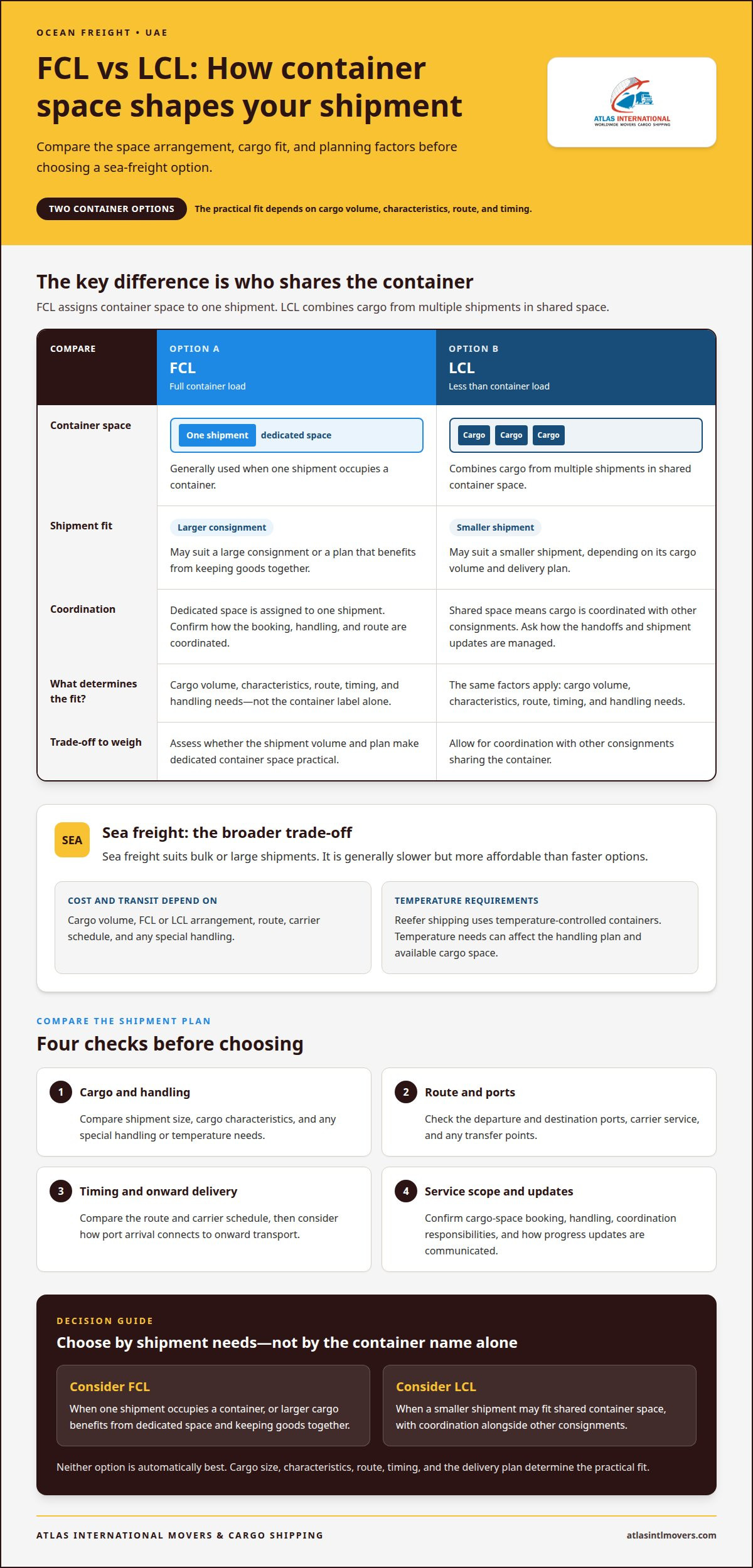
FCL, or full container load, is generally used when one shipment occupies a container. LCL, or less than container load, combines cargo from multiple shipments in shared container space. A large consignment may suit FCL, while a smaller shipment may suit LCL. Compare cargo volume, handling needs, and the delivery plan before deciding.
With LCL, cargo shares container space and may require coordination with other consignments. FCL assigns dedicated container space to one shipment, which can suit larger cargo volumes or a plan that benefits from keeping goods together. Neither option is automatically best: cargo size, characteristics, route, and timing determine the practical fit.
Reefer shipping uses temperature-controlled containers for cargo that needs a managed temperature during transit. Before booking, identify the cargo’s handling requirements and share them with the forwarder. The operating plan should account for temperature needs at the origin, during the sea journey, and at destination handoffs. Avoid treating reefer space as a standard container booking, because the cargo’s requirements shape the service arrangements.
To compare options, prepare the cargo dimensions, volume, destination, and handling requirements. Then assess FCL against LCL and include any temperature-control needs in the route discussion. A clear plan connects container choice, port handling, and destination arrangements without relying on a sailing estimate alone.
Sea freight for full and consolidated containers
Full-container and consolidated freight involve different cargo-space plans. The forwarder coordinates container booking, shipment grouping, transport handoffs, and updates that help importers follow cargo through the journey.
How Consolidation Works
With LCL freight, shipments from different parties share container space. A forwarder arranges consolidation by grouping cargo for transport, rather than assigning the entire container to one shipment. This can suit an importer whose goods don’t require a full container, while FCL gives one shipment its own container space.
Before booking, organize the shipment information: cargo description, dimensions, volume, origin, and destination. These details help the forwarder plan cargo space and assess whether the shipment can be grouped with other goods. For example, an importer shipping several cartons can compare consolidation with reserving a full container based on volume and handling requirements.
Consolidation adds coordination points. Cargo must be grouped for the shared container, and shipment details must remain associated with the correct consignment. Ask how the forwarder records each shipment, matches cargo to its paperwork, and communicates status as the container moves between transport stages. A clear process makes it easier to follow one consignment within a larger load.
Tracking Consolidated Shipments
Tracking should connect the individual shipment to the container’s progress. Ask which milestones are reported, such as cargo receipt, consolidation, container departure, and arrival at the destination. These updates help an importer distinguish the status of their goods from the shared container’s overall movement.
Freight forwarders arrange cargo space, coordinate with carriers, and handle shipment paperwork. For consolidated freight, these tasks link booking information with container movement. Keep the shipment reference and documents together, then use the same identifiers when requesting updates. This reduces confusion when a container includes multiple consignments.
FCL also requires coordination, even though the container space is assigned to one shipment. The booking, cargo details, carrier movement, and destination handoff still need to align. Compare the service by asking how updates are shared and who communicates changes to the transport plan. The answer should describe the shipment stages, not just make a general tracking claim.
Choose freight solutions based on cargo volume, handling needs, and how closely you need to monitor individual shipments. LCL can consolidate smaller consignments, while FCL assigns container space to one shipment. In either case, confirm how tracking follows cargo from booking through carrier movement and destination handling. A clear sequence helps teams coordinate onward arrangements.
Carrier coordination and shipment tracking
For FCL and LCL shipments, forwarders coordinate cargo space, carrier bookings, shipment paperwork, and transport handoffs. Ocean freight rates depend on the shipment and are provided after a quote request; key factors include container type, cargo volume, route, handling needs, and carrier arrangements.
FCL and LCL Carrier Coordination
For FCL, coordination centres on the container booking, cargo details, carrier schedule, and destination handoff. For LCL, the forwarder also aligns the individual consignment with the shared container’s consolidation and movement plan. Compare how the provider communicates booking status, carrier schedule changes, and each party’s role at every stage.
A clear coordination process links the booking reference to cargo records and transport documents. For example, if a sailing schedule changes, the forwarder should communicate the revised milestone and explain which onward arrangements may need adjustment. This matters in worldwide supply chains, where delivery planning can depend on multiple transport stages.
Shipment Tracking and Delivery
Tracking updates connect a shipment’s booking, carrier movement, and destination handoff. Ask which milestones are reported and how updates are shared, such as through a shipment reference or direct status notice. For LCL, updates should distinguish the individual consignment from the shared container’s overall progress.
Delivery planning begins before the vessel reaches its destination. Align the expected port arrival with onward transport, receiving arrangements, and the person responsible for acknowledging the cargo handover. A well-planned sequence makes it easier to respond to a changed schedule without confusing vessel movement with final delivery.
Shipment tracking isn’t the same as continuous live location data. Useful updates identify a clear event, such as booking confirmation, departure, or arrival notification. Keep the shipment reference and related records together so you can use the same details when discussing a status change with the forwarder.
Carrier coordination also involves communication between the shipper, forwarder, and carrier. The forwarder arranges cargo space, coordinates with carriers, and handles shipment paperwork. Agreeing on who sends updates and who responds to operational questions helps prevent different parties from working with conflicting shipment details.
Compare freight services by reviewing the promised coordination steps, not only the advertised route. Check whether the plan covers carrier booking, document handling, status updates, and destination handoff. A competitive service is one whose scope and communication fit the shipment’s needs, rather than one described with broad claims about worldwide reach.
Before cargo moves, share accurate cargo and destination details, then keep the booking reference for tracking. During transit, use milestone updates to coordinate receiving arrangements and onward transport. This gives importers a clear view of shipment progress without assuming every carrier or route uses the same tracking process.
Freight forwarder company listings across the UAE
A UAE freight forwarder directory is most useful when it distinguishes company offices, logistics hubs, and carrier operations. Jebel Ali Free Zone and Khalifa Industrial Zone Abu Dhabi are logistics hubs with warehousing, distribution, and value-added services. A location in a hub can help explain an operator’s network, but it doesn’t show on its own which shipment tasks the company coordinates.
Jebel Ali Free Zone, Rashdiya, Dubai Cargo Village, and Abu Shagara are listed among popular UAE locations for contacting freight forwarders. DP World’s headquarters are in Jebel Ali, Dubai. These locations offer searchers practical starting points, but the key comparison is whether the listed company’s operations fit the cargo route, port handoff, and inland transport plan.
Distinguish a freight forwarder from a carrier when reading company listings. A forwarder arranges shipment movement between shippers and transport services, while a carrier operates the transport service. CMA CGM, MSC, and DHL have significant operations in the UAE. Their names may appear in shipping discussions, but carriers and forwarders don’t necessarily perform the same role.
Use each listing as a starting point for a like-for-like comparison. Record the company’s stated location, transport modes, cargo-space coordination, and shipment communication process. Then compare those details with your needs, such as an ocean shipment through Jebel Ali or cargo requiring onward land freight within the UAE.
- Location: Note whether the operation is near a relevant hub, such as Jebel Ali or Khalifa Industrial Zone Abu Dhabi.
- Shipment role: Identify whether the company arranges freight, operates as a carrier, or handles both roles.
- Transport scope: Check whether the listing describes sea freight, air freight, warehousing, or land freight.
- Route coordination: Compare how the company connects the port movement with the shipment’s destination and onward transport.
Land freight supports movement within the UAE and to nearby GCC countries, while ocean freight connects UAE ports with international routes. If a shipment uses both modes, map the handoff between sea transport and inland movement. For example, a cargo plan may begin at a UAE port and continue by land to its receiving point. The listing should clarify which operator coordinates each leg.
Use this approach to turn a broad regional network into a practical shortlist. Start with locations such as Jebel Ali Free Zone or Dubai Cargo Village, distinguish carriers from forwarders, and compare services against your route and cargo plan. A smooth shipment depends on clear coordination across relevant operations, not simply on a company appearing in a UAE directory.
Atlas International Movers & Cargo Shipping: International Moving
Atlas International Movers & Cargo Shipping provides international moving and cargo shipping from the UAE. Turn to our team to plan an overseas relocation or compare sea cargo with air cargo for your shipment. We coordinate transport around your destination and cargo requirements, helping your belongings move across borders.
For moves within the UAE, Domestic Moving provides a separate option. For international cargo, share the origin, destination, shipment details, and preferred transport mode so we can shape a plan for the journey ahead. Our team can help you identify the relevant service and next steps.
To discuss your international move or cargo shipment, contact Atlas International Movers & Cargo Shipping.
Set Your Shipment Plan in Motion
Turn your shipping decision into a workable plan: match your cargo and destination with a suitable transport mode, then align the booking, paperwork, and receiving arrangements. A clear plan makes it easier to brief ocean freight forwarding companies in the UAE and compare proposed services with your shipment’s needs.
Atlas International Movers & Cargo Shipping offers International Moving and Air Cargo. For a move within the UAE, our comprehensive Domestic Moving service supports a straightforward relocation. Share your destination and transport needs to get started.
Contact Atlas International Movers & Cargo Shipping to discuss your plans and take the next step with confidence.
Frequently Asked Questions
What are the frequently asked questions?
Common questions focus on provider choice, service coverage, routes, and shipment planning. Before comparing options, prepare a short cargo profile: what is moving, its approximate volume, the origin and destination, and any special handling needs. A household relocation and a commercial import, for example, may need different coordination. These details help make answers about FCL, LCL, and transport arrangements more relevant to your shipment.
What are the leading ocean freight forwarding companies in the UAE?
There isn’t one provider that leads for every shipment, because the right fit depends on cargo, route, and coordination needs. CMA CGM, MSC, and DHL have significant UAE operations, but carrier operations are distinct from freight forwarding. Atlas International Movers & Cargo Shipping provides sea cargo and international moving from the UAE. Compare each option by its role in your shipment, not name recognition alone.
Which UAE freight forwarders offer sea freight services from Dubai, Abu Dhabi, and Sharjah?
Atlas International Movers & Cargo Shipping provides sea cargo transportation from the UAE. For a shipment originating in a particular emirate, compare how the service connects the cargo’s origin with port handling and onward movement. An office location alone doesn’t explain those handoffs. Match the service description to your cargo type, destination, and transport needs.
How do major UAE ocean freight forwarders compare by services, coverage, and customer reviews?
Compare service scope and route coverage first, then read reviews for recurring details about communication, shipment updates, and issue handling. A review involving a different cargo type or destination may not reflect your shipment. Distinguish forwarders from carriers, and compare providers offering similar transport arrangements. Look for specific experiences with coordination and delivery, not just broad ratings or promotional descriptions.
Which UAE ports and shipping routes are commonly used by ocean freight forwarders?
Forwarders coordinate ocean shipments through the UAE’s seaports and international trade routes. The right port and route depend on the cargo’s origin, destination, carrier service, and transfer points. For a useful comparison, trace the shipment from departure port to destination port, then consider how cargo reaches the next transport stage. This gives a clearer picture than considering a port in isolation.
How can businesses choose a reliable ocean freight forwarder in the UAE?
Choose a forwarder whose coordination process fits your cargo and delivery plan. Prepare shipment details, destination, handling requirements, and your preferred FCL or LCL arrangement. Then assess how clearly the provider explains its responsibilities for carrier coordination, paperwork, status updates, and handoffs. Businesses should also consider whether the proposed process fits receiving schedules and onward transport, so the shipping plan supports wider operations.
What documents are required for importing or exporting ocean freight through the UAE?
Prepare export paperwork and shipment details, ensuring cargo descriptions, quantities, and consignee details align across documents. The article also references a commercial invoice; the forwarder can clarify which documents are required for the cargo journey and who prepares and submits them.