

The lowest ocean-freight quote isn’t always the lowest-cost option overall. International ocean freight rates in the UAE depend on factors such as route, cargo size, and shipment type. FCL is priced per container, while LCL is priced by cargo volume. Charges beyond the port-to-port rate can also affect the final total.
It’s understandable to want a clear figure before arranging a shipment, but comparing quotes is easier when you know what each includes. The right option depends on how much you’re shipping and whether a dedicated container or shared space better suits your cargo.
This guide explains what affects sea freight costs, which additional charges may apply, and how FCL and LCL compare. You’ll also learn which shipment details influence a quote, helping you plan with greater clarity.
Key Takeaways
- Understand why route, cargo details and shipment type shape sea freight quotes from the UAE.
- See how destination affects estimated transit times, with routes to nearby and long-haul ports differing.
- Recognize the additional charges that may appear alongside the port-to-port freight rate.
- Compare FCL and LCL to identify which shipping arrangement better fits your cargo volume.
- Use rate benchmarks as a starting point, then compare what each quote includes before planning your shipment.
What Are Sea Freight Rates?
A sea freight rate is the charge for moving cargo by vessel between ports. For shipments from the UAE, the route and destination shape the expected transit time and the planning involved. Transit estimates generally cover port-to-port movement, not every step from collection to final delivery. Booking, port handling, and onward transport can add time before or after the vessel journey.
Estimated schedules vary by destination. Examples for cargo shipping from the UAE include:
- Mumbai or Chennai: 7-10 days.
- Singapore: 12-15 days.
- Shanghai or Shenzhen: 14-18 days.
- Felixstowe or Southampton in the UK: 18-22 days.
- Rotterdam: 18-21 days.
- Hamburg or Bremerhaven: 20-24 days.
- New York or Savannah on the US East Coast: 25-30 days.
These route examples help with planning, but they aren’t interchangeable. A general estimate for Dubai-to-Europe shipments is 18-25 days, while Dubai-to-North America shipments are stated at 25-35 days. The exact port pair matters. For example, a shipment to Rotterdam has a different estimate from one bound for a US East Coast port.
The vessel schedule is only one part of delivery time. Port congestion can affect when containers are unloaded, while handling and onward transport influence how long cargo takes to reach its destination. LCL shipments may also need consolidation before departure and deconsolidation after arrival. Include these stages in your plans rather than treating the sea transit estimate as a door-to-door arrival date.
Direct and transshipment routes can also affect the journey. A direct service sails to the destination port without transferring the container between vessels. A transshipment service moves cargo through an intermediate port before it continues on another vessel. The transfer adds a handling stage and may lengthen the schedule if a connection is missed or delayed. Route availability and vessel schedules determine which option applies.
Transit involves risks as well as timing considerations. Containers are handled at ports and may pass through several transport stages. Carrier liability alone offers minimal cargo protection, so cargo insurance is worth considering for valuable or sensitive goods. Review the coverage terms against the cargo’s value and the risks during vessel transit, port handling, and onward movement. A suitable booking plan accounts for both the route estimate and shipment protection.
What Influences Your Ocean Freight Cost?
Route, cargo volume, shipment type, documentation, and additional logistics needs all affect the total. Choosing FCL or LCL is an early decision, but customs preparation and port routing also matter.
FCL and LCL Shipping Options
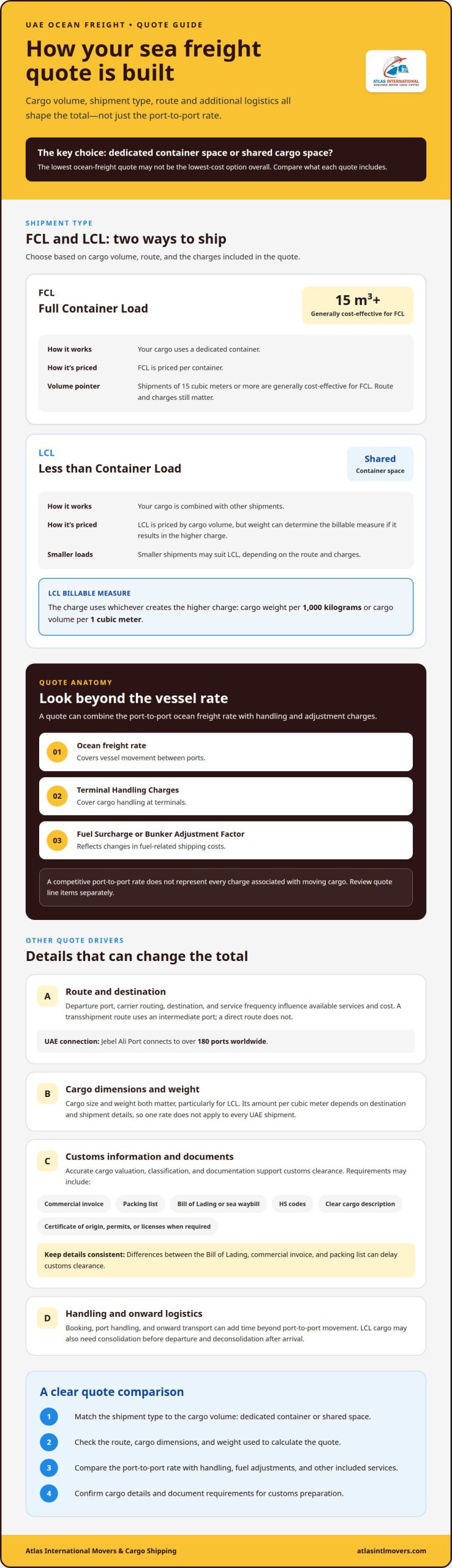
FCL uses a dedicated container, while LCL combines your cargo with other shipments. Shipments of 15 cubic meters or more are generally cost-effective for FCL; smaller loads may suit LCL, depending on the route and charges. For LCL, the charge is based on whichever is greater: cargo weight per 1,000 kilograms or volume per 1 cubic meter. Cargo dimensions and weight therefore both matter.
Ports and International Routes
The departure port and carrier route influence the available services and cost. Jebel Ali Port connects to over 180 ports worldwide, giving shipments access to international routes. The best route also depends on the final delivery location, carrier routing, and service frequency. A transshipment route may involve an intermediate port, while a direct route does not; these differences affect handling and scheduling.
LCL Cost per CBM
LCL is charged by cubic meter, though the billable measure may instead be weight if that results in the higher charge. The amount per CBM depends on the destination and shipment details, so one rate does not apply to every UAE export or import. Compare the quoted basis and included services, not just the volume figure.
Customs clearance also depends on accurate cargo valuation, classification, and documentation. Shipping paperwork commonly includes a commercial invoice, packing list, Bill of Lading or sea waybill, HS codes, and a clear cargo description. Sea freight shipments may also require a certificate of origin and any necessary permits or licenses. Some imported goods need special permits, conformity certificates, or inspections.
Consistency matters. Differences between the Bill of Lading, commercial invoice, and packing list can delay customs clearance in the UAE or destination country. Shipment details support classification and clearance, while the carrier uses booking information to plan cargo movement. Clear descriptions and consistent documents help everyone handle the shipment using the same information.
After booking, cargo moves through the selected port and route. A Bill of Lading or container number can be used to track progress. For imports into the UAE, customs documentation and any required permits form part of clearance before cargo continues toward delivery. These steps, along with the FCL or LCL choice, determine what the quote covers and how the shipment is organized.
Ocean freight cost components and surcharges
A sea freight quote can combine the port-to-port rate with handling and adjustment charges. Separating these items helps businesses see how volume, demand, and delivery arrangements affect the total.
Freight Cost Components
The main components are the port-to-port ocean freight rate, Terminal Handling Charges, and the Fuel Surcharge or Bunker Adjustment Factor. The ocean freight rate covers vessel movement between ports. Terminal Handling Charges cover cargo handling at terminals, while the fuel adjustment reflects changes in fuel-related shipping costs.
Review each component as a separate line in the quote. A competitive port-to-port rate, for example, doesn’t represent every charge associated with moving cargo. Terminal Handling Charges and the Fuel Surcharge or Bunker Adjustment Factor can change the total. Cargo volume and the selected route also shape the quoted service.
To understand landed costs, distinguish ocean transport from costs involved in getting cargo onward for delivery. A port-to-port quote and a total logistics cost answer different questions. The first covers the sea leg; the second considers the broader journey to the shipment’s destination. This distinction helps businesses assess the costs relevant to their delivery plan.
Surcharges and Additional Charges
Quotes may include a Peak Season Surcharge, Port Congestion Fee, or Currency or Route Adjustment Factor. Each responds to a different pressure: seasonal demand, port congestion, or changes linked to currency or routing. These charges can apply alongside core freight components, so review the quote’s line items rather than treating the base rate as the full cost.
Demand and available shipping capacity can affect rates. A Peak Season Surcharge may apply when shipping demand rises, while port congestion can add a separate fee. A Currency or Route Adjustment Factor reflects another cost variable. These surcharges aren’t interchangeable, so a quote should identify which named charge applies to the shipment.
Compare quotes for the same route, cargo volume, and delivery scope. If one quote lists the port-to-port rate and another combines it with handling or adjustments, their headline totals aren’t directly comparable. Note each named component, then separate core charges from surcharges. This gives businesses a clearer basis for assessing options and expected landed costs.
FCL and LCL shipment options
Container capacity helps match a shipment to the right sea freight solution. For UAE exports, compare cargo volume, weight, departure port, and carrier routes before choosing a full container or shared space.
Choosing Container Space
A standard 20-foot container holds approximately 28-30 cubic meters. A standard 40-foot container holds approximately 58-60 cubic meters, while a 40-foot high-cube holds approximately 68-70 cubic meters. The high-cube option suits lighter, more voluminous goods. These capacities help estimate how efficiently cargo uses available container space.
FCL is commonly considered when cargo fills 50% or more of a container; LCL suits cargo below that level. The practical choice also depends on the shipment’s shape and weight. Bulky goods may use more space than their weight suggests, while dense cargo can reach its weight limit before filling the container. Match both measurements to the container option.
A standard 20-foot container holds approximately 21,000-27,000 kg, and a 40-foot container can carry as much as 28,000 kg. These figures show why volume alone may not determine suitability. For example, heavy cargo might fit within the available floor area but still need careful weight planning. LCL charges can also use whichever is greater: weight per 1,000 kilograms or volume per 1 cubic meter.
UAE Port Options
Jebel Ali and Khalifa Port are key options to consider for UAE shipments. Jebel Ali handles over 14 million TEUs annually, and more than 140 shipping lines operate from the port. Port capacity and service availability can vary, so check current options when planning a shipment. The relevant choice depends on the final delivery location, available carrier routing, and service frequency.
Port selection can affect the inland leg as well as the sea route. For cargo destined for an address in Abu Dhabi, Khalifa Port may align with the final location; cargo heading elsewhere may need a different route plan. Compare the full journey from export point to destination, not just the vessel’s port call.
Carrier and Route Selection
Carrier options vary by route and service frequency. A carrier’s departure schedule, port sequence, and use of transshipment affect how a shipment moves between the UAE and its destination. A direct sailing avoids transferring the container between vessels, while transshipment adds another port and handling stage.
Before booking, match the container type to the cargo measurements, then align the departure port with the destination and carrier route. For a full container, confirm that its size suits both the volume and weight. For shared space, provide accurate dimensions and weight so the shipment can be planned using the applicable charging basis. These details help keep export logistics clear from booking onward.
International ocean freight rate benchmarking
A useful benchmark compares shipments with the same route, cargo profile, and service scope. A freight rate without those details can mislead: a full container and a small shared load aren’t like-for-like. For UAE shipments, compare the same origin and destination ports, container load, weight, and included handling before judging whether a quote is competitive.
There isn’t one rate for every destination or cargo profile. A shipment’s price depends on its details and is provided after a quote request; route, cargo volume, weight, and requested services all affect the quote. Compare equivalent shipments rather than treating one figure as a universal standard.
Use a consistent comparison record for each quotation:
- Route: record the UAE departure port and destination port.
- Cargo: note dimensions, volume, weight, and whether the shipment uses FCL or LCL.
- Service scope: distinguish port-to-port movement from additional handling or delivery arrangements.
- Charges: identify the ocean rate, terminal handling, fuel adjustment, and any listed surcharges.
- Timing: compare the stated vessel schedule and any transshipment stages.
Seasonality can shift the benchmark. Sea freight rates in Dubai normally decrease by 15-30 percent during low season compared with peak season. This difference makes the booking period relevant, but it doesn’t replace route and shipment details. Compare quotes from the same seasonal context where possible, and treat a seasonal rate change separately from differences in cargo volume or service scope.
Air freight offers another point of comparison when delivery speed matters. Sea freight is usually 50-85 per cent cheaper than air freight for the same shipment. That comparison helps frame the trade-off between transport mode and budget, but a fair assessment also weighs the shipment’s schedule and handling needs. A lower freight rate may not be the most efficient choice if the delivery timing doesn’t suit the cargo.
Customs clearance and onward delivery also matter when assessing the full logistics picture. Compare the shipment details and services each quote covers, then separate sea transport charges from other costs. This gives you a clearer view of the expected landed cost without treating every quote as identical.
For a shipment moving from the UAE, use these factors to prepare a like-for-like comparison and plan sea cargo shipping around the route, load, and required delivery scope.
Atlas International Movers & Cargo Shipping: International Moving
Atlas International Movers & Cargo Shipping supports international moves with sea cargo options for belongings travelling from the UAE. Our team organizes shipments around your destination, cargo volume, and preferred FCL or LCL arrangement, so the shipping plan reflects your practical requirements.
Choose international moving when you need support coordinating belongings across borders, or sea cargo when ocean transport suits your shipment. If timing is a priority, air cargo is another option. Share your destination and shipment details with Atlas International Movers & Cargo Shipping to discuss a suitable plan.
Contact Atlas International Movers & Cargo Shipping to discuss your international move.
Plan Your Next Shipment with Confidence
Turn your freight research into a practical shipping brief before planning your move. Set out the shipment’s purpose, preferred delivery window, and the priorities for your household or business. This gives everyone involved a shared reference point as plans develop.
Use your understanding of international ocean freight rates in the UAE to make a considered choice, not simply chase the lowest headline figure. A clear brief connects transport planning with the wider move, whether belongings are heading to a new home or goods are supporting business operations. It also gives you a useful starting point for discussing priorities and next steps with a moving team.
Atlas International Movers & Cargo Shipping can help you plan an international move around your shipment needs. Contact Atlas International Movers & Cargo Shipping to discuss the next step. With a clear plan in place, you can move forward with greater confidence.
Frequently Asked Questions
How much does it cost to ship a container to the UAE?
There’s no single fixed price for shipping a container to the UAE. The quote depends on the origin and destination ports, container size, cargo type, weight, route, and requested service scope. Seasonal demand and applicable surcharges can also affect the total. To make a quote useful, specify whether you need port-to-port transport or additional delivery arrangements, then provide accurate cargo and route details.
How are container shipping prices, rates & transport costs calculated?
FCL is generally priced per container, while LCL is charged by cargo volume or weight, whichever results in the higher charge. The total may also include port handling, fuel adjustments, and applicable surcharges. For example, dense cargo can reach its billable weight basis before using much container space. Compare quotes for the same route, cargo details, and included services.
What if my cargo has special requirements, like refrigeration or oversized dimensions?
Before booking, state your requirements and provide precise cargo dimensions, weight, and handling needs. Refrigerated cargo requires its temperature requirements to be included in the shipment details; oversized goods need accurate measurements to assess space and loading arrangements. These factors can affect equipment, routing, and handling. A clear cargo description helps account for the shipment’s requirements from the outset.
What is included in ocean freight charges?
Ocean freight charges commonly include the port-to-port vessel rate, Terminal Handling Charges, and a Fuel Surcharge or Bunker Adjustment Factor. A quote may also list peak-season, port-congestion, currency, or route adjustments. The quoted sea movement doesn’t automatically cover every part of delivery. Review the service scope to see whether origin handling, destination handling, inland transport, or other services are itemized separately.
What are current international ocean freight rates from the UAE by destination and container size?
There isn’t one rate for every destination and container size. A current quote depends on the port pair, whether you choose a full or shared container, cargo volume and weight, route, and applicable surcharges. Use the same shipment details when comparing options. Specify the destination port and container size, then check whether the quoted service covers only port-to-port movement or more.
What factors affect ocean freight rates from UAE ports?
Rates can change with fuel costs, available shipping capacity, demand, and geopolitical events. Cargo type, dimensions, volume, and weight also influence the shipment plan, along with the route and container choice. At the port level, service frequency and congestion can affect charges or schedules. Accurate cargo descriptions and consistent shipping documents help prevent avoidable processing delays.
What are typical transit times for sea freight from Jebel Ali and other UAE ports?
Transit depends on the destination, vessel schedule, port congestion, and whether the route includes transshipment. Long-haul sea shipments from the UAE can take from a few weeks to a couple of months. That estimate describes the sea journey, not necessarily the full time to final delivery. Port handling, customs clearance, and onward transport can add stages around vessel transit.
Which shipping lines and freight forwarders offer ocean freight from the UAE?
Shipping-line options depend on the destination, route, and sailing schedule, so there isn’t one carrier choice for every shipment. Freight forwarders coordinate ocean transport and related shipment planning. Atlas International Movers & Cargo Shipping provides Sea Cargo and sea freight forwarding. For a shipment from the UAE, route and cargo details help determine a suitable booking plan and carrier service.