

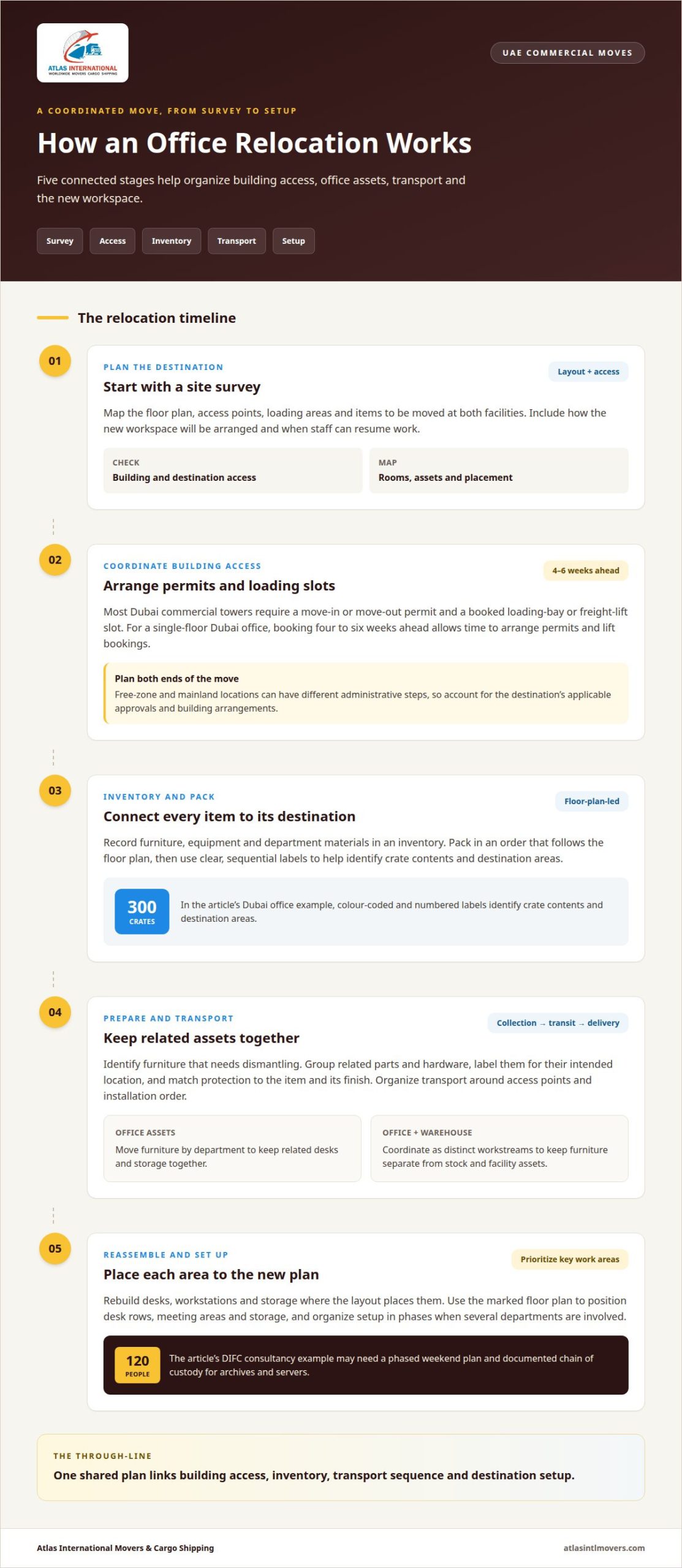
A commercial facility relocation in the UAE depends on coordinated planning, building access and careful handling of office assets. For a single-floor office move in Dubai, booking four to six weeks in advance allows time to arrange building permits and lift bookings. Most commercial towers also require a move-in or move-out permit and a booked loading-bay or freight-lift slot.
Moving desks and equipment is only part of the job. The plan also needs to account for how the new workspace will be arranged and when staff can resume work. A site survey helps map the floor plan, access arrangements and items to be moved before packing begins.
This guide explains how a UAE office move works, from packing and furniture handling to IT equipment, transport between locations and choosing a mover. Understanding how the stages fit together helps you plan the transition and keep your team focused on its work.
Key Takeaways
- Build the move plan around the facility’s layout, access arrangements, business operations and the assets being relocated.
- Coordinate furniture dismantling, transport and reassembly so workstations and storage units can be positioned for the new space.
- Plan inter-emirate transport and delivery sequencing to keep office equipment and business-critical items organized throughout the move.
- Use clear, sequential labels and suitable packing protection to make each item easier to identify and place at the destination.
- Choose a mover whose relocation experience and services fit the scale and operational needs of your facility.
What Does Office Relocation in Dubai Actually Involve?
A commercial office move in Dubai or Abu Dhabi starts with a site survey, then coordinates access, packing, transport and setup. Most Dubai commercial towers require move-in or move-out permits, plus a loading-bay or freight-lift booking through building management. Free-zone and mainland locations can have different administrative steps, so the relocation process should account for the destination’s applicable approvals and building arrangements.
Relocation Across Dubai and Abu Dhabi
Moving between Dubai and Abu Dhabi involves more than transporting desks between addresses. A site survey maps each facility’s layout, access points, loading areas and items for relocation. For a single-floor Dubai office, booking four to six weeks ahead allows time to arrange building permits and lift bookings. Include the destination’s access arrangements in the same plan. Corporate relocation planning also considers how the move affects staff, departments and business operations.
Packing and Inventorying Office Belongings
A clear inventory connects each packed item to its destination, helping teams place belongings in the right room or department. A 300-crate Dubai office move can use colour-coded and numbered labels to identify crate contents and destination areas. The packing sequence should follow the floor plan, rather than treating every box as interchangeable. Record furniture, equipment and department materials in an inventory so that items can be reconciled during unloading and setup.
Furniture Disassembly and Office Setup
Desks, workstations and storage units can be dismantled for transport, then reassembled and positioned at the new office. The floor plan guides placement, while labels help match components to their intended work areas. A 12-person marketing agency in Business Bay, for example, may need desks, monitors, cabinets and a small network rack moved together. Keeping related items grouped supports a more orderly setup and helps teams find equipment after delivery.
Moving Different Commercial Goods
Office, retail, warehouse and industrial moves have different inventory and handling priorities. Retail stock may need to stay grouped by product type, while warehouse stock can be sorted by SKU or type and moved in bins, separately from shelving. An office and warehouse can relocate at the same time, but coordinating them as distinct workstreams helps keep furniture separate from stock and facility assets.
For larger offices, phasing the move across multiple weekends can keep departments from being fully offline at once. A 120-person consultancy moving between DIFC towers may need a phased weekend plan and documented chain of custody for archives and servers. These details shape the schedule, packing sequence and setup priorities for each facility.
Furniture dismantling, transport and reassembly
Commercial furniture handling involves more than loading desks onto a vehicle. The move sequence should protect each item, keep related components together and place furniture according to the new workspace plan.
Furniture Dismantling and Transport
Before dismantling begins, identify which furniture needs to be separated for transport. Modular workstations, desks and storage units may be difficult to move intact through corridors or lifts. Group related parts and hardware together, then label them for their intended location. This helps prevent fittings from being mixed with items from another department.
Protection should match the item and its finish. For example, a reception counter with delicate panels needs different handling from a metal filing cabinet. A 200-seat insurance firm in DIFC may also have modular workstations, a server room, an access-controlled archive and a reception fit-out built over three months. Recording these assets helps the move team plan their order, handling and destination placement.
Transport planning considers how furniture will move from each room to the vehicle, then into the destination. Organize the sequence around access points and the order of installation. For a large office, moving furniture by department keeps related desks and storage together and makes it easier to direct items during unloading.
Furniture Reassembly and Workspace Setup
At the destination, reassembly should follow the workspace layout rather than a generic room arrangement. Rebuild desks, workstations and storage units where the plan places them. Group a department’s desks together and position shared cabinets nearby. This creates a usable structure before employees return to their usual tasks.
Furniture installation also means checking that assembled pieces are in their intended positions and that planned working areas remain clear. A meeting table, for example, belongs in its designated room, not in a corridor waiting to be sorted later. Connecting assembly with placement reduces unnecessary handling and helps the team complete each area in sequence.
When a commercial move involves several departments, organize setup in phases. Prioritize key work areas, then continue with secondary spaces as furniture arrives. This helps manage downtime without treating every room as equally urgent. A marked floor plan gives the installation team a shared reference for desk rows, meeting areas and storage locations.
For a coordinated furniture relocation, share the destination layout and furniture priorities with the move team before packing begins.
Inter-emirate commercial moves
A move between locations in the UAE needs one coordinated plan for collection, transit and delivery. The route, building access at both ends, shipment volume and business priorities shape the sequence. A site survey helps identify items, access conditions and the destination layout before the schedule is finalized, keeping transport planning connected to operational needs.
For moves within the UAE, transport mode depends on distance, budget and the goods being moved. Land, air or sea transport may suit different requirements. For an office move between locations, coordinate the arrival of furniture, records and essential equipment. A separate inventory for each department or facility makes items easier to direct at the destination.
Some commercial relocations can be scheduled for evenings or weekends to avoid losing a working day. Larger moves may be phased to prevent every department from going offline at once. Prioritize the spaces and equipment employees need first. Separating business-critical areas from lower-priority rooms can also reduce disruption.
Machinery, hazardous materials and sensitive equipment need different planning from ordinary office furniture. Requirements depend on the item and route, so identify these goods clearly in the inventory and handle them according to applicable requirements. Do not treat hazardous materials as standard office cargo. For sensitive equipment, document its location, handling needs and destination so the receiving team can manage it appropriately.
When choosing a commercial or industrial mover, look for a provider equipped to plan facility moves, coordinate transport and manage different asset types. The right fit depends on the project’s scale, route, equipment and operational priorities. A move involving a warehouse, machinery and office furniture needs a different plan from a small office transfer. A clear scope and item records help organize the work.
To reduce downtime and protect IT systems, businesses can prioritize the server room, network equipment and user devices in the move sequence. A 120-person consultancy relocating between DIFC towers may require a phased weekend move and documented chain of custody for its archive and servers. Coordinate IT disconnection, transport and reconnection with the facilities schedule, then place essential equipment ahead of non-critical items. This helps employees regain access to the systems their work depends on.
International moves add border-crossing logistics, while moves within the UAE focus on coordinating transport and access. Short-term storage can bridge a gap if the new office is not ready when the old lease ends. For either route, a dated inventory, destination plan and prioritized delivery sequence give the relocation team a clear operating brief.
Packing, protection and sequential labelling
Commercial packing starts by grouping assets according to destination and handling needs. Separate desk contents, shared equipment, records and fragile items before packing. Each group should follow a clear route from its current room to its assigned space at the new facility. This connects packing, loading and unpacking to the move timeline instead of treating them as separate tasks.
Protection should suit the item being moved. A monitor, glass display panel and box of office files each need different packing and handling. Protect vulnerable surfaces, secure loose components and keep related accessories with their equipment. For example, group a keyboard, cables and monitor as one workstation set. Clear grouping helps ensure consistent handling during loading and unloading.
Sequential labelling gives each package an identifiable place in the move plan. Labels can include a department, destination room and sequence reference, such as “Finance, Room 4, Box 2.” The same reference should appear in the inventory, so the receiving team can match each item to its intended location. This approach is useful when several departments are packed at once and boxes arrive in multiple vehicle loads.
Loading order should reflect the delivery sequence. Position items needed first at the destination for accessible unloading, and load later-use materials afterward. A reception area, for instance, may need its key furnishings before decorative or archived items. Use the inventory and room plan to connect each load with its destination and reduce unnecessary handling during delivery.
Unpacking works best by room or department, not by opening boxes at random. Unload a labelled group, place its contents in the named area and remove packing materials as work progresses. Unpacking desk equipment together helps staff locate related items. Account for building access and room readiness so packages do not block corridors or work areas.
A practical timeline links packing, transport, unloading and setup to the facility’s operating priorities. Schedule records and nonessential supplies separately from equipment needed to resume daily work. If the destination is not ready for every asset, planned storage can separate items awaiting placement from those ready for unpacking. Clear inventories and labels help maintain that distinction throughout the move.
Choosing a mover for SMEs or corporate facilities
Compare UAE commercial movers by documented insurance scope, applicable licensing, equipment, and the services included in their proposals. These details should align with the facility’s inventory, route, access arrangements, packing needs, transport, and setup responsibilities.
Start with the scale and complexity of the move. A Dubai SME mover can suit an office with 5 to 20 people, standard furniture, and no server room. A larger corporate relocation may involve multiple departments, specialist equipment, archives, or a warehouse. The mover’s proposed logistics plan should match those assets rather than treating every office as the same job.
Scope matters as much as transport. One proposal might cover packing and delivery, while another may also include furniture dismantling, reassembly, and workspace setup. For a company moving from Dubai to Abu Dhabi, the plan should account for collection and delivery access at both locations. A written sequence helps clarify who handles each stage and how the move connects with business operations.
Equipment and staff planning should fit the inventory. Standard desks and cabinets require a different setup from sensitive IT equipment or a server room. A 150-person firm relying on a man-and-van crew may lose three days of productivity. That example illustrates why the proposed team, vehicles, packing approach, and schedule should reflect the move’s size and operational priorities.
Storage can also affect the service scope. If the new office is not ready when the old lease ends, short-term storage can bridge the gap. Distinguish items going directly to the new facility from assets awaiting later delivery. This supports a more orderly timeline and keeps stored items separate from equipment needed immediately.
For insurance and licensing, compare the documentation and stated limits with the assets and work involved. The proposal should clarify what protection applies during packing, loading, transport, unloading and storage. Licensing documents and service scope should correspond to the work being undertaken. Judge the fit by the whole project plan, not a single feature.
A successful move is not simply the fastest one. A small office with standard furniture may need a straightforward schedule, while a corporate facility with IT systems may need phased work and coordinated setup. Match the mover’s plan to the number of departments, destination readiness, sensitive assets and acceptable downtime. This gives decision-makers a practical basis for choosing.
Plan your corporate relocation around your facility’s assets, schedule, and required service scope.
Atlas International Movers & Cargo Shipping
Atlas International Movers & Cargo Shipping helps businesses coordinate relocation planning and transport. Domestic Moving supports the movement of belongings between locations within the UAE, while International Moving supports moves across borders. Air Cargo and Sea Cargo are available for business shipments suited to those transport modes.
Turn to Atlas when your domestic or international relocation needs support organizing belongings and transport around your business schedule. Sharing the origin, destination, inventory and operational priorities helps define the next steps and align the move with your facility’s needs.
Contact Atlas International Movers & Cargo Shipping to discuss your relocation.
Set the Move in Motion
A commercial facility relocation in the UAE is easier to coordinate when one internal lead brings facilities, IT and department priorities together. Before planning begins, prepare a concise project brief covering the origin and destination, assets involved, operational dependencies and preferred schedule. This gives the relocation team a practical starting point and keeps decisions connected to business needs.
Atlas International Movers & Cargo Shipping offers Domestic Moving and International Moving, as well as Air Cargo for shipments suited to air transport. These services can support different transport needs within a broader relocation plan. Discuss your facility’s requirements with Atlas to establish a suitable scope for the move.
Contact Atlas International Movers & Cargo Shipping to discuss your relocation and take the next step with clarity.
Frequently Asked Questions
How Does the Office Relocation Process Work in the UAE?
A UAE office relocation typically moves from defining the scope to delivery and operational handover. First, record the assets, destination requirements and business priorities. Then coordinate packing, transport and placement, sequencing departments or equipment around operational needs. For example, a business can arrange earlier setup for essential work areas than for archived records. A final handover checks that destination areas receive the correct items and identifies outstanding deliveries.
What Affects Office Relocation Costs?
Relocation costs depend on the volume and type of assets, distance, packing requirements, access conditions, storage needs and setup scope. A floor with lifts and a clear loading area presents different handling needs from a site with restricted access. Specialist equipment or staged delivery can also change the work involved. The price depends on the case and is provided after a quote request, based on the project’s scope and requirements.
What Facilities and Services Do Office Movers Offer?
Office movers may handle packing, transportation, furniture dismantling and reassembly, and delivery to designated work areas. For a company with several departments, the service plan can assign delivery priorities to workstations, meeting rooms and shared equipment. Some relocations also involve storage when premises are not ready for every item. Match the requested scope to actual needs rather than assuming every mover includes the same tasks.
What services do commercial facility relocation companies in the UAE provide?
Commercial relocation services can cover office and corporate moves, domestic or international transport, and related cargo or storage needs. Atlas International Movers & Cargo Shipping provides Corporate Relocation, Domestic Moving, International Moving, Air Cargo, Sea Cargo, and Storage & Warehouse services. Businesses can identify which parts of a move need support, from transferring a facility locally to arranging transport for assets moving farther afield.
How much does commercial office or facility relocation cost in the UAE?
There is no single relocation price that applies to every UAE facility. The total depends on the inventory, distance, access, packing and handling requirements, storage, and requested setup work. A move involving standard office furniture differs from one with specialist equipment or multiple delivery stages. The price depends on the individual project and is given after a quote request, once the required scope and logistics are understood.
What are the steps and typical timeline for a commercial facility relocation in the UAE?
The main stages are defining the move scope, surveying the sites, preparing the inventory, coordinating access, packing, transport, delivery and setup. The schedule depends on facility size, building arrangements, destination readiness and whether the move needs to be phased. For example, a business opening in stages can prioritize its customer-facing area before back-office storage. Planning ahead gives teams more room to coordinate approvals and building access within the project timeline.
What risks and hidden costs should businesses plan for when relocating a facility in the UAE?
Common planning risks include restricted building access, delays in destination readiness, unplanned storage, extra handling and unclear responsibility for specialist assets. These can affect the schedule and add work beyond the initial scope. Document valuable items and their handling needs. Liability for loss or damage is limited unless full-value protection or comprehensive insurance is purchased. Declare valuable items and consider comprehensive insurance coverage.