

The most useful first decision when moving from the UAE to the United Kingdom isn’t choosing a neighbourhood; it’s coordinating your legal preparations, arrival plans and accommodation search. Your destination and housing needs will shape the move, while the right preparation helps keep each part manageable.
Moving from the UAE to the United Kingdom involves more than finding a place to live. You’ll also need to plan your belongings, arrival and the practical changes of settling in a new country. This guide covers rental decisions, shipment preparation and arrival planning to help you make informed choices before departure.
Key Takeaways
- Identify the visa route that fits your circumstances and understand its eligibility requirements before setting a moving date.
- Plan the move from Dubai or elsewhere in the UAE alongside your UK arrival and tax-residency considerations.
- Assess accommodation by location, household needs and the costs you’ll need to budget for beyond rent.
- Prepare for settling in by considering everyday expenses, transport, healthcare and education needs.
- Understand the customs process for personal belongings and how professional international moving support can help coordinate the shipment.
Legal and administrative preparations
Start with immigration eligibility, because your visa route affects when you can work, study or join family in the UK. For a Skilled Worker visa, the role and salary must meet the applicable requirements. The UK Home Office lists £41,700 as the general salary threshold for a UK Skilled Worker visa. The job must also meet the relevant skill criteria, and applicants need to satisfy the visa’s eligibility rules before they submit an application.
Prepare a clear file for the application process. Include identity and employment information, evidence relevant to your visa route, and records for accompanying family members. Keep names and dates consistent across documents. If you’re relying on a UK sponsor, align your application with the role and sponsorship information. For a student or family application, organise documents around that route. Build your timeline around the visa decision, not just your planned departure date.
Tax residency requires separate planning from immigration status. Spending more than 183 days in the UK during a single tax year will typically make a person a UK tax resident under the Statutory Residence Test, according to HM Revenue & Customs. The UK and UAE use different tax and residency frameworks, so UK tax residence can affect how income is treated after arrival. Social security treatment depends on work location and employment arrangements; include payroll and contribution records in your relocation file.
Check separately whether and how you can use or exchange your UAE driving licence after arrival. Don’t assume it can be used indefinitely or exchanged automatically; requirements depend on your status and circumstances. Keep your licence and driving history documents accessible while you establish which rules apply to you in the UK.
Before relocating, check the practical dependencies that can disrupt a move: visa approval, employment start dates, accommodation timing, family documentation, tax records and driving arrangements. For example, a delayed visa decision can affect both a worker’s start date and the planned shipment schedule. Aligning the administrative calendar with international move planning helps keep those decisions connected.
An eligible migrant can use a UK Skilled Worker Visa to reside in the UK for 5 years. Eligible visa holders may apply for Indefinite Leave to Remain after 3-10 years, depending on their visa and conditions. Keep the route and its conditions in view when planning each stage, and organise relevant documents so that your application reflects the permission you are seeking. Allow time to check how your circumstances fit the applicable route before making commitments around work or accommodation.
For a Spouse Visa, the UK sponsor’s minimum income requirement is £29,000 per year. Family visa conditions and permitted stay depend on the route and the applicant’s circumstances. Unmarried partner visa applicants may need to show they have lived together for at least two years before applying. Compare the relationship routes against your circumstances, then arrange supporting records around the requirements for the route you choose. If applying as an unmarried partner, plan to gather evidence of shared residence; for a Spouse Visa, prepare the sponsor’s income documentation. Checking these points early can help identify missing paperwork before travel or housing arrangements are finalised.
Moving from Dubai or the UAE to the UK
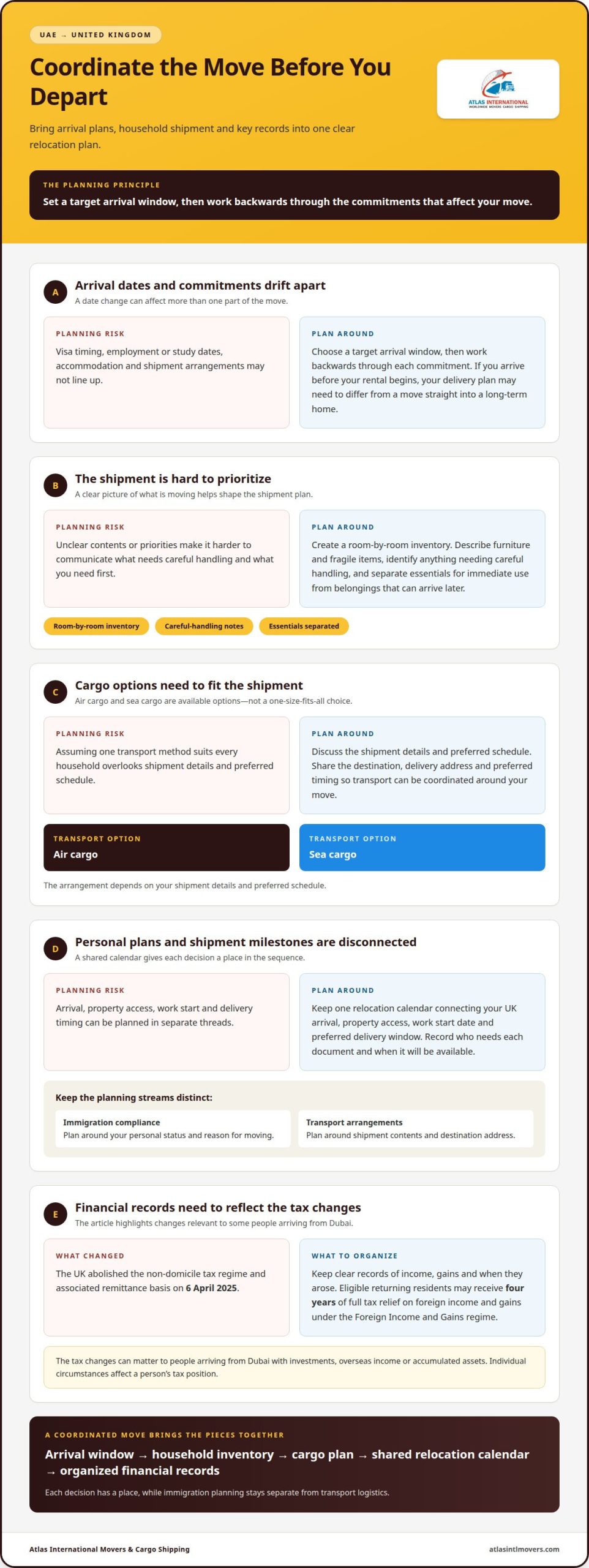
Moving from the UAE to the United Kingdom involves coordinating transport with your departure date, arrival plans, household needs and finances. Set a target arrival window, then work backwards through key commitments such as visa timing, employment or study dates, accommodation and shipment arrangements. For example, if you arrive before your rental begins, you may need a different delivery plan from someone moving straight into a long-term home. Aligning these dates helps prevent avoidable gaps.
Next, decide which belongings to take and which to leave in the UAE. A room-by-room inventory gives the moving team a practical picture of the shipment, including furniture, fragile items and anything needing careful handling. Separate essentials you’ll need immediately from belongings that can arrive later. This helps communicate priorities and keep the shipment plan consistent from collection through delivery. Clear descriptions also make it easier to track the contents as your plans progress.
Air cargo and sea cargo services are available transport options for international shipments. The arrangement depends on your shipment details and preferred schedule. Prepare an inventory that describes the contents and identifies items requiring careful handling. Share your destination, delivery address and preferred timing as part of the planning discussion. This gives the moving team a clear basis for coordinating the transport of your belongings without assuming that one method suits every household.
Financial planning deserves attention before departure. The UK abolished the non-domicile tax regime and associated remittance basis on 6 April 2025. Eligible returning residents may receive four years of full tax relief on foreign income and gains under the Foreign Income and Gains regime. These changes can matter to people arriving from Dubai with investments, overseas income or accumulated assets. Keep clear records of income, gains and when they arose. Those records can help clarify your individual tax position.
Finally, build one relocation calendar connecting personal commitments with shipment milestones. Include your UK arrival, property access, work start date and preferred delivery window. Record who needs each document and when it will be available. This supports coordination while keeping immigration compliance separate from transport arrangements. National status and the reason for moving shape personal administration; shipment contents and destination address shape logistics. For anyone moving from the UAE to the United Kingdom, a structured calendar gives each decision a place and helps the move proceed in sequence.
Rent and accommodation
Choose a UK rental location based on your daily routine, not just its name. London offers access to the capital’s employment and transport network, while towns and cities elsewhere have different commuting patterns and neighbourhood options. Rent for a one-bedroom apartment varies by location, with London generally more expensive than areas outside the capital. Compare the likely journey to work or study with the space your household needs before narrowing your search.
Start with your household’s practical requirements. A single person may prioritise a short commute and a manageable home, while a family may need more bedrooms, storage and proximity to schools. If you’re arriving alone, consider whether a furnished property fits your plans. For example, someone bringing furniture from the UAE may prefer an unfurnished home, while a temporary first rental may be easier to manage furnished. Match the property type to what you’re bringing.
Use your expected arrival date to shape the search. A rental that begins well before your belongings arrive can create an overlap between housing and shipment arrangements. A later start date may leave you without a settled address when you reach the UK. Set a target move-in date, then coordinate it with your travel and delivery plans. Keep the property address and access arrangements available for anyone handling your household goods.
Before agreeing to a rental, read the tenancy terms carefully and note what the rent covers. Check which utilities or services are separate, how rent is paid, and what the agreement says about its start and end dates. These details affect your household budget beyond the headline rent. Compare the rooms, storage space and access route with your planned furniture. A narrow staircase or limited lift access can complicate delivery of larger items.
Compare areas using consistent criteria rather than relying on broad labels such as “central” or “affordable.” Note the commute, nearby shops, school needs, public transport and how well the property fits your belongings. UK citizens returning home and people arriving for work or study may have different priorities, but both benefit from linking housing decisions to daily routines. Keep a shortlist that records each property’s location, layout, move-in date and included services. This makes trade-offs clear before you commit and helps align your accommodation with your arrival plan.
Settling into life in the UK
Daily routines depend on where you live, how you travel and which services are nearby. During your first weeks, prioritise essentials such as healthcare, school arrangements, transport and household utilities. Keep key documents accessible, including identification, proof of address and relevant family records. These can help with practical administration as you establish a home in a new country.
For healthcare, identify a nearby GP practice and ask about its registration process after you arrive. For urgent NHS care, call 111 for a non-life-threatening emergency or attend an A&E department for immediate medical attention. Call 999 for an ambulance in a life-threatening emergency. Save these numbers in your phone and share them with household members.
Families should connect school planning to their new address and children’s ages. UK primary education covers ages four to 11, while secondary education covers ages 11 to 16. Contact the relevant school or local education authority about enrollment arrangements for your area, and prepare children’s existing school records. For example, a child changing schools during the academic year may need previous reports to support continuity.
Plan childcare early, too. Availability and arrangements vary by location and provider, so include care needs in your housing and work plans. If you’re returning to work, you may need childcare close to home or a reliable route between the provider and workplace. Keep the expected start date, daily schedule and emergency contacts together. This helps coordinate family routines during the transition.
Build a household budget around recurring costs, not rent alone. Include utilities, groceries, local transport, mobile service, internet and household essentials. Costs depend on your UK location, travel habits and household size. For example, a London commute can affect transport spending differently from living near work in a smaller town. Review your spending after arrival and adjust the plan using actual bills and travel patterns.
Some routines will feel different from those in the UAE. Weather, daylight, public transport and local service schedules can all affect how you plan your week. Check local transport routes before accepting work or school commitments, and keep an updated calendar for appointments, school dates and household tasks. If children are moving with you, discuss their new routines before departure and let them help organise familiar belongings. A consistent weekly plan can make the transition more manageable for the whole household.
Use typical costs as a starting point, then compare them with your household’s needs and location. These estimates cover different household situations, so don’t treat them as directly comparable or add them to individual budget items without checking what’s included.
Track your actual spending after settling in and revise your budget accordingly.
What are the UK customs rules for bringing personal belongings from the UAE?
Customs treatment of belongings moving from the UAE to the UK depends on the items and the circumstances of the move. No single allowance applies to every household shipment. Before departure, prepare a clear inventory with accurate descriptions. This gives the person handling the shipment the information needed to assess how each item should be presented for customs processing.
List belongings individually or in sensible groups rather than using broad labels such as “household goods.” For example, identify kitchenware, books, clothing and furniture separately, adding quantities and distinguishing details where useful. “Wooden dining table” is more informative than “items.” Keep the inventory consistent with the shipment so its contents can be understood without assumptions.
Separate personal belongings from items intended for sale, gifts or business use. The purpose and ownership of goods can affect how they’re treated, so describe each category honestly. Keep purchase records or other ownership information for valuable items when available. For example, a recently purchased laptop and a long-used personal desk shouldn’t be described as though their histories were identical.
Identify belongings that need particular attention during transport or review. Clearly describe fragile, high-value or unusual items, and provide relevant supporting details. Don’t hide an item under a general category. If the contents differ from the inventory, update the shipment information before the goods move. Consistent records help avoid confusion between the physical shipment and its paperwork.
Before dispatch, bring together the inventory, sender and recipient details, destination address and expected arrival arrangements. Make sure names and addresses match across shipment documents. If the UK delivery address changes, update the relevant records so the shipment isn’t associated with outdated details. Keep copies of the final inventory and supporting documents accessible after departure. Clear records help answer questions about what’s being moved and where it’s going.
Customs requirements can depend on the exact contents and circumstances, so accurate information matters more than a generic description. A shipment of used furniture, personal clothing and books differs from one containing new purchases or commercial goods. Provide a complete account of the items and their purpose from the outset. This gives the customs process a reliable basis and helps keep shipment information aligned from collection to arrival.
Atlas International Movers & Cargo Shipping
Atlas International Movers & Cargo Shipping helps coordinate the transport side of a move from the UAE to the UK. Its International Moving service supports household relocations, while Air Cargo and Sea Cargo offer different transport options for belongings. The suitable arrangement depends on the shipment, its contents and your preferred schedule. If your move also involves changing address within the UAE, Domestic Moving can support that part of the transition.
Turn to Atlas when you’re ready to plan how your belongings will travel alongside your arrival and accommodation arrangements. Sharing your destination, shipment details and preferred timing helps shape the moving plan around your relocation needs. For a discussion about your move, contact Atlas International Movers & Cargo Shipping.
Make your next move a planned one
Use your confirmed arrival plans as the starting point for coordinating practical details. A clear picture of your destination, household contents and preferred schedule helps bring separate decisions into one relocation plan. As plans develop, keep important changes together so your arrangements stay aligned.
For transport, Atlas International Movers & Cargo Shipping offers International Moving, Domestic Moving and Air Cargo. The appropriate service depends on whether you’re arranging an international household relocation, a move within the UAE or air transport for belongings. Share an outline of your move to start a practical discussion about suitable arrangements.
Moving from the UAE to the United Kingdom is a significant transition, but careful coordination can make the logistics easier to manage while you focus on settling in. Contact Atlas International Movers & Cargo Shipping to discuss your move and consider the next steps with a relocation team.
Frequently Asked Questions
How can a professional mover help UAE residents arrange international shipping, insurance, and delivery to the UK?
A professional mover can coordinate shipment planning and delivery arrangements around your inventory, destination address and preferred schedule. Atlas International Movers & Cargo Shipping provides International Moving, Air Cargo and Sea Cargo services. Share details about fragile or valuable belongings so they can be identified in the move plan. Declare valuable items and consider comprehensive insurance coverage; liability for loss or damage is limited unless full-value protection or insurance is purchased.