

A business move can be carefully scheduled and still disrupt operations if no one is coordinating the transition around your team’s needs. Business relocation specialists do more than arrange transport: they help organize the move around your company’s priorities so employees can return to work with minimal disruption and downtime.
It’s reasonable to be concerned about interruptions, especially when responsibilities are split between a moving provider and your internal teams. A well-organized relocation starts with a clear scope, named responsibilities, and a practical plan for maintaining business continuity.
This guide explains what business relocation specialists may coordinate, which decisions and tasks typically stay with your company, and how to compare providers beyond broad service descriptions. You’ll find practical questions to ask about office equipment and infrastructure, scheduling, storage, and communication during the move. Atlas International Movers & Cargo Shipping provides corporate relocation support for organizations moving office equipment and infrastructure. Clarifying the proposed scope before appointing a partner can help you plan a structured transition while keeping attention on day-to-day operations.
Key Takeaways
- Business relocation specialists can coordinate planning and moving logistics, but the exact scope should be agreed in advance.
- Build the move plan around business requirements, timing, assigned responsibilities, inventory, and destination readiness.
- Compare specialist coordination, general moving support, and internal planning by the workload each leaves with your team.
- Ask providers to clarify handling, communication, scheduling, and assumptions, then record responsibilities in writing.
- Atlas provides corporate relocation support for organizations moving office equipment and infrastructure. Confirm the proposed scope before planning.
What Business Relocation Specialists Do for a Company Move
Moving a workplace involves more than shifting desks from one address to another. Equipment, infrastructure, staff responsibilities, and business activity all need to be considered together. Without coordination, internal teams may end up managing move logistics while also trying to keep their regular work on track.
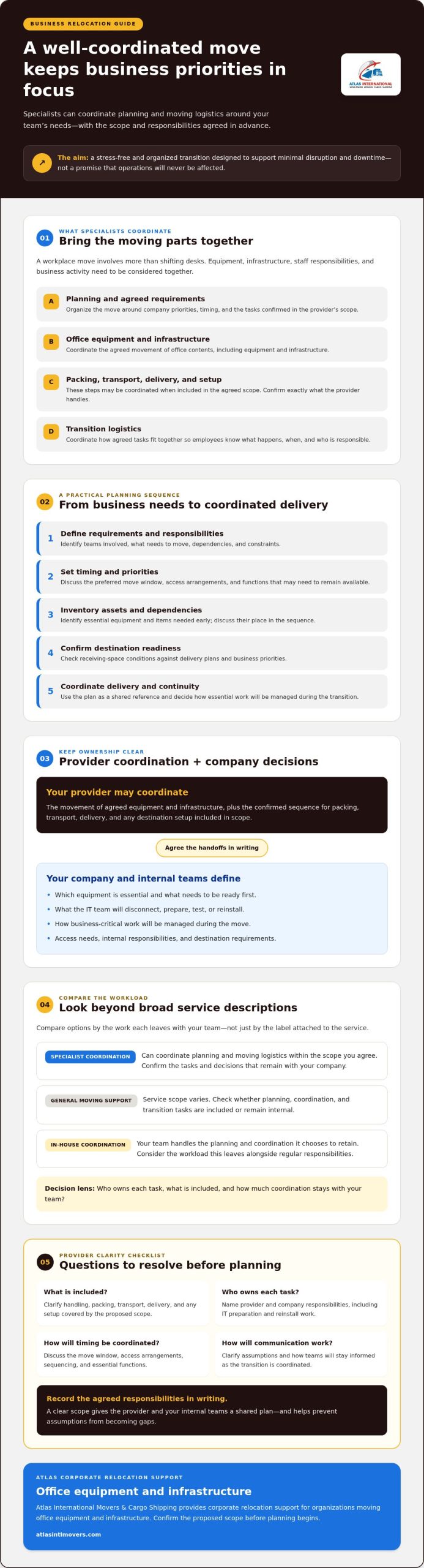
Business relocation specialists coordinate the planning, moving requirements, and transition logistics involved in relocating a company’s workplace. Their role may extend beyond transporting furniture or equipment to organizing how agreed tasks fit together. The general scope of relocation services varies, so confirm the provider’s responsibilities before the move is planned.
For a quick overview of the time-saving role a specialist may play, watch this video:
Which parts of a business move can a specialist coordinate?
A provider may help organize the movement of office equipment and infrastructure, including the sequence for packing, transport, delivery, and any setup agreed for the destination. For an IT move, this might include accounting for workstations and other equipment alongside the wider office contents. Your IT team should define what it will disconnect, prepare, test, or reinstall. Confirm exactly which tasks the provider handles and which remain with your company.
These steps depend on one another. Delivery plans need to match the receiving space and the company’s priorities. Equipment needed early may require a specific place in the sequence, so identify it in the inventory and discuss it before confirming the plan. Details depend on the move and the provider. Request a written scope rather than assuming a broad service description covers every task.
Why businesses seek specialist relocation support
A structured plan gives employees a clearer understanding of what happens, when it happens, and who is responsible. It can also help internal teams focus on decisions that require their knowledge, such as identifying essential equipment and preparing staff, while the provider coordinates agreed moving requirements. The goal is a stress-free and organized transition designed to support minimal disruption and downtime, not a promise that operations will never be affected.
Atlas provides corporate relocation support that includes moving office equipment and infrastructure. Review our corporate relocation service and confirm the proposed scope before planning begins.
How Specialists Plan a Stress-Free and Organized Business Relocation
A practical move plan starts with the company’s requirements, not a standard checklist. The reasons for relocating, such as changing workforce needs or seeking different market access, help shape priorities. Reading about reasons for business relocation can help frame those decisions. From there, the business and provider can map the assets, dependencies, timing, and destination conditions that affect the transition.
A business relocation plan moves from defining requirements and responsibilities to scheduling, inventorying assets, confirming destination readiness, and coordinating delivery. This sequence gives teams a shared reference point and can reduce avoidable confusion. It cannot guarantee operations will be unaffected, so the plan should also identify how the business will manage essential work during the transition.
Start with scope, responsibilities, and timing
Begin by identifying the teams involved, what needs to move, which activities depend on particular assets, and what constraints could affect the schedule. These may include your preferred move window, access arrangements, or the need to keep specific functions available. A clear brief helps the provider plan around business priorities instead of making assumptions.
Next, distinguish confirmed provider responsibilities from tasks your company will retain. A provider may handle agreed moving logistics, while internal teams decide business priorities or define technical requirements. Record responsibilities in writing and create a shared schedule with named decision-makers, key dates, and agreed communication points. If one part of the plan changes, the people responsible for other dependent tasks can then respond.
Coordinate equipment, infrastructure, and destination readiness
An inventory helps the business and provider understand what is moving and identify items that need particular handling. Keep IT planning at the right level: list the equipment and infrastructure involved, then ask your IT specialist to define technical requirements such as disconnection, configuration, or testing. Confirm who owns each task rather than assuming moving support includes technical setup.
Before delivery, check that the destination is ready to receive the items. Confirm access arrangements, where equipment should be placed, what setup has been agreed, and the intended delivery sequence. If the receiving space or handover plan changes, update the schedule and notify the relevant teams. These checks support a stress-free and organized move designed to minimize disruption, without promising zero downtime.
Businesses assessing a relocation partner can review our corporate relocation support for moving office equipment and infrastructure. See our corporate relocation service and confirm the proposed scope, responsibilities, and planning assumptions for your move.
Business Relocation Specialists vs General Movers and In-House Coordination
Choosing support for a company move depends on how much coordination the business needs, not simply how many items must be transported. A general moving service may suit a straightforward move with a clear inventory and an internal lead—for instance, working with commercial movers like Tru Nationwide LLC for transport and delivery. More complex moves may involve several teams, equipment categories, or locations, increasing the work needed to keep schedules and responsibilities aligned.
In-house coordination is another option. If the company has enough time, suitable staff, and a manageable scope, it may be able to plan the move itself. The trade-off is that scheduling, communication, packing coordination, and transport arrangements then fall to employees alongside their usual responsibilities. Business relocation specialists may take on agreed coordination tasks, but the service label alone does not establish what a provider includes.
Compare the responsibilities, not just the service labels
| Approach | Scope | Coordination load | Internal time required | Questions to confirm |
|---|---|---|---|---|
| Relocation specialist | May coordinate multiple agreed moving requirements and transition logistics. | Shared, based on the written scope. | Planning input and decisions still come from the business. | Who owns the schedule, communication, packing coordination, and transport planning? |
| General moving service | Typically focused on the moving tasks confirmed with the provider. | The business may coordinate activities outside that scope. | Depends on how much planning remains internal. | Which items and tasks are included, and what must the company arrange? |
| In-house coordination | Set and managed by the company. | Handled internally. | Can be substantial if several teams or dependencies are involved. | Who has capacity and authority to manage decisions, updates, and logistics? |
When does a business need more than a general moving service?
A move may require broader coordination when departments have different priorities, office furniture and IT infrastructure need separate handling plans, or several locations are involved. Each dependency can add handovers and scheduling decisions. Specialist support may be useful when the business wants help aligning these moving requirements, while a small, clearly defined move may need less coordination.
Match the approach to your capacity
Before choosing, list the company’s assets, constraints, and available internal capacity. Then ask each provider to state what it will coordinate, what it excludes, and what the business must supply or decide. Compare responsibility for scheduling, updates, packing coordination, and transport planning in writing. This makes proposals easier to assess and helps prevent assumptions from becoming gaps in the plan.
Atlas provides corporate relocation support, including moving office equipment and infrastructure. Review the stated scope of our corporate relocation service as part of your comparison.
Questions to Ask Business Relocation Specialists Before Choosing One
A broad service description can sound reassuring while leaving important tasks undefined. Before choosing business relocation specialists, ask what’s included, who coordinates each stage, and what your company must arrange. Clear answers make it easier to compare providers on practical responsibilities rather than general promises.
Compare documented scope, responsibilities, and assumptions, not broad promises. Request a written outline that identifies the provider’s confirmed role and separates it from tasks requiring your internal team or another provider. This matters especially for IT infrastructure: moving equipment and providing technical disconnection, configuration, or testing are distinct responsibilities. Confirm who will handle each one.
Questions about scope, handling, and communication
- Which office items and infrastructure are included in the proposed move plan? Ask how the inventory will be recorded and updated.
- How will special handling requirements be identified, documented, and communicated to the people managing the move?
- What tasks are excluded from the proposal, and which responsibilities stay with our employees or IT team?
- Who will manage day-to-day coordination, and how will teams receive updates if plans or timings change?
- Which person on each side can confirm decisions and resolve questions during planning?
Look for specific answers. If a provider says IT equipment is covered, clarify whether that means transport only or includes any agreed setup. Don’t assume one phrase describes the full service.
Questions about timing, storage, and transition support
- How does the proposed schedule depend on building access, destination readiness, and our business requirements?
- What could affect the delivery sequence, and how will schedule changes be communicated?
- If move dates don’t align, is secure storage available, and what storage arrangements should we confirm?
- How will delivery locations, setup expectations, and handover responsibilities be documented before work begins?
- Which tasks must be completed by our team before the provider can proceed?
Use the answers to check whether the proposed plan fits your assets and operating priorities. A useful written scope names the work covered, exclusions, assumptions, decision-makers, and communication points. If an answer is unclear, ask for clarification before confirming arrangements.
Atlas provides corporate relocation support that includes moving office equipment and infrastructure. Review our corporate relocation service and contact us to discuss your company’s moving requirements.
How Atlas Supports Business Relocation from Planning to Transition
After defining the move’s scope and comparing what providers will handle, discuss your requirements with a potential partner. Atlas International Movers & Cargo Shipping provides corporate relocation support for organizations moving office equipment and infrastructure. Confirm the proposed scope before planning proceeds, especially where technical tasks may need your own IT team or another specialist.
A coordinated partner for business moving requirements
Start with your operational priorities: which assets are moving, what timing constraints matter, and what needs to be ready at the destination. This helps clarify which requirements may fit the proposed service and which responsibilities remain with your business. We aim to support a stress-free and organized transition, with minimal disruption and downtime as an objective, not a guaranteed outcome.
Our corporate relocation service supports businesses moving office equipment and infrastructure. Depending on your requirements, our international moving service can support moves across borders, while domestic moving may suit a move within the country. If move dates and destination readiness don’t align, ask whether our storage and warehouse solutions may suit your needs. Confirm each element as part of the proposed scope.
Plan the next steps with confidence
A brief asset overview makes an initial discussion more focused. Note the main equipment and infrastructure categories, preferred timing, destination considerations, and business constraints. Identify the right internal contact for technical requirements so those decisions can be coordinated with your IT team.
- List the office equipment and infrastructure to be moved.
- Share preferred timing and any access or destination-readiness considerations.
- Identify technical tasks your internal IT team or another provider will manage.
- Ask what moving and storage requirements may be included, and request exclusions and assumptions in writing.
We can discuss your requirements and clarify potential service scope before you decide how to proceed. Contact our team about corporate relocation to discuss your company’s move. A clear brief and documented responsibilities provide a practical starting point for planning the transition.
Make Your Business Move Easier to Plan
A successful company relocation starts with clear responsibilities, a realistic schedule, and agreement on what the provider will handle. Business relocation specialists can coordinate moving requirements beyond transporting items, but the appropriate level of support depends on your assets, constraints, and internal capacity.
Before choosing a provider, compare written scopes rather than broad service descriptions. Confirm how office equipment and infrastructure will be handled, who manages communication, and which tasks remain with your team or another specialist. These details help shape an organized transition, with minimal disruption and downtime as an objective rather than a guarantee.
Atlas provides corporate relocation services for organizations moving worldwide. We also offer international and domestic moving, air and sea cargo, and storage solutions. The appropriate scope depends on your company’s requirements, so a clear discussion is a practical place to begin.
Discuss your business relocation requirements with our team. A defined plan and documented responsibilities can help you move forward with greater clarity and confidence.
Frequently Asked Questions
What do business relocation specialists do?
Business relocation specialists coordinate the planning, moving requirements, and transition logistics for a company move. They may organize office equipment and infrastructure across agreed stages such as packing, transport, delivery, and setup. Their exact role depends on the provider’s written scope. Businesses should clarify which tasks the specialist handles, which remain with internal teams, and whether technical IT work needs a separate provider.
How are business relocation specialists different from general movers?
Business relocation specialists may coordinate broader move requirements, while a general moving service may focus on the specific transport and handling tasks agreed with the provider. The distinction isn’t guaranteed by the service label. Compare written proposals to see who manages scheduling, communication, packing coordination, and delivery planning. Confirm what’s included, what’s excluded, and which responsibilities your employees or IT team retain.
When should a company hire business relocation specialists?
A company may benefit from specialist coordination when its move involves several teams, different equipment categories, multiple locations, or dependencies that need careful sequencing. Support can also help when internal employees don’t have enough time to coordinate logistics alongside their usual responsibilities. A smaller move with a clear inventory and an available internal lead may need less support. Choose based on your assets, constraints, and staff capacity.
How do specialists help reduce disruption during an office move?
Specialists can help organize tasks, responsibilities, and delivery priorities around the company’s operational needs. A shared schedule, clear contacts, and agreed handling requirements give teams a reference point and help reduce avoidable confusion. The business should identify essential activities and coordinate technical tasks with its IT team. A plan can support minimal disruption and downtime as an objective, but no provider should be assumed to guarantee uninterrupted operations.
What should a business ask relocation specialists before choosing one?
Ask which office assets and infrastructure are included, who coordinates the schedule and updates, how special handling needs are recorded, and what the provider excludes. Clarify whether IT setup or testing is part of the proposed scope or belongs to your own team or another provider. Also ask how access, destination readiness, delivery order, and any storage requirements affect the plan. Request responsibilities and assumptions in writing.
Can business relocation specialists help with international moves?
Some providers coordinate international business moves, but their capabilities and responsibilities vary. Confirm what the proposed service covers, how the movement of office equipment will be organized, and which requirements need another provider or your internal team. Atlas provides corporate relocation services for organizations moving worldwide, alongside international moving and air and sea cargo. Discuss the specific requirements and confirm the scope rather than assuming every international service is included.
How can a business prepare for a relocation specialist’s assessment?
Prepare a basic inventory of office furniture, equipment, and infrastructure, along with preferred timing and any known access or destination constraints. Identify departments whose work depends on particular assets and appoint internal contacts for operational and IT decisions. Note which tasks your team expects the provider to handle, then ask the provider to confirm or amend that scope in writing. This gives both sides a clearer starting point for planning.