

The cost of cargo container packing services in the UAE depends on the cargo and the work involved, so there isn’t one price that fits every shipment. Packing is only one part of the decision: container freight and storage can also affect the overall plan, and pricing is provided after a quote request based on the shipment’s requirements.
It’s understandable to want a clear cost before arranging a move or shipment. A useful estimate starts with practical details: cargo type and quantity, packing materials, handling needs, and whether freight or storage is required. This guide explains what professional packing may cover, which factors shape the cost, and how container freight and storage fit into an organized shipping plan.
Key Takeaways
- Professional packing can involve choosing suitable materials, secure wrapping, labeling and loading assistance, depending on the shipment.
- Industrial machinery, fragile goods, bulk commodities, artwork and electronics each call for handling suited to their cargo type.
- For a useful cost estimate, describe the shipment’s contents and packing needs, then consider how freight and storage fit into the plan.
- Container freight moves goods by road to or from ports and domestically; align the container plan with the shipment’s transport and storage needs.
Packing materials, labeling, and loading
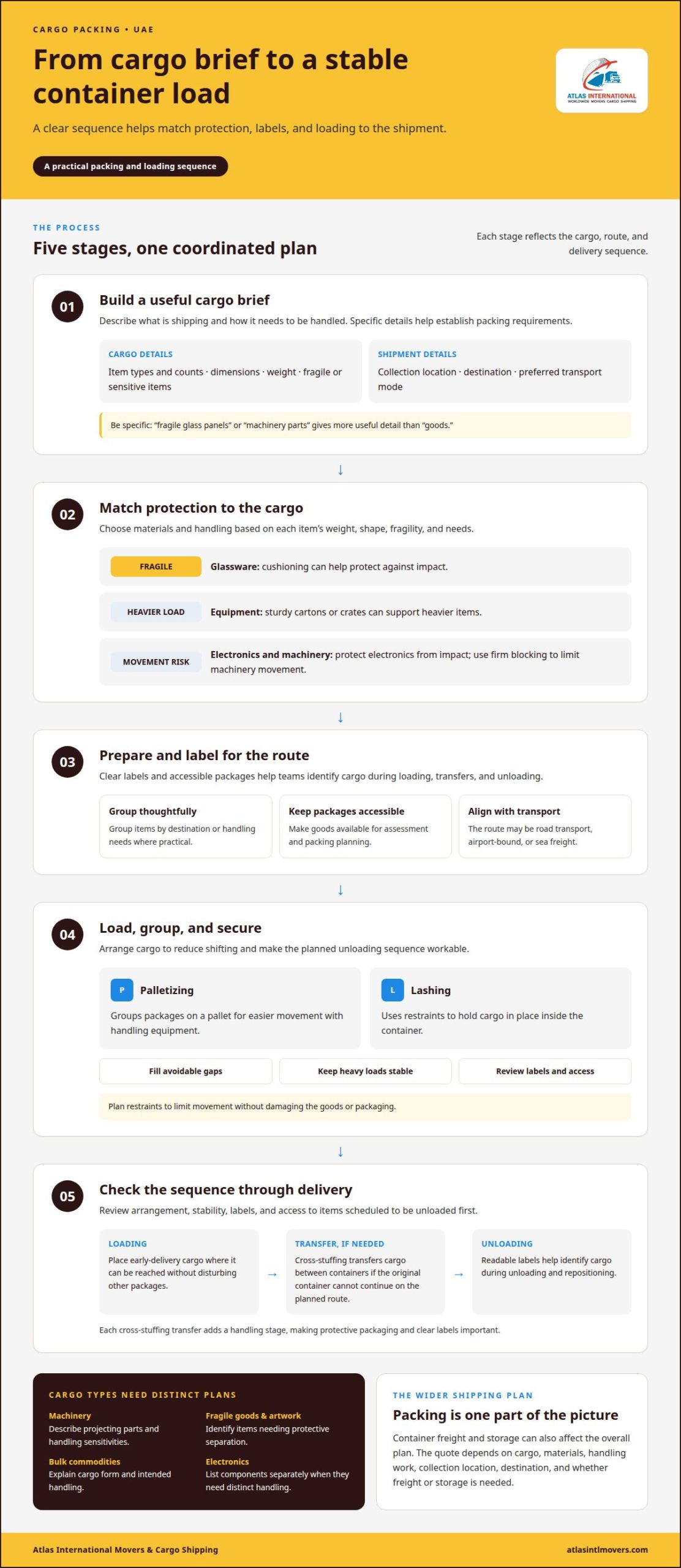
Effective container packing matches protection to the cargo and plans its movement from collection through unloading. Materials, labels, and load arrangement should reflect the shipment’s contents and route.
Packing Material Selection
Professional cargo container packing services in the UAE can involve selecting materials, wrapping and labeling goods, and coordinating loading. The right approach depends on the cargo: cushioning can protect fragile glassware, while sturdy cartons or crates can support heavier equipment. Electronics need protection from impact, while machinery may need firm blocking to limit movement. Consider each item’s weight, shape, fragility, and handling needs when planning materials.
Cargo Labeling and Preparation
Before booking, prepare a cargo description with item counts, dimensions, weight, handling sensitivities, collection details, destination, and preferred transport mode. Clear information helps determine packing needs and whether the shipment is suited to road transport, an airport-bound route, or sea freight. Use specific descriptions such as “fragile glass panels” or “machinery parts” rather than a broad label like “goods.”
To arrange packing, share the shipment details and request a quotation for the required packing and loading work. Keep packages accessible for assessment, and group items by destination or handling needs where practical. This preparation helps the team plan materials and the loading sequence before filling the container.
Loading, Unloading, and Cross Stuffing
Container loading means arranging cargo inside a container; unloading reverses the process at the destination. Cross-stuffing transfers cargo between containers, which may be needed if the original container cannot continue on the planned route. Each transfer adds a handling stage, making protective packaging and readable labels important. Clearly marked fragile cartons, for example, are easier to identify during unloading and repositioning.
Poor packing can allow cargo to shift, collide, or suffer crushing during transport. Reduce these risks by matching protective material to each item, filling avoidable gaps, and keeping heavy loads stable. For airport-bound shipments, air cargo transport planning can shape packing choices around the selected route.
Palletizing and Cargo Lashing
Palletizing groups packages on a pallet for easier movement with handling equipment. Lashing uses restraints to hold cargo in place inside the container. Both methods should suit the load’s dimensions, weight distribution, and handling characteristics. Safe UAE cargo packing depends on the cargo and transport mode. Plan restraints to limit movement without damaging the goods or packaging.
What types of cargo can packaging companies in UAE handle?
UAE cargo packing can cover preparation for varied shipments, from household goods to industrial consignments. Cargo packaging companies and container logistics providers are the relevant provider categories for container stuffing and lashing services.
Cargo can include industrial machinery, fragile goods, bulk commodities, artwork, and electronics. Each needs a plan suited to its shape, weight, fragility, and handling requirements. Machinery may need support to limit movement, while artwork needs protection from contact and impact. Bulk commodities require an arrangement that suits their form and destination. A detailed cargo description helps define the work.
Container logistics coordinate goods moving in standardized containers to or from ports, or between domestic locations. For international shipments, the route and destination affect how cargo is grouped and prepared for transfer. The container plan should distinguish goods travelling together from items requiring separate handling. This keeps the logistics stages aligned without treating every shipment alike.
Warehouse and on-site packing provide different starting points. A warehouse allows cargo to be organized before dispatch. On-site packing begins where goods are stored or produced, such as machinery prepared at an industrial facility. The location affects access, workspace, and movement to the loading point. Sharing the cargo details and current location helps establish a workable plan.
When assessing a UAE packing provider, match the work scope to the shipment. A useful cargo brief includes item types, approximate dimensions, weight, destination, and whether packing begins at a warehouse or on-site. Identify oversized, irregular, or fragile items separately. These details help coordinate packing, container stuffing, and lashing instead of assuming every item needs the same approach.
- Industrial machinery: describe projecting parts and handling sensitivities.
- Fragile goods and artwork: identify items needing protective separation.
- Bulk commodities: explain the cargo form and intended handling.
- Electronics: list components separately when they need distinct handling.
When different cargo types share a container, the loading sequence affects access on arrival. Grouping items by handling needs supports orderly unloading. Clear descriptions also help coordinate warehouse preparation, on-site packing, and onward transport within the UAE or internationally.
How much does professional cargo packing cost in UAE?
There isn’t one fixed price for professional packing in the UAE. Cost depends on the cargo, packing materials, handling work, collection location, and destination. Request a quote based on the shipment’s requirements and whether packing, loading, freight, or storage is needed.
For personal shipments, the contents and care required shape the work. A few cartons of household items differ from a full home shipment with fragile crockery, electronics, and furniture. Commercial cargo may involve repeated product units, coordinated labeling, or preparation for warehouse transfer. Industrial shipments have distinct demands, especially when equipment is heavy, oversized, or difficult to handle.
For a useful quote, provide a clear cargo description and destination. Include item quantities, dimensions, weight, packing location, and handling sensitivities. “Industrial pump with detachable parts,” for example, is clearer than “machinery.” Mention whether the shipment is domestic or international, and describe any customs paperwork or delivery-stage requirements that affect the plan.
Packing industrial machinery and equipment requires attention to the unit’s shape, exposed components, and movement during transport. A plan may need to separate removable parts, protect vulnerable surfaces, and secure the equipment for loading. The work varies depending on whether the machine is already crated, needs preparation at its operating site, or forms part of a larger industrial shipment.
For machinery and industrial cargo, the container plan matters too. A compact unit with a stable base has different handling needs from long equipment with projecting components. Dimensions and weight distribution influence preparation and positioning for transport. These details help distinguish straightforward wrapping from more involved packing and securement.
- Personal cargo: describe fragile household items, furniture, and carton quantities.
- Commercial cargo: identify product types, repeated units, and warehouse handling.
- Industrial cargo: share equipment dimensions, weight information, and exposed parts.
- Destination: state the route and relevant delivery or customs paperwork needs.
When reviewing a quote, compare its scope rather than focusing on the total alone. Check whether it covers packing materials, preparation, loading, and any requested freight or storage arrangements. An estimate based on a complete cargo description makes it easier to understand the shipment’s needs and what affects the cost.
Choosing a reliable packing provider
For a UAE shipment, assess whether the packing plan suits the cargo, route, and delivery requirements. Export machinery needs a different process from household cartons. Look for a clear description of the work, from preparation and materials through loading and handover. A defined scope shows which tasks are covered and how the shipment moves between stages.
Relevant experience is reflected in practical details, not broad claims. A plan for fragile electronics, for example, should explain how items are separated, protected, labeled, and positioned for transport. Machinery needs attention to exposed parts, dimensions, and stability. For bulk commodities, the loading arrangement should reflect the cargo’s form. These examples show whether the proposed handling suits your shipment.
Review the quote line by line. It should distinguish packing from container loading, lashing, freight, storage, and delivery where applicable. If the shipment moves through a warehouse before export, the scope should explain that transition. Confirming handover points in writing helps prevent gaps, such as packing being covered while loading is outside the agreed work.
- Cargo details: Match the plan to item type, dimensions, weight, and handling needs.
- Service scope: Separate packing, loading, lashing, freight, and storage tasks.
- Route and delivery: Identify the export destination and each handover stage.
- Communication: Keep the cargo description and agreed work in a written record.
Ask how changes are handled if the cargo description differs from the shipment presented. An additional oversized item, for example, may affect materials, loading order, or container space. A documented process for recording changes gives both sides a shared reference and helps keep the export schedule aligned with the actual cargo.
Insurance is separate from packing. Cargo insurance isn’t automatically included with cargo packaging services in the UAE and is usually arranged separately through a freight forwarder or insurance broker. Read the service scope carefully so packing and insurance aren’t confused. Packing concerns physical preparation; insurance concerns financial cover under its own terms.
Finally, check that the proposed delivery sequence suits the destination. Cargo needed first should not be buried behind goods scheduled for later unloading. For mixed shipments, such as machinery and spare-parts cartons, clear labels and planned placement support orderly handling on arrival. A sound arrangement connects packing decisions to the full journey, from preparation through final delivery.
Container freight and storage services
Container freight links cargo preparation with its movement by road to or from ports, or between locations domestically. Ocean freight containers range from 20 feet to 45 feet in length. The right plan connects container choice, collection, port movement, and any storage needed before onward delivery.
For international shipping, the container is one part of a wider journey. Cargo travels from its packing location toward a port, then continues along the route arranged for the shipment. A domestic move may instead use a container between locations within the UAE. Identifying the origin, destination, and handover points helps organize each stage.
Choose a container size that suits the cargo volume and planned loading arrangement. Bulky equipment may use space differently from cartons of commercial goods. Dimensions, shape, and handling needs affect how items fit together. A sound plan considers usable space and access for loading and unloading, rather than capacity alone.
Storage can help when packing, collection, freight, and delivery don’t happen at the same time. A warehouse may hold cargo before a container is ready or between arrival and onward movement. For example, goods collected before the delivery site is ready can remain in storage until transport is arranged. Choose secure, flexible storage with access suited to the shipment’s timing and handling needs.
Keep freight and storage arrangements connected. The cargo description, destination, loading plan, and delivery sequence should align at every stage. If goods are split across containers, records should show which items travel together. This supports warehouse coordination and helps locate the right cargo when the shipment continues.
- Before freight: establish where cargo is packed, collected, and loaded.
- During movement: map the road leg to or from the port, or the domestic route.
- During storage: clarify the holding point and when cargo needs onward movement.
- At delivery: align unloading with the destination’s readiness and sequence.
For a shipment requiring a pause between collection and delivery, storage and warehouse options can form part of the movement plan. Plan freight, storage, and final delivery as connected stages. This keeps the cargo’s route clear, whether a container moves to a port or between UAE locations.
Atlas International Movers & Cargo Shipping
Atlas International Movers & Cargo Shipping connects cargo planning with the movement that follows. For a household move or business shipment, we help align the route and transport option with your cargo requirements. Our services include International Moving, Domestic Moving, Air Cargo, and Sea Cargo.
International shipments may need a different transport plan from cargo moving within the UAE. Share the cargo type, origin, destination, and preferred mode so we can understand the shipment’s needs and discuss a suitable service. This is a practical next step when packing, freight, and movement need to fit one organized plan.
Contact Atlas International Movers & Cargo Shipping to discuss your cargo movement requirements.
Set Your Shipment in Motion
The next step is to turn your shipment requirements into a coordinated plan. Decide what the cargo needs to be ready for at its destination, then align packing, movement, and any storage around that outcome. A clear plan keeps decisions connected as the shipment moves from preparation to delivery.
If you’re arranging cargo container packing services in the UAE, consider how packing fits the wider journey, not just the moment cargo enters a container. A household move, business shipment, or industrial consignment may each need a different combination of transport and coordination. The next step is to bring those needs together in a practical plan.
Start planning your shipment with Atlas International Movers & Cargo Shipping. We’re ready to help you move ahead with a clear, organized approach.
Frequently Asked Questions
What is included in a standard cargo packing service in UAE?
The agreed scope should identify the work from the first handling point through handover for transport. It should state who prepares the cargo, who provides access, and what happens when packing is complete. For a mixed shipment, such as household goods alongside business stock, separate entries help prevent either cargo group being overlooked.
What kinds of packing do you do?
We provide professional packing and unpacking for residential moves. The approach can reflect household needs, such as keeping everyday essentials separate from items intended for longer-term storage. Fragile crockery and sensitive IT equipment need different handling. Clear grouping also makes unpacking more orderly, especially when belongings are going to different rooms or destinations.
What size container do I need for my cargo?
The suitable container depends on how the shipment is consolidated and whether it travels as one load or is divided by destination. A cargo manifest shows which goods belong together and how the shipment should be organized. Planning around the complete consignment helps avoid separating items that need to arrive as a set, such as equipment and its associated components.
Where does the packing happen?
The packing location should suit where the goods are ready and what access the work requires. At a residence, a clear working area helps keep packed belongings separate from items still in use. At a business site, the packing sequence can be coordinated around goods prepared for dispatch. Sharing access restrictions and site arrangements helps establish a practical start plan.
How much do container packing services cost across the UAE?
There isn’t one fixed UAE-wide charge for every shipment. Request a quote for the specific work, and compare what each estimate covers rather than totals alone. One proposal, for example, may describe packing while another also sets out related handling stages. A clear written scope helps you understand the basis of each quote before choosing an arrangement.
What factors affect container packing and stuffing prices in the UAE?
The quote reflects the agreed work and the shipment presented for that work. Changes to the cargo list after planning, such as adding goods or splitting a consignment, can change the required arrangement. The estimate should explain how changes are handled and whether a revised scope needs a new quotation. Keeping the final cargo inventory aligned with the booking helps avoid mismatched expectations.
What is included in UAE container packing services, such as labor, materials, and cargo securing?
Name those elements separately in the written service scope so it’s clear which tasks are covered. A shipment may, for instance, need packing completed before a separate team takes responsibility for onward handling. Read the scope as a division of responsibilities: it should show where packing ends and who takes over the cargo for the next stage.
What documents and customs requirements apply to packed export containers in the UAE?
Export paperwork and customs requirements depend on the shipment and destination. The exporter or party coordinating the shipment should establish which documents apply to the specific goods and route. Keep cargo descriptions consistent across shipment records, and ensure the party preparing export paperwork has accurate item information. Requirements differ between destinations, so don’t rely on a generic document list.