

A single layer of bubble wrap might suffice for a local move, but international shipping is a grueling marathon of physics that requires a much higher standard of protection. When your most delicate belongings face the combined forces of sea freight pressure and air cargo vibration, standard domestic methods simply aren’t enough. It’s natural to feel concerned about sentimental items breaking or insurance claims being denied because of packing oversights. You need the confidence that comes from using export-grade materials and professional techniques. This guide focuses on the specific requirements for packing fragile items for international shipping in 2026, ensuring your assets are protected across every border.
We understand that a successful relocation is built on meticulous preparation and the removal of logistical burdens. By mastering the industry-standard “double-box” method and adhering to new 2026 global packaging regulations, such as the EU’s Packaging and Packaging Waste Regulation (PPWR), you can transform a stressful transition into a smooth, predictable process. We’ll provide a comprehensive checklist of required materials, from industrial-grade double-wall boxes to specialized cushioning. You’ll gain a clear understanding of how to meet export standards; this ensures your belongings are prepared for the journey and that your insurance coverage remains secure. Let’s build the foundation for a damage-free move.
Key Takeaways
- Understand the “Triple Threat” of global transit and why standard household boxes fail to protect against mechanical vibration and stacking pressure.
- Master the professional “Double-Box Method” for packing fragile items for international shipping to ensure structural integrity during long-haul sea or air cargo journeys.
- Identify essential export-grade materials, including multi-layered polyethylene foam and triple-walled corrugated fiberboard, that meet 2026 international standards.
- Implement item-specific strategies for high-value assets, such as vertical orientation for stemware and specialized taping techniques for mirrors and fine art.
- Recognize the critical difference between “Carrier-Packed” and “Packed by Owner” status to ensure your insurance liability remains fully intact.
The Challenges of Global Transit: Why Standard Packing Fails
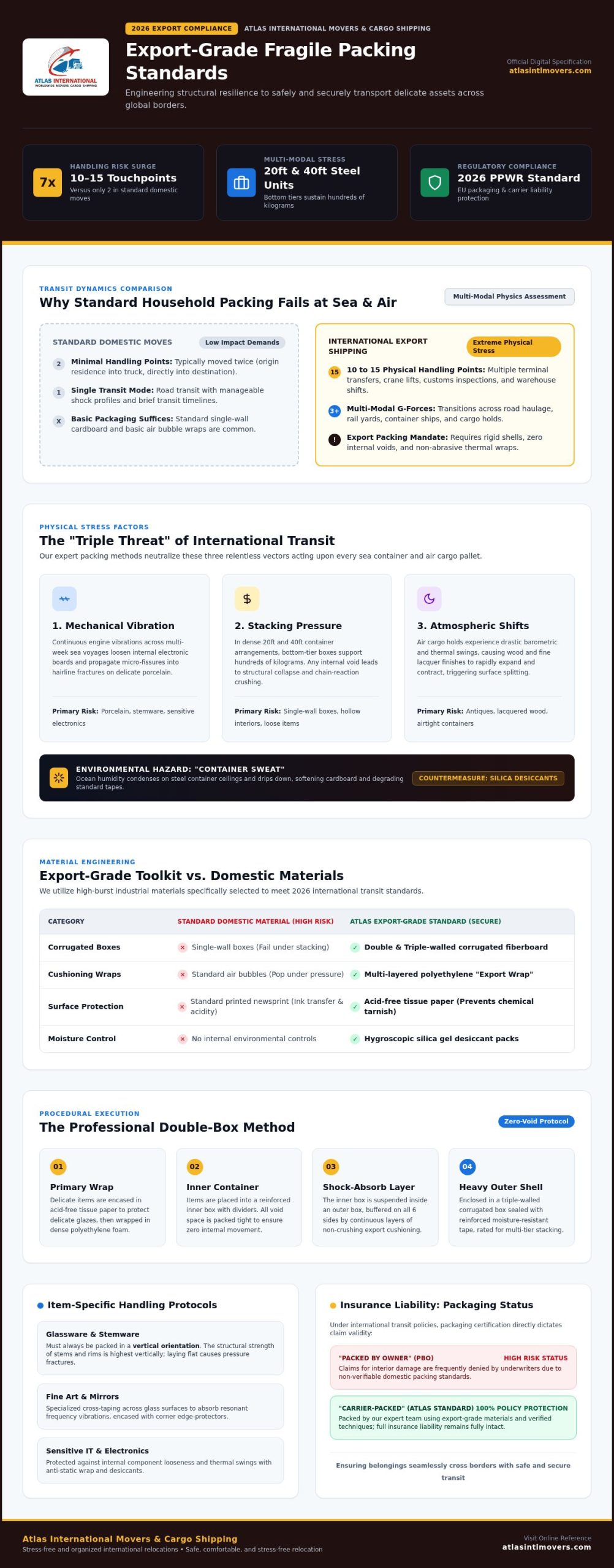
Standard packing techniques are designed for the short durations and low handling levels of a domestic move. When your belongings cross international borders, they require “Export Packing,” which is the industry standard for goods subjected to multi-modal transport. While a local move might involve moving a box twice, an international journey involves 10 to 15 different handling points. Adhering to professional packaging and labeling standards is essential to ensure your items withstand this increased physical demand. Without these specialized measures, the risks to your assets grow exponentially.
The “Triple Threat” of global shipping consists of mechanical vibration, atmospheric pressure, and stacking weight. Constant engine vibrations from sea vessels or transport aircraft can cause internal components of electronics to loosen or delicate porcelain to develop hairline fractures. In air cargo holds, shifts in atmospheric pressure can affect sealed items. Finally, the sheer weight of stacked cargo in a warehouse or container can crush boxes that aren’t structurally reinforced. Masterfully packing fragile items for international shipping requires a strategy that addresses all three of these forces simultaneously.
Certain categories of belongings are particularly vulnerable during long-haul transit. Fine art, porcelain, and glassware are susceptible to impact damage, while sensitive electronics can fail due to internal rattling. Even sturdy-looking furniture can suffer if it’s not wrapped to withstand the friction of a multi-week sea voyage. Identifying these high-risk items early allows for the application of specific protective standards that go far beyond what’s used in a typical home relocation.
The Physics of the Container: Stacking and Shifting
International shipments typically travel in 20ft or 40ft steel containers. These units are packed to maximize space, which means boxes at the bottom tier may support hundreds of kilograms of pressure from above. If a box has any “empty space” inside, it will eventually collapse under this weight, leading to a chain reaction of shifting cargo. Transitions between road, rail, and sea transport create G-forces that test the internal stability of every package. Professional packing fragile items for international shipping eliminates these voids, ensuring that the box remains a rigid, protective shell throughout the journey.
Environmental Factors: Humidity and Temperature
Containers crossing the ocean often experience “container sweat,” a phenomenon where moisture condenses on the ceiling and drips onto the cargo as temperatures fluctuate. This humidity can soften standard cardboard and cause adhesive tape to lose its grip. Air cargo holds also face extreme temperature swings that can cause wood or lacquer to expand and contract, leading to cracks. Desiccants are hygroscopic substances, such as silica gel packets, used to maintain a dry environment within a sealed container by absorbing excess moisture from the air to prevent corrosion or mold. Using these alongside moisture-resistant wraps provides the calm control needed to protect your items from the elements.
Essential Materials for Export-Grade Fragile Packing
Achieving a secure transition requires more than just careful handling; it demands the correct logistical toolkit. For packing fragile items for international shipping, the choice of box is the first line of defense. Standard single-wall boxes used for domestic moves lack the burst strength needed for sea freight. Instead, professionals utilize double-walled or triple-walled corrugated fiberboard boxes. These provide the structural integrity required to resist the stacking pressure and shifting forces typical of containerized transport.
While many DIY shippers rely on standard bubble wrap, industry experts use “Export Wrap.” This multi-layered polyethylene foam is far superior because it’s non-abrasive and provides a thicker thermal barrier. It doesn’t pop under pressure like air-filled bubbles often do. For silver, antiques, or items with fine lacquer finishes, acid-free tissue paper is essential. It prevents chemical reactions that can cause tarnishing or staining during long-haul voyages. Security is further enhanced by using reinforced gummed paper tape. Unlike standard plastic shipping tape, which can peel off in high humidity, gummed tape creates a molecular bond with the box fibers. This ensures the seal remains intact even during the “container sweat” cycles common in global transit.
Cushioning vs. Void Fill: Understanding the Difference
Cushioning and void fill serve two distinct purposes in the relocation process. Cushioning materials, such as foam planks and felt pads, protect the item’s surface directly from impact. Void fill, including air pillows and crumpled kraft paper, eliminates movement within the box. A critical standard is the “Two-Inch Rule,” which maintains a minimum 5cm buffer between the item and the box wall. This space allows the outer shell to absorb energy without transferring it to the contents. If you aren’t sure which materials suit your specific assets, consulting with the best movers and packers in uae can provide the necessary clarity for your planning.
Specialized Protection for High-Value Items
Certain items require bespoke solutions that go beyond standard boxing. Framed art and mirrors benefit from rigid corner protectors that prevent frame separation during transit. Long, fragile items like lamps or floor statues are best housed in telescoping boxes, which adjust to the item’s height for a snug fit. For sensitive electronics, we recommend using “ShockWatch” or “TiltWatch” indicators. These devices turn red if the package is dropped or tilted beyond a specific angle. This provides an immediate visual record of handling for insurance purposes. These meticulous standards ensure that even the most delicate belongings arrive in the same condition they left.
Step-by-Step Guide to the Double-Box Method
The double-box method is the professional standard for packing fragile items for international shipping. This technique creates a protective isolation chamber, shielding your assets from the mechanical vibrations and stacking pressures discussed earlier. By following this systematic process, you ensure that your belongings remain secure throughout their journey from the UAE to global destinations.
- Step 1: Wrap the individual item in multiple layers of export-grade foam or heavy-duty bubble wrap. Ensure that all protruding parts or delicate edges are fully encased to prevent friction damage.
- Step 2: Place the wrapped item into a sturdy inner box. You must fill all remaining voids with cushioning until no movement occurs when the box is gently shaken. A snug fit is essential for internal stability.
- Step 3: Select an outer box that is at least 10cm larger in every dimension than the inner box. This allows for a minimum 5cm (2-inch) buffer of padding on all six sides, creating a vital crumple zone.
- Step 4: Surround the inner box with dense cushioning, such as foam planks or heavy-duty packing peanuts. The inner box should be perfectly centered within this secondary layer of protection.
- Step 5: Seal the outer box using the H-taping method on all seams. This reinforces the box’s structure and prevents it from bursting during high-pressure handling.
The H-Taping Technique for Structural Reinforcement
Structural integrity depends heavily on how a box is sealed. The H-taping technique involves applying tape across all seams and edges to create a shape resembling the letter “H” on both the top and bottom. You should apply at least three strips of tape to each seam. Reinforcing the bottom of the box is more critical than the top, especially for heavy fragile items, as it bears the brunt of the weight during lifting. For international cargo, use a tape width of at least 50mm to 75mm (2-3 inches). This ensures the adhesive bond is strong enough to withstand the humidity and temperature shifts encountered in sea and air freight.
Labeling for International Customs and Handling
Clear communication is the final step in securing your shipment. Use standardized iconography for “Fragile,” “This Side Up,” and “Handle with Care” to ensure handlers understand the requirements at a glance. When shipping from the UAE to regional hubs like Saudi Arabia or Kuwait, multi-lingual labeling in both Arabic and English is highly beneficial. Place these labels on at least three different sides of the box. This ensures visibility regardless of how the cargo is stacked in a warehouse or container. Proper labeling reduces the risk of mishandling and assists customs officials in identifying high-value or delicate contents without unnecessary physical inspection.
Item-Specific Packing Strategies: From Glassware to Electronics
Every delicate item possesses unique structural vulnerabilities that require a tailored approach. When you are packing fragile items for international shipping, the orientation of the object often dictates its survival. For glassware and stemware, items should always be packed vertically on their base rather than horizontally. The base is the strongest part of a glass; packing it on its side places the full weight of the stack on the fragile center, which almost guarantees breakage during the vibrations of a long-haul journey. This simple shift in orientation significantly reduces the risk of structural failure during transit.
Fine art and mirrors require a different strategy to mitigate the risks of glass failure. We recommend the “Star Method,” where you apply low-tack masking tape in a star pattern across the glass surface. If the glass shatters, the tape holds the shards in place, preventing them from scratching the artwork or mirror finish. For sensitive electronics, 2026 sea freight standards emphasize the use of static-dissipative (ESD) packaging. You must also remove all batteries before transit. This prevents chemical leaks and complies with international safety regulations for air and sea cargo. Similarly, musical instruments require tension relief; loosening the strings prevents the neck from warping as atmospheric pressure shifts in the cargo hold.
Packing Heavy Fragiles: Statues and Stone
Heavy, delicate assets like marble statues or stone carvings present a weight distribution challenge. These items must be placed in smaller, reinforced boxes to prevent them from becoming too heavy for manual handling. We use custom-cut foam blocks to create internal bracing, which supports protruding parts like limbs or intricate carvings. When an item’s weight exceeds standard box capacities, we transition to custom timber crating. This provides a rigid, puncture-resistant exterior that standard cardboard cannot match. If your move involves these complex assets, our shipping service uae to saudi specialists can design a bespoke crating solution that ensures total security.
Antiques and Sentimental Heirlooms
Protecting the finish of an antique is as important as protecting its structure. Use non-abrasive wraps, such as acid-free tissue or felt, as the first layer to prevent “sweating” against the wood or lacquer. Before any item is sealed, you should inventory and photograph it from multiple angles. This documentation is vital for insurance purposes and provides peace of mind that your legacy is accounted for. You can learn more about international moving standards for high-value goods to ensure your planning aligns with global best practices. These methodical steps are essential when packing fragile items for international shipping, ensuring that your most cherished belongings arrive in the same condition they left your home.
Professional Export Packing: The Atlas International Standard
The logistical burden of a global move is best managed by those who treat your assets with the protective care of a trusted guardian. When you opt for professional packing fragile items for international shipping, your shipment is classified as “Carrier-Packed” (CP) rather than “Packed by Owner” (PBO). This distinction is vital for insurance liability. Most underwriters will only provide full “all-risk” coverage for items packed by a professional team, as PBO shipments are frequently subject to claim rejections based on “insufficient packaging.” Choosing a professional standard ensures that your financial protection is as robust as the physical crates housing your belongings.
Our process begins with on-site surveys where experts from Atlas International Movers & Cargo Shipping assess the specific fragility and dimensions of your inventory before a single box is taped. For high-value assets like grand pianos, marble tabletops, or delicate chandeliers, standard corrugated boxes aren’t enough. We utilize custom timber crating, which provides a rigid, puncture-resistant exoskeleton tailored to the item’s exact measurements. This level of precision is part of our commitment to a legacy of reliability, and it integrates seamlessly with our shipping services from UAE to Saudi Arabia. We manage the complexity so you can focus on your transition.
Why Professional Packing is a Financial Investment
Professional packing is a strategic financial choice that often pays for itself through risk mitigation and volume efficiency. Expert teams utilize “Tetris-style” loading techniques to maximize every cubic centimeter of container space, which can reduce your overall shipping volume and subsequent freight costs. Beyond the physical space, the value of your time is a significant factor. A professional crew can pack an entire household to export standards in a fraction of the time it takes an individual. This efficiency removes the logistical hurdles that often cause the most stress during a global relocation.
End-to-End Security: From Your Door to the Destination
Maintaining a secure “Chain of Custody” for fragile cargo is essential for peace of mind. From the moment your items are packed at your residence in the UAE to their final delivery, Atlas International Movers & Cargo Shipping maintains strict oversight of the handling process. For shipments that require delayed delivery or transit through regional hubs, we provide secure warehousing and climate-controlled storage. This is particularly important for delicate materials like wood, lacquer, or electronics that are sensitive to the extreme temperatures common in the region. We remain unfazed by these logistical hurdles, providing a steady and informative flow of support throughout your journey.
Request a professional packing and moving quote from Atlas International Movers & Cargo Shipping to ensure your most delicate belongings are protected by 20 years of global relocation expertise.
Securing Your Belongings for a Seamless Global Transition
Protecting your most delicate assets requires a shift from standard household methods to professional export standards. By mastering the art of packing fragile items for international shipping, you move beyond basic protection to a system designed for the rigors of 2026 global logistics. You’ve learned how specialized materials and the double-box method create a necessary buffer against the pressures of sea and air cargo. These technical steps are the foundation of a successful move, ensuring that sentimental and high-value items remain intact across every border.
With over 20 years of international logistics experience, Atlas International Movers provides the steady reliability you need for complex transitions. We utilize specialized export-grade materials and custom crating to manage the unique vulnerabilities of your cargo, particularly on our dedicated routes from the UAE to Saudi Arabia and Kuwait. Our team acts as a trusted guardian, removing the logistical burdens so you can focus on your new beginning. Get a Professional Export Packing Quote Today and take the first step toward a worry-free relocation. Your journey deserves the highest level of professional assurance and care.
Frequently Asked Questions
Is standard bubble wrap enough for international shipping?
Standard bubble wrap is typically insufficient for the rigors of a global journey. While it works for short domestic relocations, international transit requires “Export Wrap,” which is a multi-layered polyethylene foam. This material is non-abrasive and maintains its structural integrity under the stacking pressure of a shipping container. It won’t pop like air-filled bubbles, providing a consistent cushion that protects your most delicate assets throughout the entire logistical process.
What is the “Double Box” method and when should I use it?
The “Double Box” method involves placing a smaller, cushioned inner box inside a larger, reinforced outer box. You should use this technique for high-value or extremely fragile items like fine porcelain, crystal, or sensitive instruments. By maintaining a minimum 5cm buffer of dense cushioning between the two boxes, you create an isolation chamber. This setup effectively absorbs mechanical vibrations and impact energy, ensuring the contents remain undisturbed during long-haul sea or air freight transport.
Will my insurance cover items I pack myself (PBO)?
Most international insurance providers offer very limited coverage for items classified as “Packed by Owner” (PBO). Typically, these policies only cover the total loss of the entire shipment rather than individual breakage. To secure comprehensive “all-risk” coverage, your assets must be “Carrier-Packed” (CP) by professional teams. This ensures that the packing meets strict export standards, which significantly reduces the risk of insurance claim rejection based on insufficient packaging or improper handling techniques.
How do I pack sensitive electronics for a long sea voyage?
Packing sensitive electronics for a long sea voyage requires a focus on static prevention and moisture control. You must use static-dissipative (ESD) packaging to protect internal components from electrical discharge. It’s also essential to remove all batteries to prevent leaks and comply with international safety regulations. We recommend adding desiccants, such as silica gel, to the box to absorb “container sweat” and prevent moisture damage during the temperature fluctuations common in maritime transit.
What are the most common mistakes when packing fragile items for overseas moves?
The most frequent error is leaving “empty space” within a box, which allows items to shift and eventually leads to the box collapsing under stacking pressure. Another mistake is using single-wall domestic boxes instead of double-walled export-grade fiberboard. Many people also fail to use the correct tape; standard plastic tape often fails in the high humidity of a shipping container. Finally, improper labeling can lead to boxes being stacked incorrectly, increasing the risk of damage to delicate contents.
Do I need custom wooden crates for my furniture or art?
Custom timber crating is necessary for items that are exceptionally heavy, oversized, or high-value. While standard reinforced boxes are suitable for many goods, assets like marble tabletops, grand pianos, or large-scale fine art require a rigid exoskeleton. These crates are built to the item’s exact measurements, providing puncture resistance and structural support that cardboard cannot match. This professional standard is essential for ensuring your most valuable belongings survive the intense pressures of containerized international shipping.
How should I label my fragile boxes for international customs?
Effective labeling for international customs involves using standardized icons for “Fragile” and “This Side Up” rather than just text. For shipments originating in the UAE, it’s highly beneficial to include multi-lingual labels in both Arabic and English to assist handlers in regional hubs like Saudi Arabia or Kuwait. You should place these labels on at least three sides of the box. This ensures visibility regardless of how the shipment is stacked or oriented in a warehouse.
Can I use old newspaper as a cushioning material?
We don’t recommend using old newspaper for packing fragile items for international shipping. The newsprint ink can permanently stain delicate surfaces, such as porcelain, fine art, or wood finishes, especially during a long voyage with varying humidity. Newspaper also lacks the structural resilience needed for long-haul transit; it compresses too easily under pressure. Instead, use acid-free tissue paper for direct wrapping and thick kraft paper or foam for cushioning to ensure your items remain clean and protected.