

Finding stored goods later starts with deciding how to track them before they leave your hands. Choosing warehouse storage is only one part of the process. Household belongings and business inventory are easier to manage when preparation, records, and access are planned from the start.
It’s understandable to have questions about what to store, how to prepare it, and how to retrieve it when plans change. A clear process can reduce uncertainty and help keep essential items identifiable throughout their time in storage. We provide secure, flexible, and easy access storage for short-term and long-term needs, supporting household moves, corporate relocation, and inventory management.
This guide explains how to match a storage approach to your goods and timeframe, prepare items, and create an inventory and retrieval plan. You’ll also learn how storage can bridge timing gaps during a move or support business operations, so you can manage stored goods with greater confidence.
Key Takeaways
- Separate household belongings from business inventory to clarify what needs storing and how it should be managed.
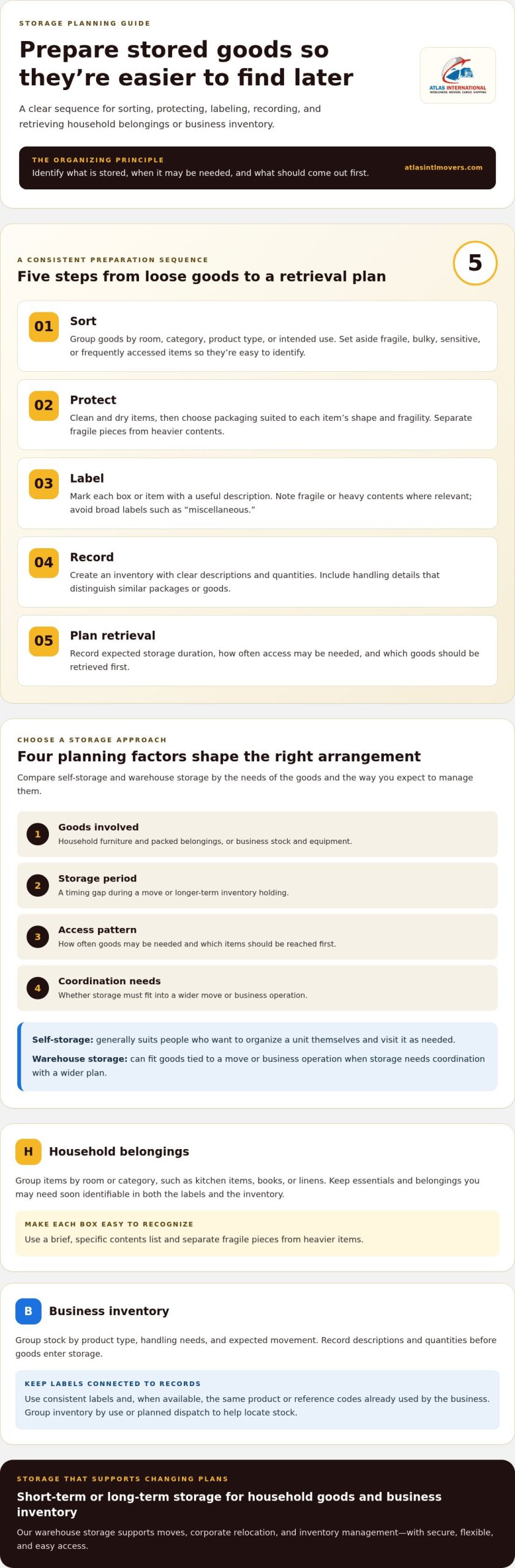
- Prepare goods in a consistent sequence: sort, protect, label, record, and plan how you’ll retrieve them.
- Compare self-storage and warehouse storage by the goods involved, storage period, access pattern, and coordination needs.
- Use a master inventory with clear descriptions, quantities, labels, and grouping. Consistent reference codes can help businesses track stock.
- Our warehouse storage supports household goods and business inventory with secure, flexible, and easy access for short-term or long-term needs.
Warehouse Storage Basics: Start by Defining What You Need to Store
Before arranging space, define what you’ll store and what needs to happen while it’s there. Warehouse storage is managed space used to hold goods, business inventory, equipment, or household belongings until they’re needed again. A warehouse can support the movement and holding of goods as part of a wider supply chain. The Warehouse overview explains its broader functions and types.
That managed approach differs from self-storage, where the customer typically rents a unit and organizes its contents independently. The right arrangement depends on the goods, storage period, access pattern, and level of coordination needed. Start by separating household needs from business requirements. Furniture and packed personal belongings may need storage during a move, while a company may need to hold stock or equipment for inventory management.
Which goods are suitable for warehouse storage?
Group goods by purpose before planning their storage. Household furniture, packed belongings, business stock, and equipment each need clear descriptions and labels. Set aside fragile, bulky, sensitive, or frequently accessed items so they’re easy to identify and plan for. Note which items belong together and which may need to be retrieved separately. Clean, dry goods packed appropriately are easier to organize and track.
How do storage duration and access needs affect planning?
Storage during a move may bridge a gap between leaving one home and settling into another. Longer-term inventory holding follows a different schedule, with retrieval tied to business needs. Record the expected duration, how often you’ll need access, and which goods are likely to be needed first. This information helps establish a practical retrieval sequence instead of leaving priority items buried among less urgent goods.
Before goods go into storage, make a simple plan: identify what’s being held, when it may be needed, and what should be retrieved first. For businesses, grouping inventory by use or planned dispatch can make stock easier to locate. For households, a brief list of box contents can distinguish everyday essentials from belongings intended to remain stored.
We provide short-term and long-term storage for household goods and business inventory, including support for moves and corporate relocation. Our warehouse storage service is designed to be secure, flexible, and easy access, helping you plan around your goods and the timing of your move or operations.
How to Prepare Goods for Warehouse Storage Safely and Systematically
Preparation involves more than packing items into boxes. A consistent process makes goods easier to identify, handle, and retrieve later. Use this sequence:
- Sort: Group goods by room, category, product type, or intended use.
- Protect: Clean and dry items, then pack them appropriately for their shape and fragility.
- Label: Mark each box or item clearly, including fragile or heavy contents where relevant.
- Record: Note item descriptions and quantities in an inventory.
- Plan retrieval: Identify what may be needed first and record its priority.
In short, sort goods, protect them, label each package, record its contents, and plan how you’ll retrieve it. Clean, dry items in suitable packaging are easier to group and track. For general information on warehouse hazards and safe work practices, the Occupational Safety and Health Administration provides guidance on preparing goods safely and systematically. Use it as a reference, rather than as a statement of UAE requirements.
How should household belongings be sorted and packed?
For household storage, group belongings by room or category, such as kitchen items, books, or linens. Separate fragile pieces from heavier contents, and use packing materials suited to each item. Label boxes with a useful description instead of a broad term such as “miscellaneous.” Keep essentials and belongings you may need soon identifiable in both the labels and your inventory.
How should business inventory be prepared?
For business goods, group stock by product type, handling needs, and how often it’s expected to move. Record descriptions and quantities before items enter storage, then use consistent labels that match those records. If your business already assigns product or reference codes, use the same system on storage labels so team members can connect physical goods with inventory information.
Keep the record practical: note what each package contains, how many units it holds, and any handling detail needed to distinguish it from similar goods. Avoid relying on memory or labels that only make sense to the person who packed the items. When plans change, a clear inventory helps you identify priorities without opening every box or recounting every item.
Our warehouse storage service supports household belongings and business inventory for short-term or long-term needs. A well-prepared inventory makes it easier to coordinate storage with a move or ongoing operations.
Warehouse Storage vs. Self-Storage: Match the Approach to Your Goods
Self-storage and warehouse storage serve different needs. Your choice depends on what you’re holding and how you expect to access it. Self-storage generally suits people who want to organize a unit themselves and visit it as needed. Warehouse storage can be a practical fit when goods are part of a move or business operation and storage needs to be coordinated with a wider plan.
| Consideration | Self-storage | Warehouse storage |
|---|---|---|
| Goods type | Personal belongings or items you want to organize yourself | Household goods, business stock, or equipment held as part of a move or operation |
| Storage duration | Can suit a period shaped by your own storage plans | Can support short-term move timing gaps or longer-term inventory holding |
| Access pattern | Useful when you plan to visit and retrieve items yourself | Best planned around expected retrieval needs and item priorities |
| Coordination needs | You manage the unit and its contents | May be considered alongside a move, corporate relocation, or inventory plan |
Neither approach is right for every situation. Compare the goods, expected storage period, access frequency, and retrieval sequence before deciding. For more information about our service, see our warehouse storage service information.
When might warehouse storage suit household belongings?
A gap between moving dates or access to a new home can leave belongings without a convenient place to go. Storage can bridge that transition. Grouping belongings by room, such as kitchen, bedroom, or living room, can make later delivery and unpacking more orderly. Mark items needed soon clearly in your inventory so they’re easier to prioritize when planning retrieval.
When might warehouse storage suit business inventory?
Businesses may need to hold stock or equipment between operational stages, such as before goods are needed for use or distribution. A planned access pattern helps teams identify what should be retrieved first, while consistent records help match stored goods to inventory. The Material Handling Industry’s Warehouse Storage Inventory and Retrieval Plan offers related guidance on organized warehouse environments. For a corporate move, consider how storage timing fits with the relocation schedule and the order in which equipment will be needed.
How to Create a Warehouse Storage Inventory and Retrieval Plan
A useful inventory turns stored goods into a system people can act on. Create one master record before items are packed or moved, and use the same labels on the physical goods and in the record. An effective storage record identifies each item, its quantity, its location or group, and its retrieval priority.
For warehouse storage, keep the inventory straightforward and consistent. Include an item name or description, quantity, container label, and category, such as office equipment, seasonal stock, or household goods. Add handling notes only when they reflect a known need, such as identifying a fragile item. Avoid vague descriptions such as “supplies” when a more specific name will help someone find the goods.
What should a warehouse storage inventory include?
Choose a format that the people coordinating storage and retrieval can access and understand. A spreadsheet or shared record can work if it stays current. For example:
Item: Network cables | Quantity: 12 packs | Label: IT-014 | Category: Office equipment | Priority: Retrieve for setup
For household belongings, a row might identify a box by room and contents, such as “Kitchen, cookware” rather than simply “Box 6.” Keep the inventory accessible to the people who will plan retrieval, and make sure everyone uses the same version.
How can teams make stored goods easier to retrieve?
Before packing, decide which items are likely to be needed first. Mark those priorities in the record and make sure the corresponding label is easy to match. Group related goods and apply one consistent reference-code system across boxes or stock units. Businesses can use an existing SKU or create a simple reference code, provided each code connects clearly to the inventory entry.
For instance, a business might group replacement components separately from slower-moving stock, then identify each container with a product category and reference code. This makes the retrieval request more precise than asking for “the parts.” Share retrieval priorities with the relevant coordinators so they know what to locate and why.
Keep the system current. Update quantities when goods are added or removed, and revise labels or grouping details if items are reorganized. A brief update each time something changes helps prevent the inventory from drifting away from what is physically stored. We provide storage for household goods and business inventory, and our warehouse storage service supports planned storage needs as part of a move or business operation.
How Atlas Supports Secure, Flexible Warehouse Storage
Storage can help keep a move or business plan on track when goods can’t go directly to their next destination. Atlas International Movers & Cargo Shipping provides short-term and long-term storage for household belongings and business inventory, with a service designed to be secure, flexible, and easy access. Planning around the goods, expected storage period, and retrieval priorities helps make the arrangement practical and straightforward.
How does storage fit into a household move?
Moving dates and access to a new home don’t always align. Storage can bridge that timing gap, giving household belongings a place to stay between stages of a move. Clear labels and an inventory grouped by room can help keep belongings identifiable and support a stress-free and organized transition when it’s time to move them onward. Atlas International Movers & Cargo Shipping coordinates storage as part of the wider moving process, helping reduce the logistical burden while you focus on settling in.
How does storage support business operations and relocation?
Businesses may need to hold inventory or equipment between operational stages, or while an office move is being planned. A clear record of stored goods and their retrieval priorities helps teams coordinate what is needed next. Atlas International Movers & Cargo Shipping supports storage alongside corporate relocation and inventory management, helping businesses plan around their goods and work toward minimal disruption and downtime.
Before goods enter storage, identify what’s being held, how long it may be needed, and what should be retrieved first. This gives our team a clear basis for coordinating storage with your move or business requirements. The plan can adapt as circumstances change, whether you’re storing household belongings during a transition or holding business inventory for later use.
Explore our warehouse storage service to learn how Atlas International Movers & Cargo Shipping supports household goods and business inventory with secure, flexible storage.
Make Storage Easier to Manage
A reliable storage plan starts with knowing what you’re storing and how you’ll need it later. Sort and prepare goods carefully, keep labels and inventory records consistent, and set retrieval priorities before items are packed away. The right approach depends on whether you’re holding household belongings through a move or managing business stock and equipment.
Our warehouse storage supports short-term and long-term needs for household goods and business inventory. We can integrate storage with moving and corporate relocation, helping bridge timing gaps and keep the process organized. With secure, flexible storage and easy access, you can plan around your belongings while focusing on your next steps.
Ready to plan storage around your move or business needs? Explore our warehouse storage service and take the next step toward a more organized transition.
Frequently Asked Questions
What is warehouse storage?
Warehouse storage is the organized holding of goods, inventory, or personal belongings in a warehouse. People may use it during a move when dates don’t align, while businesses may store stock or equipment between operational stages. Before items go into storage, prepare a list, label containers clearly, and decide what may need to be retrieved first. These steps help keep stored goods identifiable and make retrieval easier to coordinate.
How do I prepare items for warehouse storage?
Start by sorting belongings or stock into clear groups, then pack items appropriately and label each container. Record contents and quantities in an inventory, noting fragile or heavy items so they’re easy to identify. Before storage begins, decide which goods may be needed first and mark their priority in your records. For example, keep essential household items distinct from boxes intended to remain stored throughout a move.
Is warehouse storage suitable for household furniture?
Yes, warehouse storage can be suitable for furniture when it fits your storage plan and is prepared appropriately. Group pieces by room or intended use, and identify fragile components so they’re easy to distinguish in your records. If storage supports a move, organize furniture and packed belongings around the expected delivery or unpacking sequence. This can make it simpler to coordinate what should come out first as you settle in.
How long can goods stay in warehouse storage?
The storage period depends on your needs and the arrangement. Storage may bridge a short gap between moving dates or support longer-term holding of household belongings and business inventory. Set an expected duration and consider how often you may need access before goods are stored. If your plans change, update the inventory and retrieval priorities so the record continues to reflect what’s being held and when you may need it.
How can a business keep track of warehouse inventory?
Use a consistent record that connects each item or group of goods to a clear description, quantity, category, and label. A SKU or reference code can help staff match stored stock to inventory records. Record goods as they enter, leave, or move within storage, and note which items should be retrieved first. Keep the current inventory available to the team responsible for coordinating stock access and retrieval.
What is the difference between warehouse storage and self-storage?
Self-storage commonly involves renting and managing a unit yourself, while warehouse storage can support the organized holding of household goods or business inventory as part of a wider plan. The practical fit depends on what you’re storing, how frequently you need access, and whether storage needs to coordinate with a move or business operations. Compare these needs and your retrieval plan before choosing an approach.