

A well-prepared international shipment starts with a clear inventory, destination-specific paperwork, and secure packing that protects each item from shifting in transit. Learning how to pack household goods for international shipping means checking import restrictions before packing, choosing suitable materials, and recording what goes into every box. The destination country’s requirements determine which documents and declarations you need.
It’s easy to focus on cartons and cushioning, but accurate records matter just as much. An itemised inventory can support customs declarations and help document the shipment. This guide explains how to prepare paperwork, review restrictions, compare air and sea freight, choose packing supplies, and create a useful inventory. You’ll also find practical steps for protecting fragile items, organising boxes, and keeping essential documents and belongings with you during the move.
Key Takeaways
- Wrap fragile belongings individually, cushion empty spaces, and keep heavier items at the bottom of each box.
- Review the destination country’s import restrictions before packing, since requirements and documents vary by country.
- Compare air and sea freight based on shipment size, urgency, route, and service needs.
- Choose sturdy cartons and suitable cushioning, then label each box clearly to support handling and unpacking.
- Record each item’s description, condition, approximate value, box number, and destination room in a master inventory.
What Does Shipping Household Goods Overseas Actually Involve?
International packing means preparing each item for handling, loading, and extended transit. A clear plan, secure cartons, and an itemised record help keep the shipment organised from your home to its destination.
Use these steps to prepare furniture, electronics, and household goods for overseas transport.
For a visual demonstration, watch this guide to packing for an overseas move:
-
Plan the Household Shipment
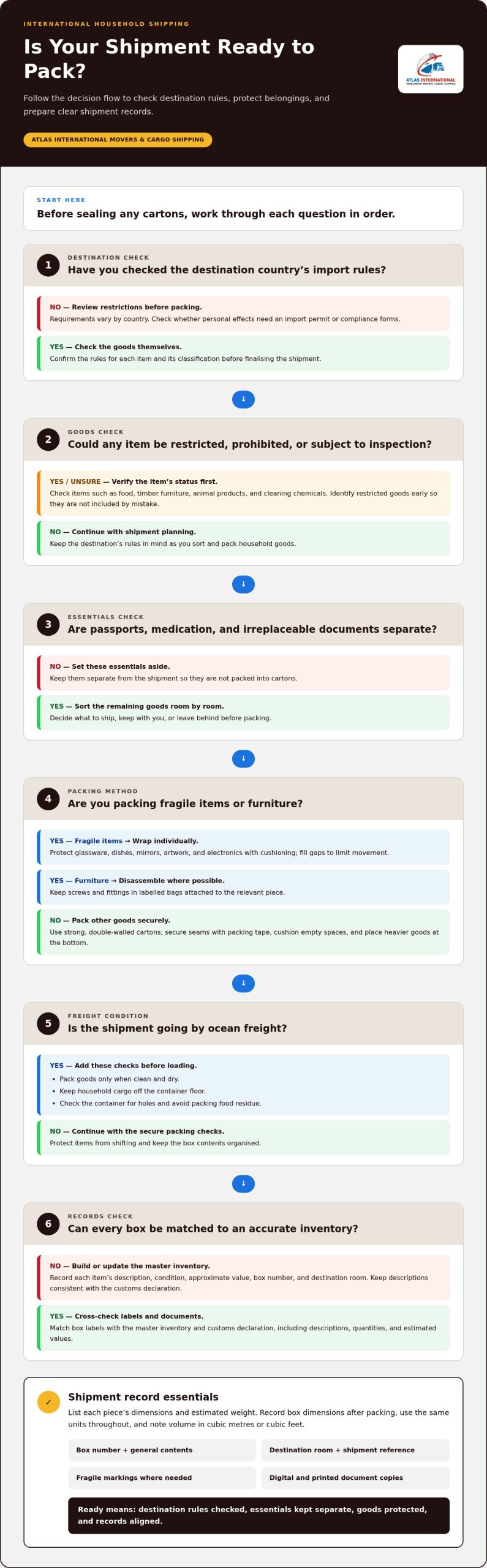
Start by sorting household goods into items to ship, keep with you, or leave behind. Check the route, destination requirements, and packing needs before sealing cartons. A common mistake is packing everything before identifying restricted goods or setting aside passports, medication, and irreplaceable documents. Keep essentials separate, and follow a room-by-room packing sequence to avoid rushed, unlabelled boxes.
-
Pack Boxes and Furniture Securely
Choose strong, double-walled cartons for international shipping and use packing tape to secure the seams. Wrap items individually, then fill empty spaces with cushioning so the contents cannot shift. Place heavier goods at the bottom and lighter items above them, and avoid making boxes too heavy to lift safely. Disassemble furniture where possible, and keep screws and fittings in labelled bags attached to the relevant piece.
-
Protect Fragile Items and Furniture
Wrap glassware, dishes, mirrors, artwork, and electronics separately before placing them in sturdy boxes. Add cushioning around each item and fill gaps to limit movement during transit. For ocean freight, pack goods only when they are clean and dry, and keep household cargo off the container floor to reduce exposure to condensation and humidity. Check the container for holes before loading, and avoid packing food residue that could attract pests.
-
Calculate Shipment Volume and Weight
Prepare a list of furniture and packed goods, including each piece’s dimensions and estimated weight. International movers assess shipment volume by measuring each piece of furniture and adding the volumes together. Volume may be recorded in cubic metres or cubic feet. Estimate weight by weighing or assessing the listed items, then adding their weights. Include bulky pieces and filled cartons, since overlooking either can distort the shipment estimate.
Record box dimensions after packing, not just before. Cushioning can expand a box, and irregular furniture can affect the total space required. Use the same units throughout your list, and flag unusually heavy or delicate pieces for careful handling.
Label each box with a box number, general contents, destination room, any needed fragile markings, and an owner or shipment reference. For high-value items, consider additional insurance, secure cases, valuation records, photographs, serial-number records, and purchase receipts.
Preparing customs paperwork and checking import restrictions
Before household goods leave the UAE, prepare accurate shipment records and review the destination country’s import rules. Customs requirements differ by country, so follow the destination’s rules rather than assuming the same process applies everywhere.
-
Prepare Customs Declarations and Documents
Start with an itemised inventory describing each household item and its estimated value. Gather personal identification, invoices, import permits, and compliance forms if the destination requires them. Use consistent descriptions across the inventory and customs declaration. For example, write “wooden dining table” instead of “furniture.” Incorrect descriptions, missing documents, or mismatched values can complicate customs clearance.
Keep digital and printed copies of the inventory and supporting records. Match each document to the same shipment reference, and update the inventory if packing changes the box count. An itemised record prepared during packing can support the customs declaration and help document an insurance claim.
-
Check Import Restrictions and Regulations
Review the destination country’s customs regulations before packing or shipping goods. Check whether food, timber furniture, animal products, or cleaning chemicals are restricted, prohibited, or subject to biosecurity inspection. Requirements vary by destination, and an item accepted in one country may need special handling elsewhere. Identify restricted goods early so they aren’t included in the shipment by mistake.
Also check whether personal effects require an import permit or other compliance forms. Restrictions and documentation requirements can depend on the item and its classification. Incomplete paperwork or prohibited materials can hold up clearance, so compare the inventory with the destination’s import rules before finalising the shipment.
-
Account for Customs Duty and Taxes
Find out how the destination country treats used household goods before estimating import charges. Used goods are often not subject to customs duty, but eligibility and possible charges depend on that country’s regulations. Customs duty is a tax levied by the destination’s customs authority and is usually based on the goods’ value.
Do not assume a used item automatically qualifies for duty-free import. Ownership history, residency conditions, declarations, and supporting evidence can affect the destination’s assessment. Import duties and VAT rules differ between countries, so identify the requirements for your route before dispatch. Keep purchase receipts or other value records available when required.
-
Organise Records for Clearance
Before the shipment is collected, compare every box label with the master inventory and customs declaration. Confirm that descriptions, quantities, and estimated values agree across the documents. If an item is omitted, added, or repacked, revise the records before submission rather than relying on memory during clearance.
Keep identification and original documents accessible while the shipment is in transit. A well-organised set of documents helps answer customs questions about ownership, contents, and declared value. Store copies separately from the shipped cartons, so a missing or delayed box doesn’t also take away the paperwork needed to identify its contents.
Choosing international movers and shipping methods
Choose a shipping method by matching shipment volume, urgency, route, packing needs, and customs requirements. Packing yourself can suit a manageable shipment if you have time. Professional packing is useful for bulky furniture, fragile goods, or a complex inventory.
- Assess what the international move includes before comparing freight options. Prepare an inventory and estimate the shipment’s volume and weight, noting fragile or unusually bulky items. A 20ft container can roughly suit the belongings of a one- to two-bedroom apartment, while a 40ft container can roughly suit a three- to four-bedroom home. These are planning guides, not substitutes for measuring your actual goods.
Also identify the route, required delivery timing, packing support, customs requirements, and pickup and delivery arrangements. Comparing methods without these details can lead to a poor fit between the shipment size and transport plan.
- Match air or sea freight to the shipment’s urgency and size. Sea freight is commonly used for a full household, with either a Full Container Load using an exclusive container or a Less than Container Load sharing space with other shipments. LCL charges are based on cubic metres, and other cargo may be handled alongside yours during transport and loading.
Air freight suits a few urgent personal items, but it has practical weight and volume limits. Consider which belongings need to arrive sooner, then decide whether they justify a separate air shipment. For a large household shipment, compare the space and handling needs before selecting container freight.
- Review the written quotation and service agreement line by line before booking. Confirm the goods included, approximate volume and weight, transport method, packing arrangements, and pickup and delivery details. Check which charges and services are included or excluded, including possible surcharges, storage, inspections, and destination handling.
Read the customs and insurance provisions alongside the transport details. A low headline quote alone doesn’t show whether the shipment’s actual requirements are covered. Clear records of scope, charges, and responsibilities help you compare options on the same basis.
- Choose valuation coverage after documenting the goods and their value. Compare the insured value, coverage limits, exclusions, deductible, claims process, reporting deadline, and required supporting documents. Standard carrier liability may be limited and may not reflect the replacement value of household belongings, so review its terms separately from any valuation option.
Keep receipts, photographs, and serial-number records for higher-value electronics or artwork. These records help identify items and support a claim. Include fragile pieces in the inventory, and note their condition before packing so the shipment records are useful if damage occurs.
Selecting moving supplies
Choose supplies to suit the goods, handling requirements, and container journey. Use this sequence to build a practical packing list and avoid buying materials that don’t suit the shipment.
-
Select Packing Materials
Gather strong corrugated boxes, packing tape, cushioning, labels, and markers before packing begins. Match protection to each item: use anti-static bubble wrap for electronics without original packaging, and cushioning for glass or decorative pieces. Keep cleaning supplies separate from household goods to contain spills. Plan enough material to wrap each fragile item individually and prevent contact with neighbouring contents.
-
Choose Moving Cartons
Select double-walled cartons for household goods travelling internationally. Inspect each box for dampness, crushed corners, or weakened seams before filling it. Choose a carton size that suits its contents rather than filling a large box with dense items that become difficult to handle. Leave space for cushioning, but fill gaps so the contents don’t shift during transit.
- Set aside labels and markers for a consistent carton system. Mark every box with its number, general contents, destination room, and any fragile handling note. Add an owner or shipment reference where needed. For example, “Kitchen, glassware, box 4” is more useful during delivery than a label reading only “miscellaneous.” Keep labels visible after cartons are stacked.
- Plan supply quantities around the inventory and packing sequence. Count fragile pieces, electronics, and furniture components first, then estimate cartons and cushioning for each group. Keep tape, markers, and spare labels within reach while packing. A missing label or last-minute carton change can create mismatches between the physical shipment and its documents.
- Build material planning into your moving logistics early. People planning an international move should begin researching moving companies 3-4 months before departure and obtain at least three quotes when hiring one. Compare the written scope for packing support, shipment handling, insurance details, customs requirements, and container arrangements. Use those details to determine which supplies you need to source and which packing tasks are included.
- Keep a small supply reserve for unexpected changes, such as a carton that splits or an item needing extra cushioning. Store materials in a dry, accessible place, away from cleaning liquids. Before sealing each box, check its condition, contents, label, and inventory entry. This final review helps keep packing records aligned with the goods prepared for shipment.
Household goods inventories and paperwork
Number every box, then record its contents, condition, approximate value, and destination room on a master list. Use the same box number on the carton and inventory so each item can be identified during handling, customs clearance, and delivery.
- Create the inventory as you pack, not from memory afterward. Give each box a unique number and describe its contents clearly, such as “Box 12: two ceramic lamps.” For individual furniture pieces or valuable belongings, record the item separately. Add quantity, condition, approximate value, and destination room so the record remains useful during shipment and arrival.
- Write a matching label on each carton with its number, general contents, destination room, and shipment reference. Add a fragile marking where appropriate, but keep the written description accurate. For example, “Box 12, ceramic lamps, living room” should match the master list exactly. Avoid vague labels like “miscellaneous,” which make identification and unpacking harder.
- Record the condition of valuable or delicate belongings before packing. Note existing marks on furniture, and photograph items such as artwork, electronics, or a dining table. Keep purchase receipts and serial-number records for high-value goods where available. These records can help establish an item’s identity and condition if damage occurs or a claim needs review.
- Keep the inventory aligned with customs and shipping documents. Update quantities and descriptions when a box is added, removed, or repacked, then compare the final list against the cartons. An itemised inventory can support a customs declaration and insurance claim. Declared values also provide a record for customs assessment, where duties depend on destination-country rules.
- Retain your copy and record shipment identifiers during loading. Keep the third copy of the household-goods inventory. Note the container and seal numbers, then report them to your shipping contact. When the goods arrive, compare the delivered boxes with the master list and note missing cartons, torn packaging, crushed boxes, water exposure, or visible damage.
For help coordinating an international household move, arrange international moving support as you organise your inventory and shipment records.
Use the master list as your reference when reviewing the packed shipment. For international household shipping, number every box and record its contents on the list. Check that the box number and contents stay associated through any packing changes, and keep the record easy to consult alongside the shipment paperwork. If a description changes, revise the matching entry rather than keeping competing versions. This ties the record to the goods being shipped, not an earlier packing plan.
At loading, add the container and seal details to the shipment record while they are available. Record the numbers and report them to your shipping contact. Keep the entry legible and with the inventory so you can find the relevant information without relying on memory. Before the shipment leaves, review the list and loading details together, resolving any mismatch between the inventory and the shipment record. This gives you a consistent reference for following up with your shipping contact or checking the delivery against the inventory.
Atlas International Movers & Cargo Shipping: International Moving
Atlas International Movers & Cargo Shipping supports households planning an international move from the UAE. Once your inventory is prepared and you’re weighing shipment size, timing, and route, our team can help you consider international moving alongside air or sea cargo options.
Sea cargo can suit larger household shipments, while air cargo can be considered for selected items with tighter timing needs. The right approach depends on your belongings, shipment volume, destination, and delivery priorities. Organised records and a clear understanding of what you’re sending help guide the logistics and keep planning focused.
For a move within the UAE, domestic moving is another relevant option. To discuss your shipment and next steps, contact Atlas International Movers & Cargo Shipping.
Move Forward with a Clear Plan
Planning how to pack household goods for international shipping is also a chance to decide what travels, how it moves, and what support will help you manage the transition. Once those decisions are clear, you can focus on preparing for life at your destination instead of coordinating every shipment detail alone.
Atlas International Movers & Cargo Shipping offers international moving and domestic moving, with air cargo for shipments suited to air transport. Whether you’re relocating abroad or within the UAE, our team can help you consider the moving option that fits your plans. The next step is to discuss your move and its practical requirements with us.
Contact Atlas International Movers & Cargo Shipping to talk through your plans. With a clear next step, you can approach the move with greater confidence and look ahead to settling in.
Frequently Asked Questions
What packing materials are best for international household moves?
Choose materials based on each item’s needs: sturdy double-walled cartons for general household goods, cushioning for breakable objects, and anti-static bubble wrap for electronics without original packaging. Keep packing tape, labels, and permanent markers close at hand. For example, use a small carton for heavier books and a larger one for light linens. Don’t use damp, crushed, or weakened boxes for a long journey.
What items are prohibited or restricted in international household shipments?
Restrictions depend on the destination country and the goods involved. Food, timber furniture, animal products, and some cleaning chemicals may be restricted, prohibited, or subject to inspection. Before packing, separate items whose contents or materials could raise import concerns, such as a timber ornament or a partly used cleaning product. Describe each item accurately in your inventory, then exclude goods the destination’s rules don’t permit.
What customs forms and packing lists are required for household goods imports?
Common shipment records include an itemised inventory and customs declaration. Personal identification, invoices, permits, or proof of prior residence may also be required, depending on the destination. Keep a working copy of the inventory and update it whenever contents change. Use consistent descriptions and values across forms, so an item listed as a table doesn’t appear under a conflicting description elsewhere.
What packing rules apply to international household shipments to the UAE?
For a shipment entering the UAE, prepare a clear inventory and declare the goods accurately. Import requirements depend on the items and applicable rules. Packing a product securely doesn’t make it eligible for import. Keep an itemised description of the contents and set aside goods that may face restrictions for review before dispatch. Don’t assume one packing checklist covers every household shipment or item category entering the UAE.