

For commercial goods transport from the UAE to Kuwait, road freight can be a cost-conscious option for heavy or bulky shipments when air freight’s speed is not essential. The route passes through Saudi Arabia, and the total cost depends on cargo weight and volume, pickup and delivery locations, handling, and transport method.
Compare more than the headline price. Delivery schedule, shipment size, tracking and included services all affect which option suits your business. Land transport may fit a shipment that is not urgent, while time-sensitive goods may call for a faster method.
This guide compares road, air and sea freight, explains what can affect costs, and shows how cargo type and shipment size shape your options. It also covers tracking, flexibility and door-to-door service to help you plan the shipment from collection through delivery.
Key Takeaways
- Road freight to Kuwait travels through Saudi Arabia, so accurate shipment documents and border processing are important to the schedule.
- Compare road, air and sea options by urgency and cargo size: land can suit heavy or bulky goods, while air is faster and sea can suit larger consignments.
- Weight, volume, pickup and delivery locations, handling and transport method all influence a freight quote. Clear package dimensions help identify a suitable option.
- Door-to-door service can bring pickup, export paperwork, transit and final delivery into one coordinated shipment plan.
- Learn what shipment details to prepare so you can compare service options and plan the move with greater clarity.
Why Choose Land Transport for Dubai-Kuwait Shipping?
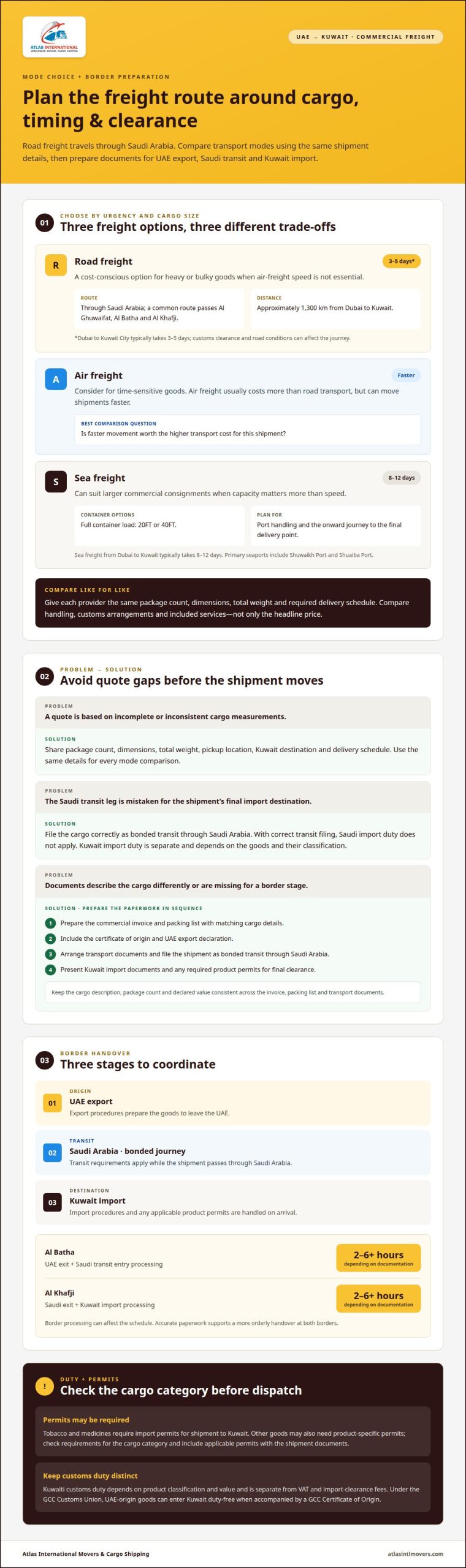
For commercial goods transport from the UAE to Kuwait, road freight suits heavy or bulky consignments. Kuwait has no direct land border with the UAE, so trucks travel through Saudi Arabia. Road transit times can vary with customs clearance and road conditions. This route can suit businesses prioritising cargo capacity over air-freight speed.
Saudi Arabia is a transit country on this route, not the shipment’s final destination. Cargo must be filed correctly as bonded transit through Saudi Arabia. With the correct transit filing, Saudi import duty does not apply. Kuwaiti import duty applies at the final destination, depending on the goods and their classification.
Tobacco and medicines require import permits for shipment to Kuwait, and other goods may also need product-specific permits. Check the requirements for the cargo category before dispatch and include any applicable permits with the shipment documents. This helps keep the declared goods consistent across transit and Kuwait import clearance.
Kuwaiti customs duties are charged separately and depend on the product classification and value. Under the GCC Customs Union, UAE-origin goods can enter Kuwait duty-free when accompanied by a GCC Certificate of Origin. Keep customs duty distinct from VAT and import-clearance fees: duty depends on classification and value.
Cross-border documents commonly include a commercial invoice, packing list, certificate of origin, export declaration and transport documents. Kuwait import documents and product-specific permits may also be required. Keep the cargo description, package count and declared value consistent throughout. For example, if the invoice lists retail electronics, the packing list and transport documents should describe the same goods.
Customs coordination covers three stages: UAE export, Saudi transit and Kuwait import. UAE export procedures prepare the goods to leave the country. Saudi transit requirements apply during the bonded journey, followed by Kuwait import procedures on arrival. Each stage requires documents relevant to that border and the shipment’s declared purpose.
- Prepare the commercial invoice and packing list with matching cargo details.
- Include the certificate of origin and UAE export declaration.
- Arrange transport documents and file the cargo as bonded transit through Saudi Arabia.
- Present Kuwait import documentation and any required product permits for final clearance.
Border processing can affect the schedule even when the road journey is planned. At Al Batha, UAE exit and Saudi transit entry processing can take 2-6+ hours, depending on documentation. At Al Khafji, Saudi exit and Kuwait import processing can also take 2-6+ hours. Accurate paperwork at both borders supports a more orderly handover between transit and import clearance.
Land transport costs compared with air and sea freight
Choose a transport mode by balancing delivery speed, shipment size and the full service scope. For UAE-to-Kuwait freight, the route, handling requirements and customs arrangements also affect the comparison.
Freight providers serving the UAE-to-Kuwait route may arrange road, air or sea transport. Compare options by transit time, cargo capacity, handling and the services included in each quote.
Land Freight Cost Comparisons
Road freight can suit heavy or bulky goods when air freight’s speed is unnecessary. Air freight usually costs more than road transport but can move time-sensitive shipments faster. Sea freight can suit larger commercial consignments when capacity matters more than speed. Compare quotes using cargo weight and volume, pickup location, Kuwait destination, customs and handling requirements.
For a useful comparison, provide the same shipment details for each transport mode: package count, dimensions, total weight and required delivery schedule. A quote based on incomplete measurements may not reflect the cargo’s actual space requirements. Compare the service scope as well as the transport method, rather than judging by mode alone.
Sea Freight Transit and Container Options
Sea freight from Dubai to Kuwait typically takes 8-12 days. Full container load shipments are available in 20FT or 40FT options. These container sizes can help businesses plan larger consignments around their cargo volume. Sea transport can make sense when delivery speed is less important than the space needed for commercial goods.
Kuwait’s primary seaports are Shuwaikh Port and Shuaiba Port. The destination port and final delivery point affect the shipment plan. When comparing sea freight with road transport, account for port handling and the onward journey. A larger consignment may benefit from container capacity, while a smaller or urgent shipment may suit another mode.
Road Routes and Transit Times
UAE-to-Kuwait road freight travels through Saudi Arabia because the two countries share no direct land border. A common route passes through Al Ghuwaifat, Al Batha and Al Khafji before entering Kuwait. The road journey from Dubai to Kuwait spans approximately 1,300 kilometers. The route also passes through Abu Dhabi before reaching Saudi Arabia.
Road cargo from Dubai to Kuwait City typically takes 3 to 5 days. Customs clearance and road conditions can affect journey time. Use the destination city and required schedule when comparing freight options. A route estimate describes transit, while the full shipment plan also needs to account for border processing.
Road Freight Services and Cargo Suitability
Road freight can carry commercial cargo, household goods, machinery, furniture, electronics and industrial equipment. Kuwait-bound shipments may travel as full truckloads or less-than-truckload consignments. A full truckload uses dedicated truck capacity, while less-than-truckload shipping shares space with other consignments.
To find an efficient option, record accurate dimensions and weight for every package. Then compare the shipment’s volume with its delivery schedule and destination. For example, machinery may need road capacity, while urgent spare parts may be better suited to faster air freight. Cargo type and urgency help guide the choice.
Cargo tracking and service flexibility
Shipment tracking is more useful when its milestones are clear. For UAE-to-Kuwait logistics, record collection, departure, border processing, arrival and final delivery. Match each update to the shipment reference and transport documents. This creates a practical timeline without assuming that every freight service uses the same tracking system.
Create a simple shipment record before dispatch, including the cargo description, package count, destination and planned transport mode. Update it as the consignment moves through each stage. If a retail order contains several cartons, list each against the same shipment reference. Receiving teams can then compare the delivery with the packing list.
- Log the UAE collection and dispatch details.
- Record border and transit milestones for the Saudi Arabia leg.
- Note arrival at the Kuwait destination or seaport.
Flexibility also means matching the shipment arrangement to cargo volume and timing. Full truckloads and less-than-truckload consignments suit different loads. Air freight can suit urgent commercial goods, while sea freight can accommodate larger consignments. Accurate weight, dimensions and package counts help logistics teams assess the appropriate arrangement.
Commercial and industrial cargo may include machinery, electronics, furniture, spare parts and product samples. Household goods also travel on UAE-to-Kuwait routes. Cargo type affects handling and scheduling: spare parts may have a tighter delivery requirement than furniture for a planned fit-out. Describe the contents clearly for transport and import records.
Plan project cargo around the actual items, not just a general cargo label. List each item’s dimensions, weight, quantity and delivery location. For machinery or industrial equipment, these details help determine whether road, air or sea transport fits the shipment. Charter transport is a separate consideration for unusual project requirements; the route, cargo profile and schedule shape that decision.
Kuwait’s primary seaports are Shuwaikh Port and Shuaiba Port. For sea shipments, identify the intended port and final delivery point in the logistics plan. Port arrival is a milestone, not delivery to the consignee. Keep the cargo reference consistent across shipping documents and receiving records to support a clear handover after import handling.
For flexible freight planning, prepare one shipment brief with the cargo type, package count, dimensions, weight, pickup and destination. Include the preferred transport mode and required delivery schedule. A complete brief makes road, air and sea options easier to compare, while clear milestone records help teams follow the consignment through each stage.
Commercial, industrial, and personal shipments
Plan UAE-to-Kuwait road freight by defining the cargo, route, schedule and clearance documents. Provide pickup and delivery locations, cargo type, package count, total weight, dimensions, preferred method and required delivery date.
Shipment Types Served
Commercial and industrial shipments may include machinery, electronics, spare parts, furniture and product samples. Personal consignments may include household goods. Cargo details affect handling: machinery dimensions inform loading plans, while fragile electronics need suitable protective packing. Separate cargo categories in the inventory so shipment documents clearly describe the contents.
For mixed shipments, list each item or package group separately. For example, a consignment containing retail stock and industrial equipment should show both categories and their package counts. Accurate details help match handling to the cargo and make the import description clear at the destination.
Shipment Planning and Delivery
Begin with the pickup location, Kuwait destination and required delivery schedule. These details help determine whether road transport suits the shipment’s timing and route. Add the cargo type, package count, weight and dimensions to the shipment brief. For a delivery from Dubai to Kuwait, include the receiving location, not just the country.
Next, align transport planning with the required customs documents. The shipment may involve UAE export procedures, Saudi transit and Kuwait import clearance. Keep the invoice, packing list and transport details consistent. For example, if retail goods are needed for a store opening, factor the delivery date into planning for border processing.
Packing and Cargo Handling
Choose packing to suit the cargo’s material, size and handling needs. Protect electronics from movement inside their packages, and identify machinery components clearly. Make sure the package count matches the packing list, then label each unit so receiving staff can reconcile the delivery. Clear descriptions also help distinguish fragile goods from heavier items during handling.
For shipment visibility, record milestones such as collection, dispatch, border movement and arrival. GPS tracking can show a vehicle’s position along the route; customs clearance is a separate milestone. Keep the shipment reference consistent across tracking updates and delivery records so logistics teams and receiving staff share a clear view of progress.
Pricing by Weight and Volume
Freight quotes depend on the shipment. Key factors include weight, volume, pickup and destination, transport method, customs and handling. Weight alone may not show how much space cargo occupies. Include each package’s dimensions and total weight when requesting a quote.
Road, air and sea freight use different transport arrangements, so compare quotes against the same cargo details and delivery schedule. A compact, heavy machinery part and a large, lightweight furniture package, for example, have different weight and volume profiles. Accurate measurements help assess the shipment and select an option suited to the cargo and destination.
Door-to-door shipping from the UAE to Kuwait
A door-to-door shipment connects pickup in the UAE with delivery to a named address in Kuwait. Depending on the service scope, it may include packing, export documents, customs clearance, transit transport, Kuwait import procedures and final delivery. Define each handover before dispatch so pickup, border processing and delivery are planned as one shipment.
Start with the collection address and exact destination, such as a warehouse in Kuwait City or a business location elsewhere in Kuwait. Then describe the goods, package count, total weight and dimensions. These details help determine the transport mode and handling needs. Smaller consignments may share transport space, while larger shipments may need a different arrangement.
Packing is an important part of the plan, especially when goods pass through several handling stages. Prepare an itemised packing list and ensure package labels match it. For example, clearly identify boxed electronics and machinery parts as separate groups. This supports handling at collection, during transit and at the receiving address.
Documents connect UAE export with Saudi transit and Kuwait import clearance. Common documents include a commercial invoice, packing list, certificate of origin, export declaration and transport documents. Product-specific permits may also apply. Keep cargo descriptions consistent across the paperwork and include the documents required for the goods and destination.
Compare door-to-door plans by what they include, not just by transport mode. Establish whether the scope covers pickup, packing, export paperwork, customs clearance, transit, Kuwait import procedures and delivery. Quotes depend on the shipment; key factors include cargo weight and volume, locations, transport method, customs and handling.
International shipping involves coordinating several stages, while the shipper prepares accurate cargo details and documents. A practical request should state pickup and delivery locations, cargo type, package count, dimensions, weight, preferred method and required schedule. This gives the transport plan a clear starting point and makes comparisons more useful.
To plan the next step, prepare the shipment details, destination and preferred delivery schedule for your UAE-to-Kuwait freight.
Atlas International Movers & Cargo Shipping: International Moving
Atlas International Movers & Cargo Shipping coordinates international moving and cargo services for goods and belongings travelling across borders. When timing or cargo size shapes the decision, our Air Cargo and Sea Cargo services offer different transport options.
Share the pickup and destination details, cargo description, package count, dimensions, weight and preferred schedule. This information helps shape the shipment plan and identify the transport option that best fits the consignment. For international moves, clear preparation supports an organized transition and helps belongings travel safely and securely.
If you’re planning a shipment or move from the UAE to Kuwait, contact Atlas International Movers & Cargo Shipping to discuss your requirements.
Set Your Shipment in Motion with a Clear Plan
Turn your transport decision into a workable shipment brief by gathering the cargo description, package measurements, collection and delivery locations, preferred schedule and any documents already prepared. A clear brief gives planning a practical starting point and helps align the transport option with your business priorities. For commercial goods transport from the UAE to Kuwait, consider how the shipment fits your wider operations, including stock replenishment, project deadlines or a planned move.
Atlas International Movers & Cargo Shipping provides international and domestic moving, as well as air and sea cargo services. If your requirements extend beyond one consignment, consider how transport planning can support the wider transition. Our team can help you plan a shipment around your cargo and destination.
Contact Atlas International Movers & Cargo Shipping to discuss your transport requirements and move forward with a clear plan.
Frequently Asked Questions
Can you ship directly from Dubai to Kuwait without going through Saudi Arabia?
No. UAE-to-Kuwait road freight normally passes through Saudi Arabia because Kuwait does not share a direct land border with the UAE. The truck crosses Saudi territory in transit before entering Kuwait for import procedures. For example, a road shipment collected in Dubai must account for both the transit leg and Kuwait entry when planning its route and delivery schedule.
How is the price for a Kuwait shipment calculated?
A shipment quote considers cargo weight and volume, including volumetric weight, as well as pickup location, Kuwait destination, transport method, customs and handling. Provide package dimensions and actual weights, not just the total carton count. A light but bulky consignment, for example, may occupy more space than its weight suggests, affecting the transport option and quote.
How long does road freight take from Dubai to Kuwait?
Road freight from Dubai to Kuwait typically takes 4 to 6 days, subject to customs clearance and road conditions. This is a transit estimate, not a fixed delivery appointment. For scheduling, allow the receiving team to coordinate around border processing and destination handover. A shipment needed for a planned store opening should be scheduled with its operational deadline in mind.
Is cargo insurance included in the price?
Cargo insurance for the Dubai-to-Kuwait route is quoted separately. Treat it as a distinct cost rather than assuming it is included in the freight charge. When reviewing a shipment quote, compare transport scope and insurance separately so the budget reflects both. For example, a business shipping valuable electronics may consider insurance as part of its planning.
How do I arrange shipping from the UAE to Kuwait?
List the pickup and delivery locations, cargo type, package count, total weight, dimensions, preferred shipping method and delivery schedule. Prepare a commercial invoice and packing list, together with relevant origin, export and transport documents. For example, descriptions of retail stock should match across the inventory and paperwork. These details provide a clear basis for planning transport and import clearance.
Why is Kuwait more expensive or slower than shipping to Saudi Arabia?
A Kuwait-bound road shipment passes through Saudi Arabia in transit before proceeding to Kuwait for import procedures. A shipment destined for Saudi Arabia ends there, so the route and border stages differ. The final quote also depends on cargo, pickup and delivery locations, transport method, customs and handling. Compare the full route and service scope rather than assuming every Kuwait shipment costs more or takes longer.
What are the main commercial freight options from the UAE to Kuwait: road, air, and sea?
Road, air and sea freight are the main options, and each suits different priorities. Road can carry heavy or bulky cargo; air is useful for urgent goods; sea can suit larger consignments where volume matters more than speed. Air shipments from the UAE to Kuwait have a stated transit time of 1-3 working days, while sea shipments from Dubai typically take 8-12 days.
How much does commercial goods transport from the UAE to Kuwait cost by road, air, and sea?
There is no single price for every road, air or sea shipment. The quote depends on the shipment details and is provided after a request. Key factors include cargo weight and volume, pickup location, Kuwait destination, transport method, customs and handling. To compare options, submit the same cargo details and delivery schedule for each transport mode.