

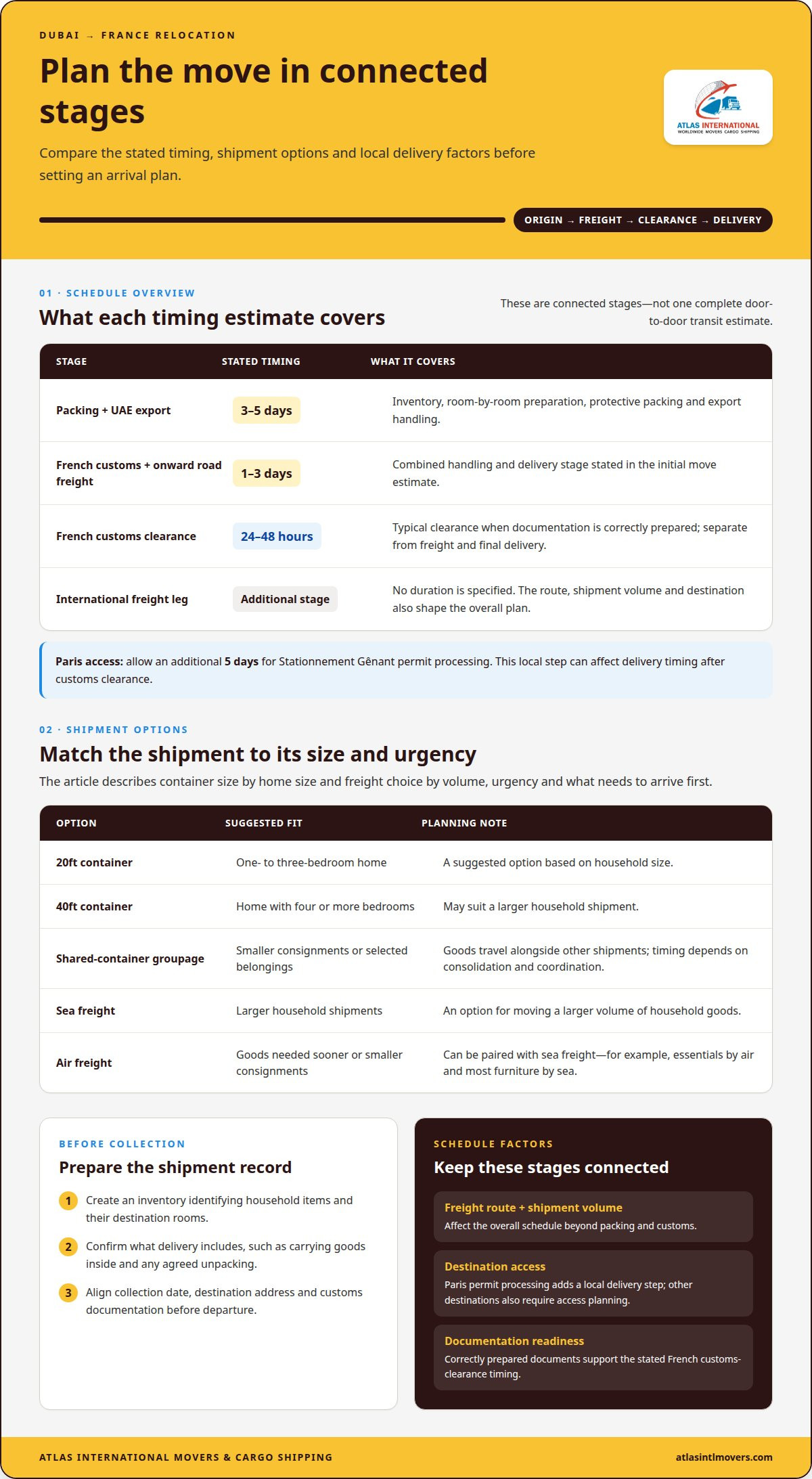
A move from Dubai to France unfolds in stages: allow 3-5 days for packing and UAE export, then 1-3 days for French customs clearance and onward road freight to your address. These figures cover handling and delivery stages, while the full schedule also depends on the international freight leg. When moving from the UAE to France, customs preparation can be just as important as transit timing.
When moving from the UAE to France, it’s natural to want a clear arrival date and a straightforward delivery process. You’ll learn how door-to-door relocation works, what affects the schedule, and when personal belongings may qualify for customs-duty and tax relief. Eligible household goods generally need to have been used privately for at least six months, and the transfer of your main residence must meet the applicable conditions.
We’ll also explain France’s Transfert de Résidence exemption and why submitting the Certificat de Changement de Résidence on time matters. Understanding the timeline, delivery steps and customs requirements can help you plan your move with greater confidence.
Key Takeaways
- Plan the move as connected stages, from origin packing and freight to customs clearance and final delivery.
- For Paris, account for local parking-permit arrangements when planning access and delivery timing.
- Use your household size and shipment volume to understand which container option may suit your move.
- Learn how residence history and the use of your belongings affect eligibility for customs relief.
- See how the Certificat de Changement de Résidence fits into customs paperwork and import VAT treatment.
How long does it take to move from Dubai to France?
Allow 3-5 days for packing and UAE export, followed by 1-3 days for French customs clearance and onward road freight to your address. These are separate stages, not a complete door-to-door schedule: the international freight leg, shipment volume and delivery location also shape the overall plan. A freight consultation can help map those stages around your preferred arrival window.
Export packing starts with an inventory and room-by-room preparation. Items are wrapped, protected and labelled for identification at delivery. Fragile crockery, furniture and boxed personal effects need different handling, while clear labels help direct cartons to the right rooms. If unpacking is part of the agreed service, the delivery team can place items in their designated spaces after arrival. Confirm the unpacking tasks included in your moving plan before scheduling the move.
Shipment size affects the shipping option. A 20ft container is suggested for a one- to three-bedroom home, while a home with four or more bedrooms may suit a 40ft container. Smaller consignments can use shared-container groupage, where household goods travel alongside other shipments. Groupage can suit people sending selected belongings rather than a full household, though its schedule depends on consolidation and coordination.
Sea freight is an option for larger household shipments, while air freight can suit goods needed sooner or smaller consignments. The choice depends on volume, urgency and what must be available first. For example, a family might send most furniture by sea and arrange a smaller air shipment for essentials. For a planned international relocation, international moving arrangements connect export preparation with transport and destination delivery.
After arrival, practical tasks begin alongside unpacking. To register for healthcare and social security, start the relevant application with France’s health insurance system and prepare identity, residence and employment documents relevant to your circumstances. This administrative step is separate from shipment customs clearance, so plan for it as part of settling in.
For a French bank account, prepare identity and address documents, then arrange an appointment or apply online with your chosen bank. Phone plans and utilities are usually set up with the provider serving your new address, so keep proof of identity and occupancy available. These steps help you establish essential services after arrival.
For a dog or cat, an EU-format health certificate must be issued by an officially authorised UAE government veterinarian within 10 days of travel; France does not require quarantine for pets that meet EU import requirements. A car needs its own transport and import planning, separate from household goods, with paperwork and delivery arranged around the vehicle’s destination and registration process.
Families relocating from the UAE can compare public, private and international schools near their French address. A French national returning from the UAE may also need to plan for school enrolment and income tax administration. Choosing a school near home or work can simplify daily travel, especially in a city centre.
Door-to-door relocation from Dubai and Abu Dhabi to France
A door-to-door move connects collection at your UAE home with delivery to a French address. The schedule depends on the freight route, customs processing and access at the destination.
Door-to-Door Service
The process brings together home collection, export packing, international transport, customs documentation and delivery. Before packing, prepare an inventory that identifies household items and their destination rooms. This provides a clear record from collection through arrival.
Shipping Timelines
Timing involves more than the journey between the two countries. For a Dubai-to-France household move, French customs clearance is typically completed within 24-48 hours when documentation is correctly prepared. The freight leg and onward road delivery add separate stages, so use a planned sequence rather than treating customs time as the full transit estimate.
Paris deliveries require an additional 5 days for Stationnement Gênant permit processing. This local access step can affect the delivery date even after goods have cleared customs. For Marseille or another destination, address access and delivery arrangements also belong in the schedule. Keep your expected arrival date aligned with the customs and final-delivery plan.
Dubai and France Cost of Living
Compare household budgets by category, not by a single headline figure.
In France, housing costs differ between Paris, Marseille and smaller cities. Build a destination budget around rent, utilities, transport and household needs, then compare those categories with your current UAE spending. A city-centre address may affect both housing costs and delivery access. Keep relocation charges separate from ongoing living expenses.
Planning Delivery and Charges
Before the shipment leaves, align the collection date, destination address and customs documentation. Give the freight plan enough detail to connect export packing with arrival and final delivery. If your move includes office contents or employee transfers, a corporate relocation plan can help coordinate the timing and documentation across those requirements.
For household moves, list access details such as building entry, lift use and available unloading space. Share these details with the specialist arranging delivery. A careful plan helps account for customs, insurance paperwork and local access before the goods reach the address.
Customs-duty relief for personal belongings
Household goods may enter France without customs duty or import taxes when you transfer your main residence from outside the European Union. For a move from the UAE, eligibility depends on your residence history and how you used the belongings. Treat customs relief as a separate planning task alongside transport, delivery and arrival arrangements.
The residence condition is specific: you must have lived outside the EU for at least 12 months. Eligible personal and household belongings generally must also have been used privately for at least six months before the move. These are separate tests, so a long period living in the UAE does not by itself establish that every item meets the use requirement.
Make a clear inventory before packing. Identify items such as a sofa, dining table, kitchen equipment and clothing as household or personal effects, and record which belong to your move. Keep purchase or ownership records and other dated evidence of private use. Items bought shortly before departure may need particular attention because they may not meet the six-month use period.
Organize your residence timeline as well. Records showing when you lived in the UAE and when your main residence transfers to France can help explain the circumstances of the move. Keep these separate from documents for French healthcare registration or a residence permit, which relate to different parts of settling in. A French national returning from the UAE should also organize evidence relevant to their residence history.
Build customs preparation into the shipment schedule, rather than leaving it until after the goods arrive. Match the inventory to the belongings being transported, and keep supporting records accessible for customs formalities. If the move includes goods for several household members, identify each person’s belongings clearly instead of grouping everything under a vague description. This makes the shipment details easier to interpret.
Eligibility applies to qualifying personal and household belongings, not automatically to every item in a shipment. Keep new purchases separate from goods used privately, and describe the contents accurately. Key considerations include your time outside the EU, the transfer of your main residence and each item’s private-use history. These details help customs assess a request for relief.
Customs relief is separate from local registration or a delivery access permit. A move to a French city centre, for example, may require separate delivery arrangements after customs processing. Keep those logistics distinct from evidence supporting relief. Organizing the inventory, residence records and transport details before departure helps clarify each step.
France’s Transfer of Residence customs exemption
France’s Transfert de Résidence exemption can relieve qualifying used household goods from import VAT. The Certificat de Changement de Résidence, or CCR, is central to the customs process.
Relocation Document Requirements
Prepare the CCR for French customs before the household shipment arrives, or submit it when the goods reach the French port. The certificate supports a request to apply the residence-transfer exemption. Keep it with the shipment inventory and records explaining your move from the UAE to France.
For the visa application described in the relocation guidance, France requires at least €30,000 of insurance coverage for the entire Schengen region. Keep your passport and visa documents separate from customs paperwork, since they serve different purposes. An apartment lease or other residence record can help document the destination address and your transfer of residence.
Organize the shipment inventory so customs can identify household goods clearly. For example, list furniture, kitchen items and personal effects as separate entries instead of using broad labels. Keep supporting records accessible during transport. A clear file connects the CCR, inventory and shipment to the same household move.
Tax and Residency Rules
For French tax residence, the guidance identifies spending at least 183 days per year in France as a relevant threshold. According to the UAE Ministry of Finance, the UAE levies 0% personal income tax. Tax residence and customs relief are separate matters, so an income-tax position does not itself establish eligibility for the import exemption.
Qualifying used household goods moved from outside the EU may be exempt from French import VAT, or TVA, at 20%. The exemption is established under EU Regulation 1186/2009. It applies to qualifying goods transferred with a change of residence, rather than automatically covering every item in a shipment.
Timing is critical. French customs must receive the CCR before or when household goods arrive at the French port. If the certificate is submitted late, import VAT is assessed on the shipment’s full declared value and cannot be waived retroactively. Align submission with the shipment’s arrival plan, whether the destination is Paris, Marseille or another French city.
Keep the exemption documents consistent with the shipment inventory. If the declared contents include an apartment’s furniture and used household effects, describe those items clearly in the records. Separate newly acquired goods from belongings transferred with the household, and retain evidence supporting the move and the goods’ use history.
Plan the CCR alongside freight arrangements, not after arrival. Customs delays can affect when household goods are released for delivery. Coordinating the certificate, inventory and port arrival date gives customs the documents needed to assess the residence-transfer request during the import process.
Documents for relocating from UAE to France
Separate immigration paperwork from household-shipment documents before packing begins. Passports, visa application papers, insurance evidence and customs records serve different purposes. Keep them in clearly labelled folders to avoid confusing a travel document with a shipment document during the move.
For the visa application described in the relocation guidance, France requires at least €30,000 of insurance coverage for the entire Schengen region. Keep the insurance certificate with the application papers, alongside your passport and relevant identity records. The required documents can vary with the application type, so arrange the papers around the route you are applying under.
Prepare a household inventory describing the goods being transported. Use clear entries such as “dining table,” “books” and “kitchen utensils,” rather than one broad label. Keep ownership or purchase records that support the inventory, together with documents showing your UAE residence history and move to France. These records help explain the household transfer and the contents declared for shipment.
- Travel and identity: Keep your passport and visa application documents together.
- Insurance: Include the certificate showing the required Schengen-wide coverage.
- Shipment inventory: Describe furniture, personal effects and other household goods clearly.
- Residence evidence: Organize records that show your move from the UAE to France.
- Customs paperwork: Keep the CCR and supporting shipment documents with the inventory.
The Certificat de Changement de Résidence, or CCR, belongs in the customs file for a residence-transfer exemption. Keep its details aligned with the inventory and shipment information. Include the CCR in the customs file and coordinate its submission as part of the shipment process. Late submission can lead to import VAT being assessed on the full declared shipment value, without a retroactive waiver.
Make a working copy of each key document and store the originals securely. Keep digital copies accessible during travel, while making the customs file available to the person coordinating the shipment. If household goods belong to several family members, identify whose belongings appear in the inventory. This simple distinction makes the records easier to follow.
Review the documents before the shipment leaves the UAE. Match the inventory to the packed goods, group residence evidence together and keep the CCR ready for arrival. For a move involving an employer or transferring staff, coordinated relocation planning can connect the paperwork with the shipment arrangements.
Atlas International Movers & Cargo Shipping: International Moving
Atlas International Movers & Cargo Shipping supports international moves from the UAE, with freight options for different shipment sizes and schedules. Our team can help coordinate household relocation planning and explain whether sea cargo or air cargo better suits your belongings and priorities.
Sea cargo may suit larger household shipments, while air cargo can be an option for smaller consignments or items needed sooner. The right choice depends on your shipment, timing and destination arrangements. We coordinate transport details to help your belongings cross borders and arrive safely.
Preparing a move to France? Contact Atlas International Movers & Cargo Shipping to discuss your relocation and shipping requirements.
Turn your relocation plan into a clear next step
As you prepare to move from the UAE to France, bring your decisions together in one practical plan. Set out your preferred collection window, destination address, shipment priorities and the documents that need to travel with your household goods. This gives each part of the move a clear place in the sequence.
Consider what you’ll need immediately after arrival, then separate those essentials from belongings that can follow in the main shipment. Keep customs paperwork organized alongside the inventory, and make sure delivery arrangements reflect access conditions at your French address. A well-ordered plan can help you focus on settling in instead of reconstructing details during transit.
Atlas International Movers & Cargo Shipping can help turn your requirements into international moving arrangements, with transport planning shaped around your shipment and priorities. For a practical conversation about the next step, contact our team about your France relocation. A considered plan is a steady start to your new chapter.
Frequently Asked Questions
Do You Need a Visa When Relocating From the UAE to France?
Visa requirements depend on your nationality, purpose of stay and intended length of residence. Many non-EU, non-EEA and non-Swiss nationals need an appropriate long-stay visa to stay in France for more than 90 days. UAE residence alone doesn’t determine which visa applies. Before making travel arrangements, identify the visa route that matches your plans, such as employment, study or family residence. For UAE residents exploring European business or relocation pathways, 360globalimmigration.com provides guidance on eligible visa and residency programs.
What visa or residence permit do UAE citizens and residents need to move to France?
UAE citizens and residents should identify visa requirements based on passport nationality and the reason for moving. A UAE residence permit doesn’t replace the French visa or residence process for anyone who needs one. For a long-term move, choose the application route that matches your circumstances, such as work or study, and organize the supporting records. If your move involves securing an opportunity with a major international employer, consulting guides on Job Hunt Mode Blog can provide insight into hiring and interview stages. The appropriate category depends on the purpose and duration of the stay.
What are the customs rules for shipping personal belongings from the UAE to France?
Used household goods may qualify for customs-duty and tax relief when you transfer your main residence from outside the EU, subject to eligibility conditions. Keep newly purchased items separate from privately used belongings, and describe the shipment contents accurately. For example, list a recently purchased television separately from established household furniture. This helps distinguish items with different use histories during customs assessment.
What are the cost of living and rent in France compared with the UAE?
Costs vary by destination, housing choice and household needs, so compare budgets by category rather than assuming one country is universally cheaper. Set out rent, utilities, transport and everyday spending separately for your current UAE home and intended French destination. Paris, Marseille and smaller cities can differ in housing costs. A practical comparison uses the same household size and housing type for both places.
What should you know about schools, language, and settling in France?
Start by identifying schools near your intended home and asking about language of instruction, admissions timing and required records. French-language and international schools may suit different family needs. For example, a child joining a French-language classroom may benefit from language support. Plan everyday tasks, such as learning local transport routes and arranging essential services, around the neighbourhood where your family will live.