

The hardest part of an office move isn’t getting desks from one address to another; it’s coordinating every detail while keeping work on track. Turnkey office shifting services in the UAE bring planning, packing, transport, IT relocation, and setup into one coordinated process. A practical starting point is to begin planning at least 3-4 months ahead.
It’s understandable to want a clear plan: teams need to know what happens to furniture, equipment, files, and the systems they rely on every day. Turnkey office shifting services in the UAE can bring these tasks together, clarify responsibilities, and prepare the new workspace for a smoother transition.
This article explains how office move planning works, what packing and transport involve, and how IT equipment and sensitive files can be handled during relocation. You’ll also learn which details shape the schedule and how a coordinated approach can help reduce disruption and downtime, so your team can focus on keeping business moving.
Key Takeaways
- Map out IT equipment, servers, and sensitive files before the move so each item has a clear handling and relocation plan.
- Coordinate furniture dismantling, transport, and setup around the new office layout to support an orderly arrival.
- Use consistent labels and an inventory to make it easier to track packed items and direct them to the right work areas.
- Assign clear responsibilities for schedules, access, and move-day decisions to keep the relocation process organized.
- Compare the scope of office moving packages by the tasks they cover, from packing and transport to IT relocation and setup.
IT equipment, servers, and sensitive-file relocation
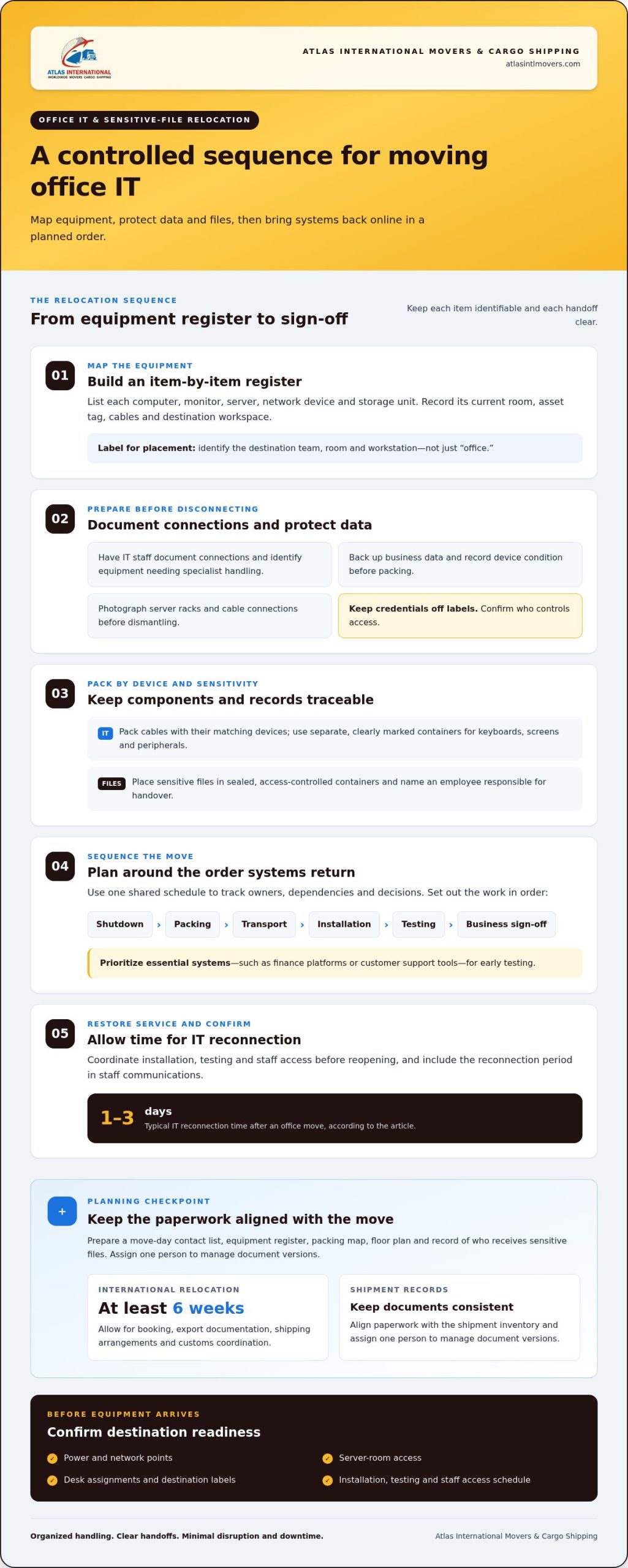
IT assets need their own relocation sequence, separate from desks and general cartons. Start with an equipment register covering each computer, monitor, server, network device, and storage unit. Record its current room, asset tag, cables, and destination workspace. For example, label a finance workstation with its department and assigned desk, not simply “office.” This makes placement clearer when teams unpack at the new site.
Before disconnecting equipment, have your IT staff document connections and identify items requiring specialist handling. Back up business data, confirm who controls access, and keep passwords or credentials off carton labels. Photograph server racks and cable connections before dismantling. Pack cables with their matching devices, and use separate, clearly marked containers for keyboards, screens, and peripherals. Keep sensitive files in sealed, access-controlled containers, with a named employee responsible for handover.
Build the relocation schedule around the order systems must return to service. The move plan should identify shutdown, packing, transport, installation, testing, and business sign-off. IT reconnection after an office move typically takes 1-3 days. Include that period in staff communications and identify essential systems, such as finance platforms or customer support tools, for early testing. A project coordinator can track owners, dependencies, and decisions in one shared schedule.
Prepare an administrative file alongside the physical inventory. Include the move-day contact list, equipment register, packing map, floor plan, and a record of who receives sensitive files. For international relocation, allow at least six weeks for booking, export documentation, shipping arrangements, and customs coordination. Keep paperwork aligned with the shipment inventory, and assign one person to manage document versions. This is especially useful when a UAE office move involves equipment crossing borders.
- Confirm the new office’s power, network points, server-room access, and desk assignments.
- Back up data and record device condition before packing.
- Mark each item with its destination team, room, and workstation.
- Separate sensitive files and assign a responsible handover contact.
- Schedule installation, testing, and staff access before reopening.
Optional services can change the relocation scope and overall cost. Key factors include equipment volume, access at both premises, packing requirements, transport distance, and whether storage or international shipping is needed. A move involving server racks and confidential archives needs different coordination from a small office with standard desks. Define these needs during planning so the schedule and quote reflect the inventory, handling, and setup work.
Packing, transport, furniture dismantling and setup
Office furniture and equipment need a clear route from the current workspace to their assigned positions. Plan packing, loading, transport, and setup around the floor plan, access points, and teams that need priority workstations. Coordinating these stages for an office and IT relocation helps limit disruption and downtime.
Furniture Disassembly and Installation
Before dismantling a desk, cabinet, or meeting table, identify its destination and record how its parts fit together. Keep fasteners and fittings with the matching item, and protect surfaces for transport. At the new office, movers can follow the floor plan to install furniture in the correct rooms. Include assembly and placement in the work scope so arrival tasks are clear.
Furniture Reconfiguration and Assembly
A new setting may call for a different layout from the old office. Mark desk positions, shared tables, and storage areas on the destination plan before transport begins. For example, assign a meeting table to a conference room and modular desks to team areas. Tell movers which furniture needs reconfiguration, not just reassembly, to avoid unnecessary handling after delivery.
Packing should match each item and its destination. Wrap desk surfaces and cabinet doors to reduce scuffs, and group small accessories with their related furniture. Mark cartons clearly by department and room, such as “Accounts, storage area.” Keep fragile belongings separate from heavy items. A written inventory helps the office lead identify missing pieces and direct unpacking without opening every carton.
Organize loading according to the delivery sequence. Items needed first at the destination should be accessible, while furniture assigned to later setup can be loaded accordingly. Confirm collection and delivery access, lift arrangements, and the route between premises before move day. For moves within the UAE, distance and building access affect the practical schedule. International shipments also need packing and transport plans suited to their route.
At the destination, follow a room-by-room setup sequence. Place large office furniture first, then assemble smaller items and position equipment according to the layout. Check that cabinets open freely and desks leave clear walkways. A team representative can compare each room with the floor plan and flag adjustments before staff return to their workstations.
Separate furniture that won’t be reused from items moving to the new office. Identify suitable pieces for reuse, donation, or recycling before packing begins, and keep them apart from the relocation inventory. This reduces confusion during loading and helps the business decide what to do with unwanted furniture. State which items stay, travel, or leave the premises in the move plan.
For a coordinated move, explore corporate relocation planning alongside the office layout and transport requirements.
Packing, labeling, inventory tracking, and unpacking
Use a packing plan that links each carton and asset to its destination room, so teams can unpack by priority. Before hiring office movers, review the insurance policy’s covered items, exclusions, valuation basis, claim steps, and any deductible; confirm how those terms apply to the business inventory.
Packing Materials and Transit Protection
Match packing materials to each item’s shape and handling needs. Use protective wrapping for monitor screens, corner guards for desks, and sturdy cartons for stationery or small equipment. Mark fragile items clearly and keep heavier items in manageable containers. Ask for the packing scope to specify materials, who packs, and how items are protected during loading and transport, rather than relying on a general “packing included” description.
Secure Asset Handling and Inventory
Create one inventory before packing begins, then assign each item a label with its department and destination room. For example, “Sales, Room A” is more useful than “Box 12” during unpacking. Record high-value equipment by asset tag and note its condition. A designated employee can oversee access to confidential records and reconcile the inventory at collection and delivery.
Transport and Unpacking Services
Plan transport around the order in which items must be placed at the new office. Load priority workstations and essential supplies for accessible delivery, then direct each carton to its labeled room. Define whether unpacking includes removing materials and placing items on desks. A handyman may be needed for tasks outside the moving team’s agreed scope, such as minor adjustments to fixtures.
A consistent packing sequence can reduce disruption on move day. Start with non-essential supplies, archive materials, and spare furniture; keep daily-use items available until the agreed packing time. Separate cartons by department, and use the same room names on the inventory and floor plan. This gives staff a clear route from delivery to workstation.
- Photograph delicate equipment before wrapping it.
- Keep an inventory copy with the move coordinator.
- Mark cartons with destination room and handling instructions.
- Set aside essential items for first-day access.
On delivery, compare the inventory against the items received before opening cartons. Unpack by department, check visible condition, and record any discrepancy with the item label and delivery area. Keep packing materials separate from office waste until the receiving team confirms everything is accounted for. These steps make moving services easier to coordinate across several departments or floors.
For a domestic or international relocation, align packing dates with transport arrangements and the receiving office’s access schedule. A clear handover between the packing lead, transport coordinator, and office representative helps belongings move through each stage without confusion.
Office move project management and planning
Begin planning an office move at least 3-4 months ahead, with one coordinator tracking deadlines, facilities, and decisions. Compare moving proposals by written scope and included services, not price alone. A shared plan gives decision-makers and department leads a clear view of responsibilities before move day.
Pre-Move Surveys and Written Quotes
A pre-move survey records inventory, access limits, furniture, IT requirements, and storage needs. Use its findings to compare detailed written quotes from two or three moving companies. Check that each proposal covers the same tasks, such as packing, transport, installation, and unpacking. Review exclusions and schedule assumptions too, so a lower quote does not simply reflect a narrower scope.
Move Timeline and Employee Support
An initial survey is typically scheduled 4-8 weeks before the move, followed by planning 3-6 weeks ahead. Packing and labeling usually take place 1-2 weeks before relocation. IT reconnection typically takes 1-3 days after the move, while final office setup typically takes one week. Share these stages with employees so teams can plan work and access.
Send staff a move notice with the destination floor plan, packing instructions, and a named contact for questions. For example, explain when each department should clear its desks and where shared equipment should go. Assign facilities staff to coordinate building access and installation priorities. Clear updates help employees understand what to expect and where to direct questions.
Comparing Movers by Price, Services, and Reviews
Compare quotes using one checklist: assessed inventory, packing and transport, setup responsibilities, and storage needs. Reviews can reveal specific experiences with communication, punctuality, or careful handling. Look for details relevant to your priorities instead of relying on a rating alone. A fair comparison shows what each price covers and which tasks remain with your staff.
Project coordination works best with named owners and clear decision points. The move coordinator can maintain a master schedule, log unresolved items, and update department leads when stages change. A shared tracker can mark each work area as prepared, collected, delivered, or installed. This gives practical visibility into progress without assuming a live digital tracking system.
Office relocations within the UAE can usually be arranged within one to two weeks. Advance planning gives staff and facilities teams more time to coordinate access, utilities, and internal decisions. Keep the final schedule, task owners, contact details, and access arrangements in one document. On move day, the coordinator can use it to monitor each stage and keep the transition organized.
Which UAE companies offer turnkey office shifting and what do their packages include?
UAE moving companies may provide office relocation packages covering packing, transport, and setup. The word “turnkey” can describe different scopes, so compare the written tasks rather than relying on the package label. Check whether the proposal covers your actual inventory, destination access, and required installation work.
Start with a pre-move survey. It gives the company details about office furniture, equipment, access limits, and any special handling needs. Use the same inventory and floor plan when requesting quotes from two or three providers. This helps you compare like-for-like proposals instead of weighing different service scopes as if they were equivalent.
Review each package line by line. One proposal may cover packing and transport, while another may also include furniture setup or unpacking. Check who handles IT equipment, where items will be placed, and whether storage is part of the scope. Ask for exclusions and responsibilities to be written clearly, so your facilities team can plan its own tasks.
- Planning: Survey, inventory review, move schedule, and assigned contacts.
- Packing: Packing materials, item labeling, and handling instructions.
- Transport: Collection, delivery, and coordination around access at both sites.
- Setup: Furniture placement, assembly, and any included unpacking.
Compare prices only after confirming that each quote covers the same work. Cost depends on inventory volume, access, transport distance, and the services required. A lower quote may cover fewer tasks, while an itemized proposal shows what the business is paying for and what remains for employees to complete.
Reviews can add context to a written proposal. Look for specific descriptions of communication, punctuality, and how the company handled office furniture or equipment. Compare those examples with your priorities, such as careful packing or coordinated setup. Treat reviews as one input alongside the survey, written scope, and schedule, not as a substitute for them.
Before selecting a provider, confirm the move coordinator, key dates, and process for handling changes. Ensure the proposed schedule puts packing, collection, delivery, and setup in the correct order. For a tailored discussion of your office move, share your relocation requirements.
Atlas International Movers & Cargo Shipping: International Moving
Atlas International Movers & Cargo Shipping supports businesses planning office relocations within the UAE or across borders. Our Corporate Relocation and International Moving services help organize moves around business requirements, while Air Cargo and Sea Cargo provide different transport options for shipments.
For international relocation, early coordination helps align shipment arrangements with your office schedule and the items being moved. Atlas supports international moves with air and sea cargo options. For a move within the UAE, our Domestic Moving service helps organize the relocation.
If your business is preparing an office move, contact Atlas International Movers & Cargo Shipping to discuss your requirements.
Set Your Office Move in Motion
Before setting a move date, agree on what a successful first working day should look like. Consider which teams need access first, what decisions must be made before handover, and who will coordinate final adjustments. Clear priorities give your business a practical measure for choosing turnkey office shifting services in the UAE and keeping the transition aligned with daily operations.
Bring decision-makers together to confirm the move’s priorities and the responsibilities that will shape the next stage. A shared direction helps employees understand what to expect and gives the relocation plan a clear purpose beyond moving items between addresses.
Atlas International Movers & Cargo Shipping can be part of that next step as you consider the relocation support your business needs. Contact Atlas International Movers & Cargo Shipping to discuss your office move. With a considered plan and clear priorities, your team can look ahead to its next workspace with confidence.
Frequently Asked Questions
What do turnkey office shifting services in the UAE include?
Turnkey services can bring the main move tasks together under one coordinated plan, but the exact scope depends on the written agreement. It may cover packing, transport, furniture handling, delivery, and setup. Before approving a proposal, define what “ready to work” means for your business. For example, specify whether the move ends at delivery or includes placing furniture and equipment in assigned rooms.
How much do office relocation services cost across the UAE?
Office relocation costs depend on the move’s inventory, access conditions, distance, and requested services. A compact office with straightforward access differs from a multi-floor move involving specialist equipment or storage. Request a written quote based on your actual requirements, and compare matching scopes rather than headline figures. The final price for a specific move is provided after a quote request.
How do UAE office movers handle IT equipment, servers, and data security?
Businesses should agree on who is responsible for disconnecting, transporting, reconnecting, and testing each IT asset. Create a handover record for equipment leaving and arriving, and limit access to sensitive devices and files to named staff. IT leads should decide the order for restoring network services, then test essential systems before employees resume work. Keep the technical sign-off separate from the general delivery check.
What permits or approvals are needed to move an office in the UAE?
Coordinate move access with the management teams at both office premises. Ask about their procedures for booking loading areas, service lifts, vehicle access, and move-day timings, then share the approved schedule with the coordinator. Requirements can differ between buildings and locations. Keep written approvals and access instructions with the move plan, so staff and movers follow the same arrangements on the day.
How long does a typical UAE office relocation take, and what is the step-by-step process?
The duration depends on office size, access, shipment distance, and the amount of setup required. The usual sequence is to assess the move, confirm scope and responsibilities, prepare staff and premises, pack and collect items, deliver them, then complete installation and operational checks. For example, a team can reopen only after its designated work areas and essential systems have passed their handover checks.
How should businesses prepare staff, inventory, and utilities for an office move in the UAE?
Give employees clear instructions for their own work areas, including what to pack, what to leave, and where to direct questions. Assign department leads to reconcile equipment and furniture against the relocation inventory. Facilities staff should coordinate service changes at the old and new premises, including internet, telephones, and other essential utilities. Record account contacts and requested activation dates in the internal move plan.
What risks or hidden charges should businesses watch for when booking office shifting services in the UAE?
Unclear scope can lead to unexpected costs or tasks left to employees. Review the quote for excluded packing, dismantling, setup, storage, difficult access, and extra handling. Confirm how changes to the inventory or schedule are treated, and make sure access conditions at both premises are included in the assessment. A written, itemized proposal makes it easier to distinguish included work from optional services.