

A shipment crossing the UAE involves more than the drive between two addresses. Domestic freight transport in the UAE moves commercial goods between businesses, warehouses and industrial sites. The right arrangement depends on the cargo, route and delivery requirements.
A pickup and delivery may sound straightforward, but shipment size, handling needs and route requirements all shape the transport plan. Smaller consignments may travel as shared loads where available, while cargo dimensions and weight help determine suitable arrangements for heavy or specialised items.
This guide explains what commercial trucking involves and how freight options differ across the Emirates. You’ll learn what to consider when comparing provider quotations, reviewing insurance coverage and planning transport for containers, temperature-sensitive goods or oversized cargo. We’ll also cover the practical requirements that can shape a delivery, so you can make an informed decision and understand how domestic freight fits into a wider moving or cargo plan.
Key Takeaways
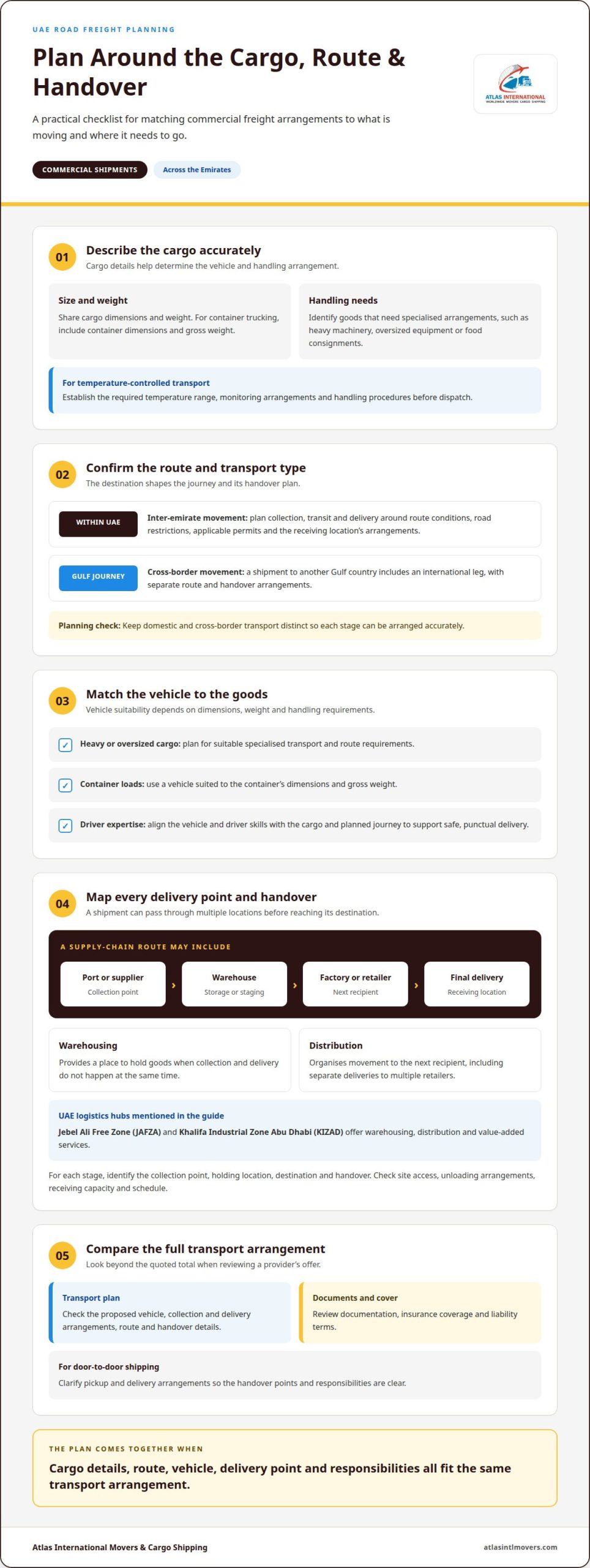
- Match the freight arrangement to the cargo’s size, weight, handling needs and delivery schedule.
- Plan how goods will move between ports, warehouses, factories and final delivery points across the Emirates.
- Compare quotations by reviewing the transport arrangements, documentation, insurance coverage and liability terms.
- Allow for route conditions, vehicle suitability and applicable requirements when planning deliveries across the UAE.
- For door-to-door shipping, clarify pickup and delivery arrangements so the handover points and responsibilities are clear.
Road freight for retail, construction, manufacturing and food industries
Commercial trucking moves business goods between suppliers, warehouses, factories and retailers across the UAE. Road freight can include shared loads where available, container trucking and specialised transport for cargo with particular handling needs. The right option depends on what is moving, its destination and how the receiving location handles deliveries.
Domestic Routes Between Emirates
Inter-emirate road freight connects commercial and industrial locations across the UAE. For example, a retailer sending stock from a central warehouse to a branch in another emirate needs a delivery plan that fits the receiving location’s schedule and capacity.
Route conditions, road restrictions and applicable permits can shape a journey. A logistics provider plans collection, transit and delivery around these factors rather than treating every shipment as a simple point-to-point trip. The route and handover plan should also reflect the cargo’s destination and the receiving site’s operating arrangements.
A construction or manufacturing site delivery may need coordination with site access and unloading arrangements. Retail stock, by contrast, may need to arrive when staff can receive it. That makes the delivery point an important part of the transport plan.
UAE and Gulf Land Transport
Land freight covers transport within the UAE and road journeys connecting the country with Gulf destinations. An inter-emirate movement stays within the UAE; a Gulf shipment crosses an international border and requires a different transport plan.
For example, a manufacturer moving components between a UAE supplier and factory arranges domestic road freight. If the supplier is in another Gulf country, the journey includes an international leg, with separate route and handover arrangements.
Keeping these transport types distinct helps logistics teams plan each stage accurately. The destination determines whether a shipment is domestic or cross-border, while the cargo and delivery points guide vehicle and handling arrangements.
Road Freight Fleet
Vehicle suitability depends on cargo dimensions, weight and handling requirements. Accurate measurements help a transport provider plan for heavy or specialised cargo, such as construction machinery or oversized manufacturing equipment. Retail cartons, food consignments and machinery each need arrangements suited to the goods.
A suitable fleet and skilled drivers support safe, punctual delivery by matching the vehicle and driving expertise to the planned journey. For temperature-controlled trucks, establish the required temperature range, monitoring arrangements and handling procedures before dispatch.
Container trucking also requires a vehicle suited to the container’s dimensions and gross weight. These details help determine vehicle suitability and collection arrangements. Heavy machinery may need specialised transport and route planning, while food deliveries may require temperature control. Matching the vehicle and driver skills to the cargo helps align the journey and handover with delivery needs.
Supply-chain connections between ports, warehouses, factories and retailers
In the UAE, goods can pass through several locations before reaching their destination. Container trucking connects ports and terminals with warehouses, factories and approved delivery locations. Imported materials, for example, can move from a port to a warehouse, then on to a factory when production requires them. Coordinating each handover helps businesses align cargo handling with the next supply-chain stage.
Supplier collection adds another link. A transport plan might start at a supplier’s premises, move goods to a warehouse for storage, then dispatch them to a retailer or production site. A retailer can hold stock before distributing it to outlets, rather than receiving it before stores are ready. Warehousing is useful when collection and delivery schedules differ.
Dubai’s Jebel Ali Free Zone, known as JAFZA, is a logistics hub offering warehousing, distribution and value-added services. It can form part of a route linking port activity with storage and onward delivery. Khalifa Industrial Zone Abu Dhabi, or KIZAD, also offers warehousing, distribution and value-added services, making it a relevant hub for supply chains serving industrial and commercial destinations.
Warehousing and distribution serve related but distinct stages. Warehousing provides a place to hold goods, while distribution organises their movement to the next recipient. A business sending products to several retailers, for instance, can use a warehouse as a staging point before separate deliveries. The transport plan should identify each collection point, holding location, destination and handover.
Storage supports a supply chain when collection and delivery do not happen at the same time. For businesses holding household goods or inventory between transport stages, storage should be secure, flexible, and easy access. A factory receiving inputs in stages may hold goods until production needs them, while a retailer may position stock before distribution. Mapping these steps connects ports, warehouses, factories and retail destinations.
Freight forwarders in the United Arab Emirates handle air and sea freight, customs clearance and warehousing, linking transport and storage within supply-chain operations.
Choosing a trucking provider, comparing quotations and checking insurance
For UAE freight, compare the full transport arrangement, not just the quoted total. Cargo type, vehicle suitability, delivery arrangements and coverage all affect whether a quotation fits the shipment.
Choosing a Freight Provider
Trucking and logistics companies across the UAE provide domestic freight and cargo transport for businesses. Choose a provider whose proposed arrangement fits the cargo, collection point and destination, rather than assuming every shipment is standard freight.
A shipment of retail cartons, for example, has different handling needs from heavy industrial equipment. Ask how the proposed vehicle arrangement, route, delivery confirmation and documentation fit your cargo. GPS tracking, fleet management systems and digital documents may be available, but features vary by provider.
Also distinguish domestic delivery from cross-border forwarding. UAE road transport stays within the country; shipments continuing into another country may involve forwarding and customs clearance arrangements. The route and service scope should match the actual destination.
Comparing Freight Quotations
Compare quotations using the same shipment details. Cargo type, dimensions and weight help determine vehicle suitability, while collection and delivery arrangements shape the movement. If one quotation includes tracking or specific delivery arrangements and another does not, the totals may not represent equivalent services.
Rates and delivery times depend on cargo characteristics, vehicle availability, route conditions, documentation, tracking, insurance and liability terms. A shipment requiring specialised handling or a more complex delivery may need a different plan from ordinary packaged goods. Review the included services alongside the expected schedule.
Useful quotation details include the cargo description, collection and destination points, vehicle arrangement, documentation, tracking, insurance and liability. Comparing these details makes it easier to understand what each proposed service covers before choosing an option.
Domestic Freight Costs
How much does domestic freight transport cost in the UAE? The cost depends on the shipment and is provided after a quote request. Cargo type, dimensions, weight, vehicle availability, delivery arrangements, documentation, tracking, insurance and liability all affect the quotation.
For a useful estimate, provide consistent shipment information, including accurate dimensions and weight. A container movement, for example, requires details that help determine vehicle suitability and collection arrangements. Different cargo or delivery requirements can change the transport plan and its price.
Cargo Safety and Shipment Insurance
Insurance and carrier liability are related, but not interchangeable. Before choosing a trucking arrangement, review what the insurance covers, its exclusions and which responsibilities remain with the shipper or provider. Cargo value and handling needs help determine which terms matter for the shipment.
Fragile retail stock and heavy machinery, for example, present different handling risks. Confirm how the proposed service describes coverage for the specific cargo and journey, and whether any exclusions affect the planned handling or delivery. Keep the quotation, cargo details and insurance terms together so responsibilities are clear if a claim arises.
Commercial transport requirements in Dubai and Abu Dhabi
Hazardous or oversized cargo can require specialised vehicles, route planning and permits; temperature-controlled freight needs handling arrangements suited to the goods. In Dubai and Abu Dhabi, the cargo type and destination shape the transport plan, so these details matter before dispatch.
Dubai’s Roads and Transport Authority publishes commercial transport conditions and procedures for transport in Dubai. The route’s location therefore matters: a commercial journey in Dubai should be planned with the applicable Dubai procedures in mind. For deliveries involving Abu Dhabi, businesses should also consider requirements from the relevant authority.
Heavy machinery, oversized equipment and some industrial materials may need a specialised vehicle. Route planning matters because the vehicle and cargo must suit the intended journey. For example, a large machine moving between an industrial site and a warehouse may need a different arrangement from standard palletised goods. Accurate dimensions and gross weight help determine suitable transport.
Container trucking also calls for specific planning. Before booking, confirm the container dimensions, gross weight, collection arrangements and vehicle suitability. These details help match the load to the right vehicle and pickup plan. Include any destination access or receiving requirements so the delivery stage aligns with collection.
Hazardous materials require particular attention because transport requirements can depend on the cargo and route. Businesses arranging UAE road freight should confirm current requirements with the relevant authority, especially for hazardous materials, oversized cargo or cross-border shipments. This planning step does not replace the need to identify the cargo accurately before dispatch.
Temperature-controlled goods have a different operational concern. Establish the required temperature range, monitoring arrangements and handling procedures before the truck leaves. Food consignments, for example, may need a vehicle plan that maintains the required conditions throughout collection and delivery. Clear instructions help coordinate handling at both ends of the route.
Keep domestic and international movements distinct. A shipment between two UAE locations remains domestic, while an international journey crosses a national border and may involve customs clearance. The route, cargo classification, vehicle suitability and applicable requirements all shape the movement. Treating a cross-border leg as ordinary inter-emirate transport can leave important planning stages unaccounted for.
A useful dispatch sequence is to describe the cargo accurately, confirm its dimensions and weight, identify collection and destination points, then plan the vehicle and route. For hazardous, oversized or temperature-controlled freight, account for relevant specialised handling and authority requirements before dispatch. This gives the transport team the details needed to organise the journey responsibly.
Domestic door-to-door shipping in the UAE
Door-to-door delivery coordinates collection at the sender’s address with handover at the recipient’s destination. The provider plans the vehicle, route and delivery arrangements around the shipment details.
Comparing Domestic Delivery Services
Road freight suits goods that need vehicle transport between UAE locations, including larger consignments. Air cargo can suit shipments where transit speed is a priority, while courier services are commonly used for smaller parcels. The right choice depends on cargo size, handling needs, urgency and receiving arrangements.
A business sending several cartons to another emirate, for example, may consider road freight, while a compact, urgent item may suit air cargo or a courier. Compare collection and delivery scope, not just the transport mode. A door-to-door plan should account for both ends of the journey.
Booking Domestic Freight
How do you arrange domestic freight transport in the UAE and receive shipment updates? Provide the cargo description, dimensions, weight, pickup and delivery addresses, preferred schedule and any handling requirements. The provider uses these details to plan collection, select a suitable vehicle and coordinate delivery.
Booking time depends on cargo details, vehicle availability, route conditions and delivery arrangements. Heavy or specialised items can require extra planning, while a straightforward packaged consignment may need fewer arrangements. Accurate information from the start helps the transport team organise the shipment and avoid unnecessary changes to the plan.
For a door-to-door movement, include access and handover details for both addresses. A warehouse collection, for instance, may require a designated receiving point and agreed delivery coordination. These instructions help align the vehicle’s collection with the recipient’s ability to accept the goods.
Tracking Domestic Shipments
Shipment updates may come through tracking systems, digital documentation or delivery confirmation, depending on the provider’s arrangements. GPS tracking may show route progress, while delivery confirmation records completion at the destination. These features vary, so the booking details should specify which update method applies.
For a retailer awaiting stock, a progress update helps coordinate receiving staff and space. For a business sending equipment between sites, delivery confirmation helps the receiving team plan the handover. Clear shipment references and accurate contact details support communication throughout the movement.
Updates are most useful when they connect to practical decisions, such as preparing a receiving area or coordinating staff. Arrange domestic door-to-door transport with pickup, delivery and shipment information prepared for the booking.
Atlas International Movers & Cargo Shipping: Domestic Moving
Atlas International Movers & Cargo Shipping provides comprehensive domestic moving support for residential and corporate relocations within the UAE, making moving easier from start to finish. When belongings need to move between homes, offices or other locations, our team coordinates collection and delivery around your needs.
Our domestic moving service is a practical next step when you need a comprehensive arrangement rather than a standalone freight journey. For shipments travelling beyond the UAE, our international moving service helps belongings seamlessly cross borders and arrive safely and securely, with air or sea cargo options shaped by the destination and shipment requirements.
Share the pickup and delivery locations, cargo details and preferred timing to begin planning. Contact Atlas International Movers & Cargo Shipping to discuss your domestic move.
Plan your next shipment with clarity
A well-prepared shipment plan gives your team a clear starting point. Decide what needs to move, how delivery fits your operations and who will coordinate the handover. This turns domestic freight transport in the UAE from a broad requirement into a defined task with a purpose and destination.
It also helps align transport planning with wider business priorities. A delivery supporting a store opening, production schedule or office move may need to fit around other work. Treat the movement as part of that plan, not an isolated journey, to help your team make decisions with confidence.
Atlas International Movers & Cargo Shipping can support domestic moving and help coordinate the next stage of your relocation needs. If you’re ready to discuss your plans, contact Atlas International Movers & Cargo Shipping. A clear brief is a practical first step toward an organized move, and our team is ready to help you plan it.
Frequently Asked Questions
What Is Commercial Trucking in UAE?
Commercial trucking is the road movement of business goods between locations such as suppliers, warehouses, factories and retailers. Domestic freight transport in the UAE can include full-vehicle loads, shared loads where available and container movements. A retailer, for example, may transport stock to a branch, while a manufacturer may move materials to a production site. The cargo and delivery plan determine the suitable arrangement.
What are the delivery times between major UAE cities and emirates?
Delivery schedules between UAE cities and emirates are shaped by the route, road conditions, restrictions, permits and delivery arrangements. Collection timing, vehicle availability and the receiving location’s access can also affect the schedule. A delivery requiring specialised handling, for example, may need more coordination than a straightforward consignment. Share collection and destination details during planning so the schedule reflects the journey and handover requirements.
What documents are required for domestic cargo transport in the UAE?
Prepare a clear shipment record with the cargo description, dimensions, weight, pickup and delivery addresses, and handover details. These particulars help match the shipment to the planned vehicle and delivery arrangement. A container movement, for example, needs container dimensions and gross weight for vehicle planning. Keep the transport quotation and shipment paperwork together so the cargo details and agreed arrangements are easy to reference during collection and delivery.
What UAE rules apply to commercial trucks and domestic freight transport?
Commercial transport requirements can depend on the cargo, vehicle and route. Dubai’s Roads and Transport Authority publishes commercial transport conditions and procedures for Dubai. Heavy or oversized cargo may require specialised vehicles, route planning and permits; hazardous materials need particular attention. For movements involving Abu Dhabi or another emirate, consider the relevant authority’s current requirements, especially for specialised cargo or a route that crosses national borders.
What insurance and liability options cover domestic freight in the UAE?
Coverage and liability terms are set out in the shipment’s insurance and transport arrangements. Review the covered cargo and journey, exclusions and each party’s responsibilities. A business shipping fragile goods, for example, should understand how the stated terms address those items and their handling. Keep the policy wording, quotation and cargo description together, and note the process and information required if damage or loss is reported.