

Professional packers can make packing more than a matter of filling boxes. They bring structure to the preparation, helping organize belongings that are fragile, valuable, or difficult to pack around a busy household or workplace.
It’s understandable to worry about crockery, electronics, and other items that need careful handling. Packing a whole home or office also takes time and coordination, from deciding what is moving to keeping everyday essentials accessible. A clear plan helps you manage those tasks without losing track of what needs special attention.
In this guide, you’ll learn what to expect from professional packing, how different belongings are prepared for transit, and what to do before packing begins. Our team provides residential packing and unpacking as part of moving services, with solutions for items ranging from fragile crockery to heavy or sensitive IT equipment. Packing can support a stress-free and organized residential move, form part of a domestic or international relocation, or help workplace moves proceed with minimal disruption and downtime.
Key Takeaways
- Professional packers organize preparation and take packing tasks off your moving-day workload.
- Belongings can be assessed, grouped, prepared, and organized for transit according to their needs.
- Compare professional packing with self-packing based on the move, the time you have, and how involved you want to be.
- Before packing day, set aside essentials and clearly identify belongings that need special attention.
- Atlas packing and unpacking can support a stress-free and organized residential move as part of broader relocation support.
Professional Packers: What Their Service Changes About Moving Day
Professional packing is the planned preparation and organization of belongings for a move. It accounts for different handling needs and keeps packed items organized as part of the relocation. Rather than treating every object alike, the team considers what is being packed and how each group of belongings should be managed.
This changes how you spend your time. Instead of packing room by room while coordinating other moving tasks, you can share priorities and decide what is included while the team handles preparation. Your input still matters, especially for items that need extra attention, but you don’t have to manage every box yourself. A general overview of how packing fits within the wider work of a moving company also helps put the service in context.
What does a professional packing service cover?
A professional packing service prepares belongings for transit and keeps them organized. That starts with identifying what is being packed and recognizing that different items have different needs. Fragile crockery, for example, calls for deliberate handling, while heavy or sensitive IT equipment requires its own considerations.
For a household, packing and unpacking can support a more organized transition between homes. Our residential moving support includes preparing belongings as part of the move, so you can focus on broader decisions instead of coordinating each box. A useful first step is to identify the belongings and rooms that need attention. That information helps shape a plan around your move rather than assuming every home needs the same approach.
When can professional packers make the biggest difference?
Packing support can be particularly useful when a move involves many rooms, a mix of fragile belongings, or little time for preparation. More rooms mean more items to sort and coordinate. A planned approach makes the work easier to oversee and gives packing a clear place in the moving schedule, instead of leaving you to fit it around work, family, and other responsibilities.
Mixed contents also benefit from a considered plan. A household may include crockery, furniture, and everyday possessions; a workplace may have furniture and IT equipment to account for together. For office moves, careful packing supports a coordinated transition with minimal disruption and downtime. For a complete household move, packing can be part of a comprehensive domestic move, connecting preparation with the wider relocation rather than treating boxes as a separate task.
Not every move needs the same level of assistance. Planned packing can reduce the number of tasks you need to manage at once. Whether you are arranging a home or workplace move, make a list of belongings that need attention and share it with the packing team so the work reflects your priorities.
How Professional Packers Prepare Different Belongings for Transit
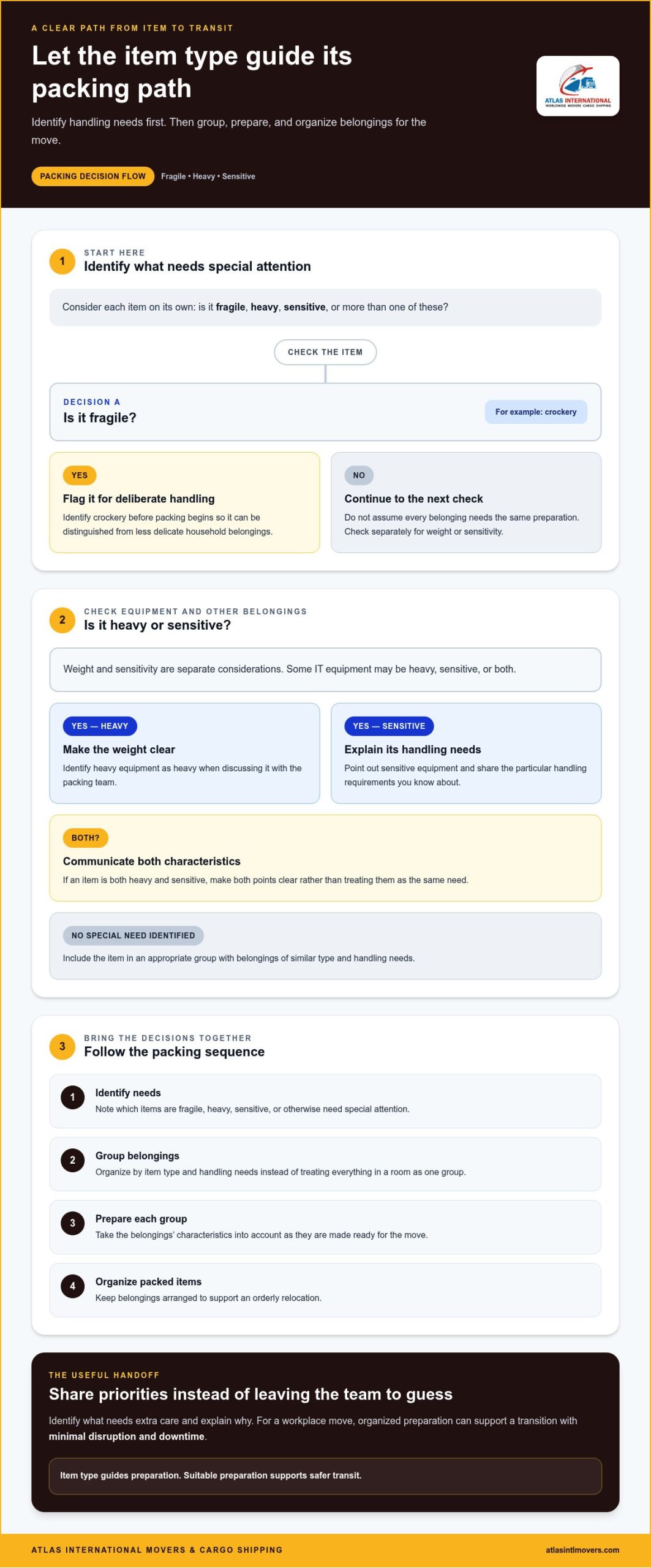
Belongings have different needs in transit. Crockery is fragile, while IT equipment may be heavy, sensitive, or both. A consistent process helps the packing team account for those differences and keep the move organized. In simple terms, the item type guides its preparation, and suitable preparation supports safer transit.
Professional packers can approach the work in a clear sequence:
- Identify needs: Note which items are fragile, heavy, sensitive, or otherwise need special attention.
- Group belongings: Organize items by type and handling needs instead of treating everything in a room as one group.
- Prepare each group: Take the belongings’ characteristics into account as they are made ready for the move.
- Organize packed items: Keep packed belongings arranged to support an orderly relocation.
This sequence makes packing decisions easier to understand and gives you a practical way to communicate priorities. Identify what needs extra care and explain why, rather than relying on the team to guess which items matter most to you.
Packing fragile crockery and household belongings
Fragile crockery calls for deliberate handling because it can be vulnerable during a move. Point it out before preparation begins so the packing team can distinguish it from less delicate household belongings and give it appropriate attention. The right approach depends on the items and the move, so one method should not be assumed to suit every piece.
Grouping helps keep the move organized. Treating crockery as a clear category makes it easier to account for among packed household belongings. The same principle applies to other items: identify their needs first, then prepare them accordingly instead of packing everything in the same way.
Preparing heavy or sensitive IT equipment
Weight and sensitivity are separate considerations when preparing IT equipment. Heavy equipment needs to be identified as such, while sensitive equipment needs attention to its particular handling requirements. Some items may be both, so make both characteristics clear when discussing them with the packing team.
In an office relocation, packing equipment is connected to the coordination of furniture and IT infrastructure, not just the movement of individual items. Organized preparation can support a workplace transition with minimal disruption and downtime. At Atlas International Movers & Cargo Shipping, our corporate relocation support brings packing into the wider planning of a workplace move.
For general consumer guidance on planning your move within the region, local transport authorities and moving associations provide helpful resources for people hiring moving services. For your own packing plan, list fragile crockery, heavy belongings, and sensitive IT equipment, then share what needs particular attention as part of your moving arrangements.
Professional Packers vs. Self-Packing: Which Approach Fits Your Move?
Choose between self-packing and professional support based on the size and complexity of the move, the time you can set aside, and how much you want to manage yourself. A smaller move with straightforward belongings may be manageable on your own. A larger household or workplace move can benefit from coordinated preparation.
| Consideration | Self-packing | Professional packing |
|---|---|---|
| Time | You set aside time to prepare belongings around your other responsibilities. | A packing team takes on preparation tasks as part of the move. |
| Customer involvement | You manage the packing decisions and the work itself. | You share priorities and provide direction while the team handles packing. |
| Organization | You plan how to group and keep track of packed belongings. | Packing is approached as an organized part of the relocation. |
| Handling needs | You assess and prepare each item yourself. | The team can account for differences such as fragile crockery or heavy and sensitive IT equipment. |
When self-packing may suit your circumstances
If you’re moving a smaller number of straightforward belongings and have time to prepare them, packing yourself can be practical. You manage the process directly and decide how to organize your items. Before you begin, consider the volume of belongings and the time available, including other tasks competing for your attention. List fragile or sensitive pieces so you can plan for them rather than leaving them until the end.
When professional packing can simplify the move
Professional packers can be especially helpful when a large household includes many rooms or fragile belongings that need careful attention. Coordinated packing reduces the number of separate tasks you need to oversee. For workplace moves, furniture and IT equipment bring distinct handling and coordination needs, so packing can be planned alongside the wider relocation.
Professional support doesn’t mean giving up control. You decide what’s moving, identify items that need special attention, and communicate your priorities. The packing team handles preparation within those directions. This shared approach lets you stay involved without managing every packing task yourself.
To choose an approach, assess three things: how much you need to pack, how much time you can realistically devote to it, and whether any belongings call for particular care. If the move is limited and uncomplicated, self-packing may fit well. If the volume, fragile belongings, or workplace equipment make preparation harder to coordinate, packing support can bring order to the process while you remain part of the decisions.
How to Prepare Before Professional Packers Arrive
Some preparation helps the packing team understand your priorities and keeps personal essentials within reach. You don’t need to pack everything yourself before the team arrives. Focus on sorting, identifying items that need special attention, and sharing information that will help the packing plan fit your household or workplace.
A practical pre-packing checklist
Work through these steps before packing day. They give the team clear direction without requiring you to take on the entire packing task yourself.
- Sort what’s moving. Separate belongings you plan to take from items you don’t want included. This clarifies what needs preparation.
- Identify items needing attention. Make a note of fragile crockery, heavy belongings, sensitive IT equipment, and anything else you want handled with particular care.
- Set aside personal essentials. Keep items you’ll need during the transition accessible and separate from belongings being packed, so you can find them easily.
- Prepare questions and preferences. Note any priorities, instructions, or household considerations you want to discuss. Clear guidance helps the packing plan reflect your needs.
Be specific when describing an item that needs attention. Naming the object and explaining your concern is more useful than a general request to “be careful.” If you’re unsure what to prioritize, focus on items that are fragile, sensitive, especially important to you, or difficult to replace.
Coordinate packing around your household or workplace
Before the team arrives, think through access to the spaces and belongings involved. Share priorities and any time-sensitive arrangements, including rooms or items that need to be handled in a particular order. This helps align preparation with the practical demands of your move without assuming every household follows the same plan.
For an office relocation, coordinate packing with the needs of the workplace. Furniture and IT equipment can affect how teams plan the transition, so sharing relevant priorities helps support minimal disruption and downtime. For a complete home move, planning around your household’s needs can complement the wider arrangements for a comprehensive domestic move.
Keep your notes concise and available for discussion. You might record which items are fragile, which belongings you need to access during the move, and any arrangements that affect access to a room or work area. You remain part of the decision-making process; preparation makes your instructions easier to communicate.
Our team provides residential packing and unpacking as part of moving support, helping you plan a stress-free and organized transition.
Professional Packing with Atlas: An Organized Part of Your Move
Packing is most useful when it fits into the wider relocation plan. At Atlas International Movers & Cargo Shipping, we provide residential packing and unpacking as part of moving support, helping you prepare household belongings and organize the work around your move. The aim is a Stress-free and organized residential transition, with our team supporting the preparation while you remain involved in decisions about your belongings.
Residential packing for a stress-free and organized transition
Every household has its own mix of belongings and priorities. Fragile crockery, everyday household items, and possessions needing special attention all have a place in the packing plan. Our team prepares residential belongings for the move and supports unpacking as part of the service, connecting preparation at your current home with settling into the next one.
For a complete household relocation, packing can sit alongside broader domestic moving arrangements rather than being treated as a separate task. Our domestic moving service provides comprehensive support for the move, while residential packing helps organize the belongings within it. Share your priorities with our team so the preparation reflects your household’s needs and supports an orderly transition.
Packing support for international and corporate relocations
For an international move, organized packing is one part of preparing belongings to seamlessly cross borders. It connects preparation with the wider arrangements for moving between countries. Atlas International Movers & Cargo Shipping provides international moving support, with packing planned in the context of the belongings and the overall transition. Professional preparation supports belongings travelling safely and securely as part of the move.
Workplace relocations bring another set of considerations. Furniture and IT infrastructure may need to be packed as part of a coordinated office move, linking the packing work to the wider relocation. Our corporate relocation support brings these workplace needs into the move plan, with careful coordination to help minimize disruption and downtime. Share priorities with our team so the packing arrangements account for the business transition.
Whether you’re preparing a household, an international relocation, or a workplace move, Atlas International Movers & Cargo Shipping brings packing into the wider moving process. We help you consider your belongings as part of the plan and keep preparation organized around your move.
Plan Your Next Move with Confidence
A move is easier to manage when your priorities are clear before planning begins. Consider what you need close at hand, which decisions you want to make personally, and where professional packers could take practical tasks off your list. This gives you a useful starting point for a plan shaped around your household, belongings, and schedule.
You don’t need to have every detail settled before planning. Start with what you know, note the questions you still have, and work through the next decisions with a team experienced in moving and packing. An organized plan helps you approach the transition with greater calm and focus.
Explore your moving and packing options with Atlas, and take the next step toward a move that feels manageable from the start.
Frequently Asked Questions
Do professional packers bring packing materials?
The packing plan should specify the materials needed and who will have them ready. Atlas provides packing solutions for belongings ranging from fragile crockery to heavy and sensitive IT equipment. List what needs packing and any particular handling concerns as you plan, so the materials and preparation can be considered in relation to the items.
Can professional packers unpack belongings after a move?
Yes. Atlas provides residential unpacking as part of its moving services. Unpacking can help you settle in without handling every packed item alone. Before the move, consider which rooms or belongings you’ll want to access first, such as kitchen essentials or everyday household items. Sharing those priorities gives the team useful direction for the transition into your new home.
Should I empty drawers before professional packers arrive?
Remove personal essentials, loose items, and anything fragile from drawers before packing begins. Whether furniture can be moved with drawer contents inside depends on the moving arrangements, so don’t assume full drawers will travel as they are. Set aside important documents, medications, keys, and other items you need to keep accessible. A clear list of exceptions helps distinguish what should stay with you from what’s being prepared for the move.
Can I ask professional packers to handle only certain rooms?
You can organize your packing priorities by room and identify where support matters most. For example, you might want help with a kitchen containing fragile crockery while preparing straightforward bedroom belongings yourself. Make a simple room list showing what’s being packed and what you’ll handle. This defines the scope and helps prevent belongings you intend to manage personally from being included by mistake.
How long does professional packing take for a home move?
There isn’t one reliable duration for every home. The time needed depends on factors such as the amount of belongings, the number of rooms, and whether items need particular care. A sparsely furnished home and a household with extensive contents have different preparation needs. Sharing a clear picture of the rooms and belongings helps the moving team plan the packing work without relying on a generic estimate.
Can professional packers prepare office IT equipment for relocation?
Yes. Atlas’s packing solutions include heavy and sensitive IT equipment, and corporate relocation support accounts for workplace infrastructure as part of a broader move. Before packing, identify equipment that needs particular attention and share relevant priorities with the team. This connects packing with the office transition, including plans for furniture and setup, while supporting the aim of minimizing disruption and downtime.
Is professional packing worth it for a small move?
It can be useful if a small move includes fragile belongings, items you find difficult to prepare, or little time for packing around other responsibilities. If the contents are straightforward and you have time to organize them, self-packing may suit your needs. Consider the volume, the care particular items require, and how much preparation you can realistically take on before deciding which approach fits your move.