

What if the clearest sign of reliable movers for international transit isn’t a promise of a perfect journey, but a plan for handling each stage with care? A move across borders involves packing, cargo transport, and delivery. Uncertainty about any one of these steps can make it harder to feel confident.
It’s reasonable to expect your belongings to be handled carefully and to want clear updates if plans change. Reliability doesn’t mean every part of international transit is free from variables. It means the process is coordinated, communication is practical, and expectations are realistic from the start.
In this article, we’ll separate common moving myths from useful signs of reliability, explain how packing, shipping, and delivery work together, and show what to look for beyond reassuring claims. At Atlas, our expert team coordinates international moving with professional packing and unpacking, alongside air and sea cargo options, to help your belongings seamlessly cross borders. We focus on careful handling and clear communication, so your relocation can feel more organized and secure.
Key Takeaways
- Look for reliable movers for international transit that demonstrate coordinated handling, clear communication, and realistic expectations, not just reassuring promises.
- Understand how preparation, packing, cargo transport, and destination delivery connect so you can follow the move from stage to stage.
- Don’t treat a speed claim as proof of reliability. Clear service scope and communication offer more practical signs.
- Compare equivalent services and consider whether air or sea cargo better fits your shipment’s contents and priorities.
- Atlas brings moving, professional packing, air and sea cargo, and storage together to support an organized international relocation.
Reliable Movers for International Transit: What Does Reliability Actually Mean?
Handing household or business belongings over for international transit can feel uncertain. You may be coordinating a move from the UAE while wondering how items will be packed, who will manage each transport stage, and how you’ll receive progress updates. Finding reliable movers for international transit means looking beyond a confident promise and examining how the moving process is organized.
Reliability means coordinated handling, clear communication, and realistic expectations throughout a move, not a promise that no disruption will occur. A mover can plan preparation and packing, coordinate the agreed services, and share updates. Other transport providers and external events may also affect an international journey, so a responsible plan should explain what is included and how changes will be communicated.
For a useful overview of what to consider when selecting an international mover, watch this video:
What should reliable international moving include?
A well-organized move connects planning, packing, transport coordination, and delivery. Each stage should build on the one before it: belongings are prepared for shipment, the selected transport approach is coordinated, and delivery arrangements are understood. Our international moving services include professional packing and unpacking to help make this process more organized.
Service scope matters, too. Moving and cargo services can play different roles in a relocation, so it should be clear which parts of the journey are covered and how they fit together. A household move may include packing as well as cargo transport, while a shipment arranged as cargo may have a different scope. Clear responsibilities help prevent assumptions about who is handling a task or providing an update.
Why reliability is more than a delivery promise
A delivery estimate can help with planning, but it isn’t by itself evidence that the whole process is well managed. International transit may involve transport providers and handover points beyond a mover’s direct control. Reliable service means coordinating responsibilities within the agreed scope, explaining expectations plainly, and communicating when relevant information changes.
Useful updates reduce uncertainty by giving you a clearer picture of what’s happening and what comes next. Clear communication doesn’t mean every external development can be predicted. It means you aren’t left to guess about the move’s status or the next step. When assessing a moving claim, consider whether it explains the service process and communication approach, not just the promised outcome.
For a more stress-free and organized transition, look for practical evidence: a connected plan for handling belongings, a clearly described service scope, and consistent communication. That is a more useful measure of reliability than a suggestion that international transit can be entirely free of variables.
How Reliable Movers Coordinate Packing, Freight, and Transit
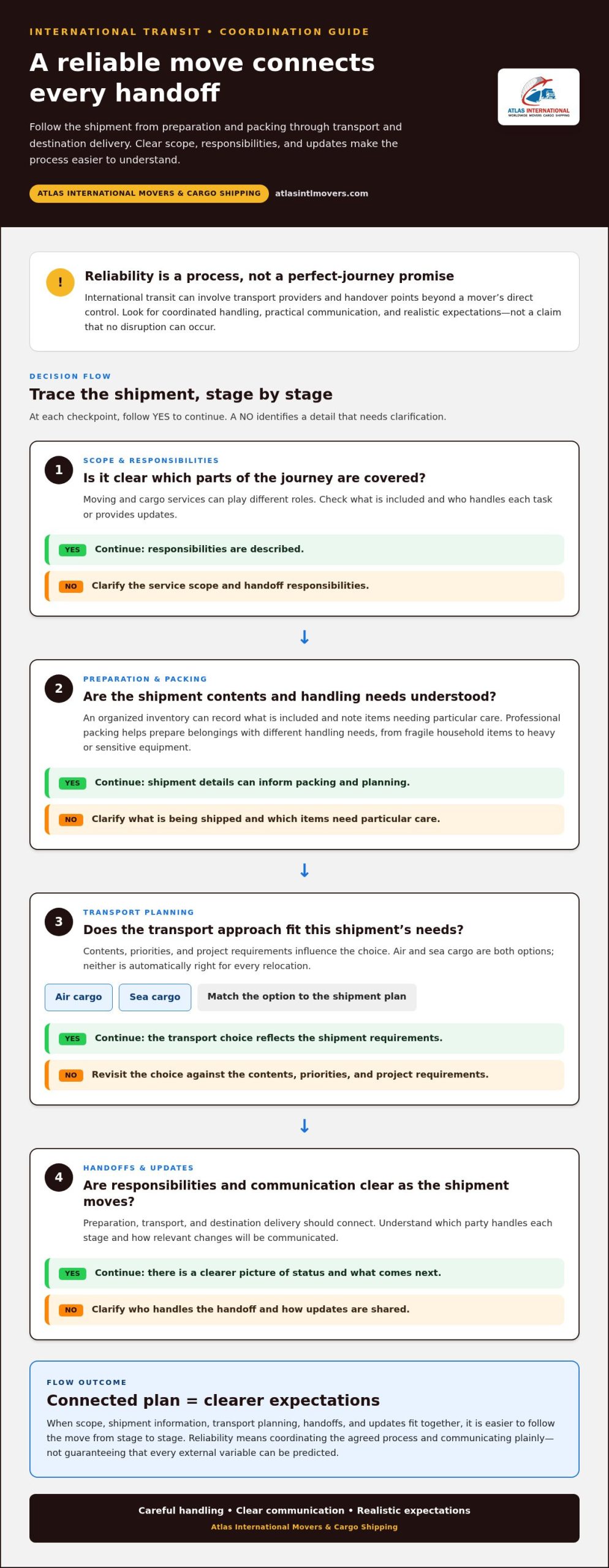
An international shipment is a series of connected steps, not a single handover. Preparation informs how belongings are packed; packing details shape shipment planning; transport arrangements determine how goods move; and destination delivery completes the journey. If one stage isn’t clearly connected to the next, it can be harder to understand who is responsible for an item or where to direct a question. For more on how end-to-end moving solutions in the UAE connect each stage, see our guide to how the process works.
Coordination keeps each shipment stage connected, so belongings, responsibilities, and updates move forward together. That’s a practical way to assess reliable movers for international transit: look for a process that explains how shipment information and care carry through each handoff, not just which transport mode is used.
Packing and shipment preparation
Professional packing helps protect belongings with different handling needs, from fragile household items to heavy or sensitive equipment. An organized inventory can support planning by recording what is included and noting items that need particular care. It can also make it easier to identify questions before transport begins, rather than relying on memory at a later handoff.
For a closer look at preparing goods for shipment, the related guide Export Packing Services UAE: How to Prepare Goods for Shipping explores packing considerations. The goal is not simply to place items in boxes. It is to prepare the shipment so its contents and handling needs are understood as the move progresses.
Air or sea cargo: matching transport to the move
Air and sea cargo are both transport options, but neither is automatically right for every relocation. Shipment contents, priorities, and project requirements influence the approach. A household shipment, for example, may have different planning needs from a selection of business items. The transport mode should fit the shipment plan rather than a broad claim that one option is always better.
We provide air cargo services, as well as sea cargo for global destinations. Our team can coordinate the relevant cargo service as part of a relocation, with the approach shaped around the shipment’s requirements rather than an assumed transit schedule.
Clear handoffs and communication
As a shipment moves between preparation, transport, and destination delivery, clear responsibilities help reduce confusion. Practical coordination means keeping shipment information organized, understanding which party is handling each stage, and sharing relevant updates when details change. These habits support careful handling, even when external transport factors affect the journey.
- Keep shipment details organized so contents and packing needs are easier to track.
- Clarify who is coordinating each stage and how updates will be shared.
- Use the selected cargo approach to guide planning, rather than assuming one mode suits every move.
The International Association of Movers offers industry information and resources for moving and forwarding professionals. Considering International Association of Movers resources alongside a mover’s clear explanation of its process can help put transit coordination in context. Our international moving service connects professional packing and transport coordination to help belongings move safely and securely.
International Moving Myths That Can Distort Reliability Comparisons
International moving claims can sound reassuring, especially when you’re planning a relocation from the UAE and want confidence that belongings will reach their destination safely. But a strong promise is only useful if it reflects a clear, coordinated service. Two common myths can make it harder to compare what movers actually do.
Myth: the fastest-sounding option is always the most dependable
A speed-focused claim doesn’t explain how belongings will be packed, handled, or coordinated between shipment stages. Nor does it show whether a transport option suits the shipment. Dependability is better assessed by looking at the whole plan, including how responsibilities and updates are managed.
Air freight isn’t automatically the best choice for every international move. The right transport mode depends on the shipment’s contents, priorities, and project requirements. A move with particular planning needs may call for a different approach from a shipment with different contents or priorities. The useful question isn’t simply “Which is fastest?” It’s “Which option fits this move, and how will it be coordinated?”
Myth: one reassuring promise covers every stage
A slogan about a smooth move can’t tell you which parts of the process are included or how handoffs are managed. A useful service explanation makes the scope understandable: it connects preparation and packing with transport coordination and destination delivery, and clarifies how communication fits in. This helps distinguish moving support from cargo transport rather than assuming they mean the same thing.
Absolute claims about disruption can also create unrealistic expectations. International shipments may involve external transport stages that a mover doesn’t directly control. Clear updates are more practical: they help you understand the shipment’s status and next steps without implying that every variable can be predicted.
To assess claims calmly, look for details that show how the service works:
- Does the explanation describe the move’s scope, rather than relying on a broad promise?
- Does the proposed transport approach reflect the shipment’s contents and priorities?
- Are responsibilities and communication across handoffs made clear?
These questions shift comparison away from slogans and toward the substance of the plan. For reliable movers for international transit, reliability is demonstrated through suitable transport, coordinated handling, and realistic communication, not a single claim about speed or an uninterrupted journey. A clear process supports safer planning and a more stress-free relocation, even when some parts of transit depend on factors beyond the mover’s direct control.
How to Compare Reliable Movers for Your International Transit
Comparing international moving services is easier when you assess the same practical details for each option. A headline about speed or convenience can sound appealing, but it doesn’t show whether the proposed service fits your shipment. Use a consistent sequence to compare the plan, responsibilities, communication, and transport approach.
- Define the shipment. Note whether you’re moving household belongings or business items, what needs careful handling, and which priorities matter most.
- Map the service scope. Identify how packing, cargo transport, delivery coordination, and any storage needs fit together. Compare equivalent services, not a full-service plan against a transport-only option.
- Assess communication. Look for a clear explanation of who coordinates each stage, what updates will cover, and how changes are communicated.
- Compare transport fit. Consider whether the proposed air or sea cargo approach reflects the shipment’s contents and priorities. Neither mode is automatically right for every move.
Match the service scope to your shipment
A household relocation may center on personal effects, furniture, and a coordinated transition into a new home. A corporate move may involve business equipment or infrastructure, where planning around the organization’s requirements is also important. The comparison should reflect those differences instead of assuming one service plan fits both.
Consider how packing, cargo transport, and storage relate to your planned move. If the shipment is personal effects, the guide International Shipping for Personal Effects: A Practical Checklist can help you think through the information and preparation involved. A clear scope makes it easier to see what the plan covers and how its parts connect.
Compare communication and coordination, not slogans
Useful communication gives you a practical picture of the process. It explains how the mover coordinates the shipment, which stages are within the service scope, and how relevant updates will be shared. This is more informative than a broad promise because it helps you understand what to expect without implying that every external factor is within the mover’s control.
At Atlas, we bring international moving and cargo services together with professional packing and unpacking, coordinating the work around the relocation’s requirements. Our international moving service supports a clear, organized approach to handling belongings as they move across borders.
As you compare options, keep the same shipment description and priorities in view. That makes differences in service scope easier to recognize and helps you focus on what matters: suitable transport, connected responsibilities, and communication that supports a well-planned move.
How Atlas Supports a More Reliable International Move
A well-planned international relocation brings several needs into one organized process. We provide international moving with professional packing and unpacking, alongside air and sea cargo, storage, and corporate relocation. Our team coordinates these services around the move, helping belongings cross borders safely and securely while keeping practical steps clear.
Reliability is reflected in how the service fits the shipment and relocation needs. A household move may call for careful preparation of personal belongings, while a corporate relocation may need planning for furniture and IT infrastructure. In both cases, coordinated support helps reduce uncertainty and lets customers focus on settling in or returning to business priorities.
Support for residential and corporate relocations
For residential moves, professional packing supports a stress-free and organized transition by preparing belongings for international transport. Our moving and packing support helps items travel safely and securely, with the move coordinated as a connected process rather than a collection of separate tasks.
Corporate relocation has different priorities. Office furniture and IT infrastructure need an approach that considers how items are packed and how the relocation fits the organization’s plans. We support corporate moves with a focus on minimal disruption and downtime. For a wider view of freight planning, the related guide Cargo Logistics Services in the UAE: A Practical Guide to Moving Freight provides useful context for understanding how cargo logistics can fit into a move.
When storage or freight support is part of the plan
Some relocations need storage as part of the overall arrangement, such as when belongings need to be held between stages of a move. Our storage and warehouse solutions are secure and flexible, with easy access for short-term or long-term needs. Air and sea cargo can also form part of an international relocation, with the transport approach aligned to the shipment and its requirements.
Keep freight and moving responsibilities clear by understanding which transport and delivery tasks are included in your relocation plan. When those steps are coordinated, it is easier to follow the shipment and understand how each part fits into the move.
Our team’s experience is part of our company’s story, but reliability is best understood through the practical coordination and communication provided for each move. Learn more about our company and team as you consider the support that fits your relocation.
Take the Next Step Toward a Clearer Move
An international relocation is also the beginning of a new routine, home, or opportunity. Give yourself room to prepare for that next chapter by turning your moving priorities into a clear plan. Consider what needs to arrive first, which belongings need particular care, and what updates will help you feel informed as the move progresses.
Those priorities can guide a practical conversation about your international transit. A clear starting point makes it easier to shape the move around your circumstances and understand how moving, cargo, and storage support can fit your plans. You don’t need to have every detail settled before taking that first step.
We’re ready to help you move forward with care and a well-organized approach. Plan your international move with Atlas and take the next step toward a relocation that feels more manageable.
Frequently Asked Questions
How can I tell whether international movers are reliable?
Look for a plan that accounts for your actual shipment, not just a general description of moving services. Compare the inventory you provide with the items and handling needs described in the proposed plan. Check that you can identify who coordinates the move and how you’ll receive updates. Reliable movers for international transit should make the process understandable without relying on absolute promises.
Is the cheapest international moving quote always the best choice?
No. A lower quote may cover a narrower scope, so compare what each proposal includes before weighing the price. Check whether packing, cargo transport, delivery coordination, or storage are part of the same plan or handled separately. For instance, two quotes may look similar while describing different packing responsibilities. Comparing equivalent services helps you understand the practical value of each option without relying on the headline figure alone.
Can international movers coordinate both packing and cargo transportation?
Yes. Atlas provides international moving with professional packing and unpacking, alongside air and sea cargo services. Bringing these elements into a coordinated relocation can help align how belongings are prepared with how they’ll be transported. For example, a shipment containing household items and fragile belongings benefits from having packing needs considered as part of the overall move, rather than treating packing and transport as unrelated tasks.
What should I do if my international shipment is delayed?
Start by gathering the shipment reference, planned delivery details, and the latest update you received. Share that information with the moving team coordinating your shipment and request its current status and the next update point. Keep essential personal or business items accessible if possible, rather than relying on the delayed shipment for immediate needs. Clear, specific information helps the team respond to your situation more effectively.
How do air and sea cargo differ for an international household move?
Air cargo and sea cargo are different transport options, and the right fit depends on your shipment’s contents, priorities, and overall requirements. Rather than assuming one is always preferable, consider what you’re sending and how it fits into the move. A household shipment with varied items may need a different plan from a shipment containing only selected belongings. The transport choice should follow the needs of the project.
Does a reliable international mover provide storage during a relocation?
Storage can be useful if your belongings need to be held between one stage of a move and the next, such as when your arrival and home access don’t align. Atlas provides storage and warehouse solutions for short-term and long-term needs. This offers a secure, flexible option with easy access as your relocation plan takes shape, without requiring every item to move on the same schedule.