

A sea freight quote is not a single UAE-wide rate. The cost of sea freight shipping in the UAE depends on the route, cargo size and weight, and whether you choose LCL or FCL. After departure, you can generally follow a shipment through carrier tracking, using its shipment or booking details to view available progress updates.
It’s understandable to want a clear cost and reassurance that your cargo is moving as planned. LCL can suit smaller shipments, while FCL reserves a container for your goods. The right option depends on your shipment volume and requirements.
This guide explains UAE sea freight pricing, charges that can affect the total, and how FCL and LCL compare. It also clarifies what port-to-port service covers, what information helps produce a useful quote, and how shipment tracking fits into the process.
Key Takeaways
- Compare LCL and FCL against your cargo volume and the total shipment scope, not just the headline freight charge.
- Allow for charges beyond ocean freight, such as terminal handling, documentation, customs-related costs and inland haulage.
- Prepare accurate cargo details and key shipping documents, including the commercial invoice, packing list and bill of lading or sea waybill.
- Clarify which port-to-port services and destination steps are included so you understand where the shipping provider’s responsibility ends.
- For international or domestic moves involving ocean transport, Atlas International Movers & Cargo Shipping provides moving and sea cargo services to support the shipment.
LCL pricing and minimum shipment volume
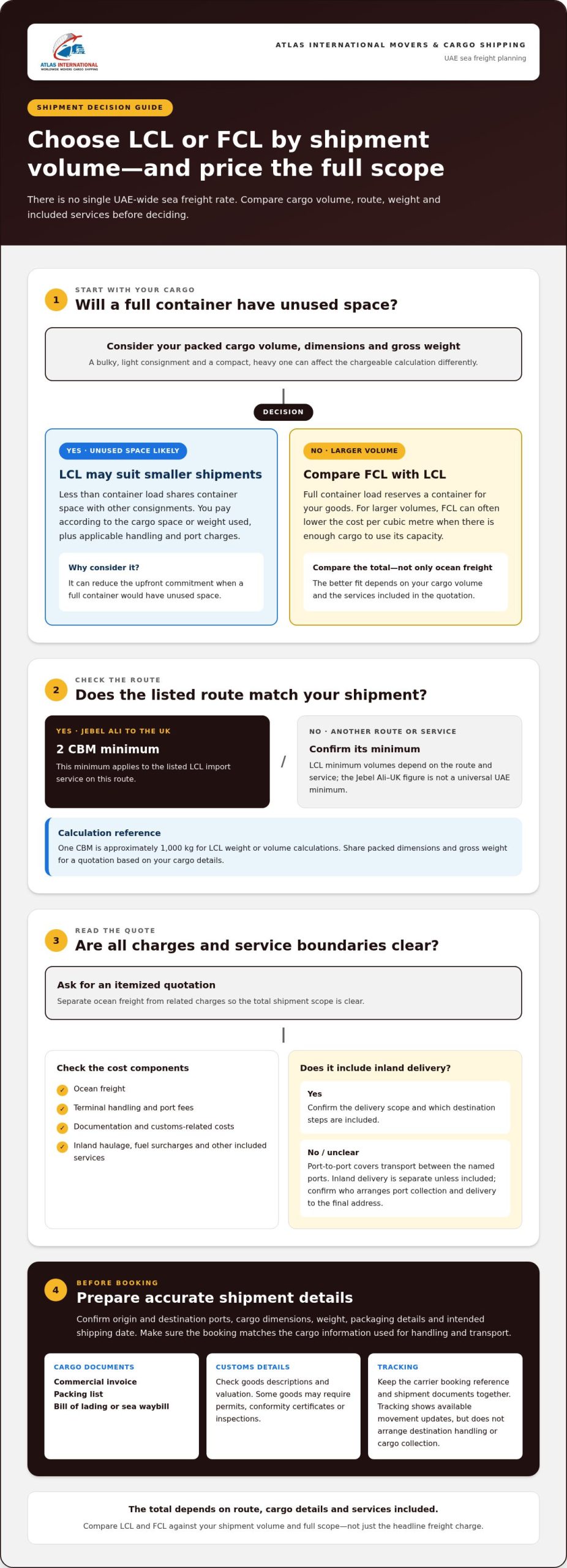
Less than container load (LCL) shipping lets smaller consignments share container space with other shipments. Instead of paying for an entire container, you pay according to the cargo space or weight used, along with applicable handling and port charges. This can reduce the upfront commitment when a full container would have unused space.
Minimum volumes depend on the route and service. For the listed LCL import service from Jebel Ali to the UK, the minimum shipment volume is 2 CBM. That route-specific figure is useful when planning an import, but it shouldn’t be treated as a universal minimum for every UAE shipment.
Compare volume and weight before booking. One CBM is approximately 1,000 kg for LCL weight or volume calculations. Prepare the packed cargo’s dimensions and gross weight, then ask for a quotation based on those details. A bulky, light consignment and a compact, heavy one can use the same space differently, affecting the chargeable calculation.
For a clear comparison, request an itemized quotation separating ocean freight from surcharges, terminal charges, documentation, customs-related costs and inland haulage. The total depends on the route, cargo details and services included. For larger volumes, compare LCL with FCL: a full container can often lower the cost per cubic metre when there’s enough cargo to use its capacity.
Booking, tracking and delivery
Start by confirming the origin and destination ports, cargo dimensions, weight, packaging details and intended shipping date. Ensure the booking matches the shipment information used for handling and transport. For LCL, cargo is consolidated with other consignments before the shared container moves by vessel. Consolidation and separation at destination add handling steps to the journey.
Keep the carrier’s booking reference and shipment documents together for tracking. Use the carrier’s tracking process to follow available movement updates, including vessel departure and arrival milestones. Tracking can show progress, but it doesn’t replace arranging destination handling or collecting cargo after arrival.
Port-to-port service covers transport between the named ports. Inland delivery is a separate part of the plan unless included in the quotation. Before booking, identify who arranges collection from the arrival port and delivery to the final address. This helps prevent mistaking a port arrival for completed delivery.
Incoterms and cargo protection
For UAE-to-GCC shipments, FOB or CIF may be used depending on who controls the shipping arrangement. Confirm the named port and each party’s responsibilities in the sales contract before booking. Review cargo insurance separately, including the insured value, covered journey and exclusions, against the goods being shipped.
What Affects Container Shipping Costs?
Container costs reflect the cargo, route, documentation and services arranged before and after vessel transport. For UAE shipments, accurate export records and clear responsibility for customs steps help avoid preventable delays.
Export and Customs Documentation
Importers shipping goods to the UAE typically need a commercial invoice, packing list and bill of lading or sea waybill. These documents describe the cargo and support its identification at the destination. Before booking, compare each document with the shipment details, including the goods’ description and valuation.
For UAE exports, declarations are submitted to UAE Customs, usually through systems such as Dubai Trade or Mirsal 2. Accurate cargo valuation, classification and documentation support customs clearance. A sea freight forwarder can coordinate transport and documentation steps, but the exporter remains responsible for supplying correct shipment details.
Restricted and Prohibited Goods
Whether goods need extra clearance depends on their type and destination. Some goods imported into the UAE may require special permits, conformity certificates or inspections. Ordinary commercial packaging or a full container load does not remove these requirements.
Before booking, identify the exact goods and their intended use, then establish whether permits, certificates or inspections apply. Use consistent descriptions across the commercial invoice and packing list. Clear details help customs officials and cargo handlers identify the shipment, unlike broad descriptions such as “general goods.”
Sea Freight Cost Factors
There’s no single sea freight price for every UAE shipment. The price depends on the shipment and is provided after a quote request. Key factors include cargo type, weight, dimensions, shipping distance and destination. LCL or full container load also affects how freight and handling charges are calculated.
The total may include terminal handling, documentation, customs costs, inland haulage, fuel surcharges and port fees. Ask for these components to be itemized so you can distinguish ocean freight from related charges. For example, a quote covering port transport alone differs from one that also includes inland delivery.
Transit Times to UAE Ports
Transit time depends on the origin, destination port, vessel schedule and route. Sea freight between the UAE and Asian destinations such as China and India takes an estimated 10-20 days port-to-port. Dubai-to-Europe shipments usually take 18-25 days, while UAE-to-Americas transit is estimated at 25-40 days.
These are port-to-port estimates, not end-to-end delivery times. Port congestion and vessel schedules can affect timing, while customs clearance or inland transport adds steps after arrival. When planning stock or a move, identify the destination port first, then account separately for destination handling and delivery arrangements.
Port-to-port shipping terms and exclusions
Port-to-port sea freight covers transport between the origin port and the named UAE destination port. It doesn’t automatically include collection from a warehouse or delivery to a final address. Before booking, compare the service description with your full logistics route, including port handling, customs clearance and inland transport.
The UAE has several port gateways, including Jebel Ali, Abu Dhabi and Sharjah. Jebel Ali is the country’s largest container port and a regional transshipment hub. Khalifa Port serves Abu Dhabi and nearby industrial zones. Match the destination port to the receiver’s location, cargo needs and onward transport plans.
For UAE-to-GCC shipments, port selection affects the onward journey as well as the sea leg. A port near the receiving business may simplify inland arrangements, while a different gateway may suit the available vessel route. Compare the named arrival port with the final delivery point before agreeing on shipping terms.
What port-to-port service covers
Check the quotation for the exact origin and destination ports, included handling and stated exclusions. For example, a shipment ending at Jebel Ali may still need separate arrangements for customs clearance and movement from the port to a warehouse. Clarify who coordinates each handover and which charges fall outside the ocean-freight service.
Smaller LCL cargo and a full container can involve different port-handling arrangements. LCL shipments are consolidated with other cargo, while a full container is reserved for one shipper’s goods. In either case, clarify whether the quoted service ends at the port or includes further delivery steps.
VGM and port cut-offs
VGM means the verified gross mass of a packed container. Align the container’s weight information with the carrier’s submission process, and keep supporting cargo details consistent with the booking. The carrier’s instructions and port cut-off schedule determine when information and cargo must be ready for the planned vessel.
Build these deadlines into the booking plan. Share cargo details promptly, confirm the applicable cut-off with the carrier, and arrange container delivery to the port accordingly. Missing a cut-off can disrupt the planned vessel connection, so leave time for weighing, documentation and transport coordination.
Choosing a UAE gateway
Use the receiver’s address and the shipment’s onward route to compare Jebel Ali, Abu Dhabi and Sharjah. For cargo serving Abu Dhabi’s industrial zones, Khalifa Port is another gateway to consider. Confirm the destination port in the shipping instructions so the carrier, consignee and inland transport arrangements follow the same plan.
FCL and LCL shipping
For international cargo moving through UAE ports, choose between a dedicated container and shared container space. Cargo volume, handling steps and delivery priorities help determine which option fits best.
Full Container Load Shipping
Full container load (FCL) reserves a container for one shipper’s cargo. A 20-foot container is one common option. FCL is usually cost-effective for shipments of 15 cubic meters or more, when the cargo can use enough space to justify booking the full unit.
FCL involves fewer consolidation points than LCL, which can simplify cargo handling, especially when coordinating a larger import or time-sensitive delivery. Compare the cargo’s packed dimensions and weight with the container arrangement, then consider the destination and inland transport required after arrival.
Less Than Container Load Shipping
Less than container load (LCL) combines your cargo with other shipments in a shared container. At a Container Freight Station, cargo is consolidated before export and separated again at destination. LCL is useful when a shipment doesn’t need a full container.
Consolidation and deconsolidation add handling steps and can make LCL take longer. For a smaller international shipment, compare the shared-space charge with the full-container option, along with delivery arrangements at both ends. Cargo dimensions and weight help determine how the shipment is assessed.
Use a practical comparison before choosing. First, measure and weigh the packed cargo. Next, compare the available LCL space and FCL container option for the same origin and destination. Then review what each service includes, such as port handling and onward delivery. This keeps the comparison focused on the overall logistics plan, not just container size.
For example, a compact shipment bound for Europe may suit LCL if it occupies only a small part of a container. A larger consignment approaching 15 cubic meters may make FCL worth comparing. The threshold is a guide to cost-effectiveness, not a rule that makes one method suitable for every cargo type or route.
Consider cargo characteristics too. Heavy goods can use little container space but still affect the shipment’s weight calculation. Bulky items may occupy more space despite weighing less. Accurate measurements help prevent mismatches between booking details and the cargo received for handling.
Finally, match the method to your delivery priorities. LCL requires coordination around other cargo at consolidation points, while FCL dedicates the container to one shipment. Compare the route, expected transit plan and destination handling needs together to choose the shipping arrangement that fits your cargo.
Sea freight services in Dubai and the UAE
Sea freight shipping in the UAE connects origin ports with UAE gateways, then links arrivals to customs clearance and onward logistics. Depending on cargo volume, the shipment can move as a full container or through shared-container consolidation.
Sea Freight Service Coverage
Dubai’s Jebel Ali is the UAE’s largest container port and a regional transshipment hub. It handles over 14 million TEUs annually, and more than 140 shipping lines operate from the port. These connections support international cargo moving between the UAE and global destinations.
Other UAE gateways include Abu Dhabi and Sharjah. Khalifa Port serves Abu Dhabi and the UAE’s industrial zones, making the receiver’s location important when choosing a port. Compare the origin, vessel route and final delivery point before deciding which gateway suits the shipment.
Container options also shape the service plan. A 20-foot general-purpose container is commonly used, while a 40-foot High Cube container can suit lighter, more voluminous goods. Temperature-controlled reefer containers are another sea freight option for cargo needing controlled conditions. Match the container type to the goods and available volume.
For smaller cargo, consolidation combines shipments before loading so they can share container space. A full container load keeps one shipper’s cargo in a dedicated container. The choice affects handling at origin and destination, so compare the cargo profile with the planned route.
Shipping Process to and from the UAE
For imports, start with cargo details, an origin port and a UAE destination gateway. Book the shipment for a vessel, then prepare it for export at origin. On arrival, destination handling and customs clearance take place before the cargo continues to its final delivery point.
For exports, first identify the cargo, destination port and suitable container load. Arrange origin handling and export documentation, then coordinate the booking and vessel cut-off. After departure, the carrier transports the goods to the destination port, where local handling and clearance precede onward movement.
In either direction, keep the booking details consistent with the cargo description, dimensions and weight. For LCL, allow for consolidation before departure and separation at destination. For FCL, coordinate container readiness and delivery to the port within the carrier’s schedule.
Jebel Ali’s transshipment role means a route may connect through another port before reaching its final destination. Review the routing, named ports and service scope in the booking. Confirm who arranges customs clearance and inland delivery, since port arrival alone doesn’t complete the journey to a warehouse or business address.
Atlas International Movers & Cargo Shipping: International Moving
Atlas International Movers & Cargo Shipping supports international moves with sea cargo for belongings travelling between countries. Our team can help you consider shipment volume, route and delivery requirements when planning your move. For cargo better suited to air transport, air cargo is also available.
International Moving is a practical next step when your shipment is part of a household or business relocation, rather than a standalone container decision. Share the origin, destination and cargo details so the transport plan reflects the move’s requirements. This brings shipping arrangements into a coordinated relocation plan.
For details about an international move or sea cargo shipment, contact Atlas International Movers & Cargo Shipping.
Plan Your Next Shipment with Confidence
Make the next step clear: identify who will coordinate the shipment and who will receive it at the destination. Agreeing on responsibilities early helps your team keep the move organized and make decisions with the wider schedule in mind.
For sea freight shipping in the UAE, a focused conversation about your plans can turn this guide into a workable next step. Share what you’re moving and the outcome you’re planning for.
Contact Atlas International Movers & Cargo Shipping to discuss your shipment and move forward with a clear plan.
Frequently Asked Questions
Can I track my shipment once it leaves the UAE port?
Yes, use the carrier’s tracking reference to follow available shipment updates after departure. Keep the booking number and bill of lading or sea waybill accessible to identify the correct consignment. For a route involving transshipment, check whether the tracking record shows an intermediate port before the final destination. Tracking reports transport milestones, while destination clearance and onward delivery remain separate steps.
Do I need different documents for each GCC country?
Document requirements vary by destination and cargo, so a UAE export shipment to Saudi Arabia may involve different processes from one to Kuwait. Saudi Arabia uses FASAH for customs processes related to GCC imports. A Certificate of Origin for UAE-made goods can affect tax-exemption eligibility through the Makasa/ATCD process. Confirm the destination-specific document set before dispatch and ensure cargo descriptions match across the paperwork.
What Influences Your Ocean Freight Cost?
Ocean freight cost depends on route, cargo type, dimensions, weight and the selected container arrangement. The total can also reflect port handling, documentation, fuel surcharges and inland transport. To compare two quotes, use the same origin, destination and cargo details, then identify whether one includes services the other excludes. The price depends on the shipment and is provided after a quote request.
What happens if my export documents are incomplete?
Incomplete or inconsistent export documents can delay cargo processing because shipment details must be clear for customs and transport handling. If an invoice describes goods differently from the packing list, the discrepancy may need correction before the shipment proceeds. Review the cargo description, values, quantities and consignee details together before submission. Keep the final versions aligned with the booking information and the goods actually packed.
What are the main UAE sea freight ports and shipping routes?
Key UAE gateways include Jebel Ali, Abu Dhabi and Sharjah, with Khalifa Port serving Abu Dhabi and industrial zones. The right port depends on the cargo’s origin, vessel routing and final delivery point. For example, a shipment destined for an industrial receiver near Abu Dhabi may need different onward arrangements from cargo entering through Jebel Ali. Check the named destination port in the booking.
What are UAE customs duties, VAT, and clearance rules for sea freight?
Customs duties and VAT at the destination are calculated and paid based on the cargo’s CIF value, which combines the goods’ value, insurance and freight. GCC countries generally maintain a common external customs tariff, but rates and procedures can vary. Clearance depends on accurate cargo valuation, classification and supporting documentation. Some imported goods may also require permits, conformity certificates or inspections before release.
How do FCL and LCL sea freight compare for UAE shipments?
FCL reserves a container for one shipper, while LCL combines cargo with other shipments. Consider a business importing several pallets: shared space may fit a smaller consignment, while a larger, regular shipment may justify a dedicated container. Compare handling steps and destination arrangements as well as cargo volume. LCL consolidation can add processing stages, while FCL reduces consolidation points along the route.
How do I book and track a sea freight shipment in the UAE?
To book, prepare the origin and destination ports, cargo dimensions, weight, goods description and preferred shipping date. Use the same details for the quotation and carrier booking to avoid mismatches at handover. Once booked, retain the carrier reference and transport document, then use them to view available tracking milestones. If the shipment changes during preparation, update the booking information before the cargo reaches the port.