

Choosing the right sea freight option means looking beyond how much cargo you have. With fcl shipping from uae, a container is allocated to one shipper’s goods rather than shared with other shipments. This can suit larger consignments or cargo that needs a coordinated loading plan, but it is not automatically the right choice for every shipment.
If you are weighing a full container load against less-than-container-load shipping, consider more than volume. How the cargo fits, how it needs to be handled, the destination, and your timing all matter. Getting clear on these points also makes it easier to coordinate documents, responsibilities, and shipment milestones.
This guide explains how FCL works, how it compares with LCL, and what to prepare before arranging sea freight from the UAE. Atlas International Movers & Cargo Shipping provides sea cargo and freight forwarding services. The specific route and arrangements are confirmed for each shipment.
Key Takeaways
- Compare cargo volume, handling needs, destination, and timing before choosing a dedicated container or shared LCL space.
- Assess FCL and LCL by looking at space allocation, cargo coordination, handling, and the complete service scope.
- For fcl shipping from uae, prepare cargo dimensions, weight, a clear description, packing or handling requirements, destination, and preferred timing.
- Before booking, confirm the route, container options, documentation, handling, delivery scope, and responsibilities with your provider.
- Atlas provides sea cargo and freight forwarding services. Confirm route-specific arrangements for your shipment.
What FCL Shipping from the UAE Means for Your Sea Shipment
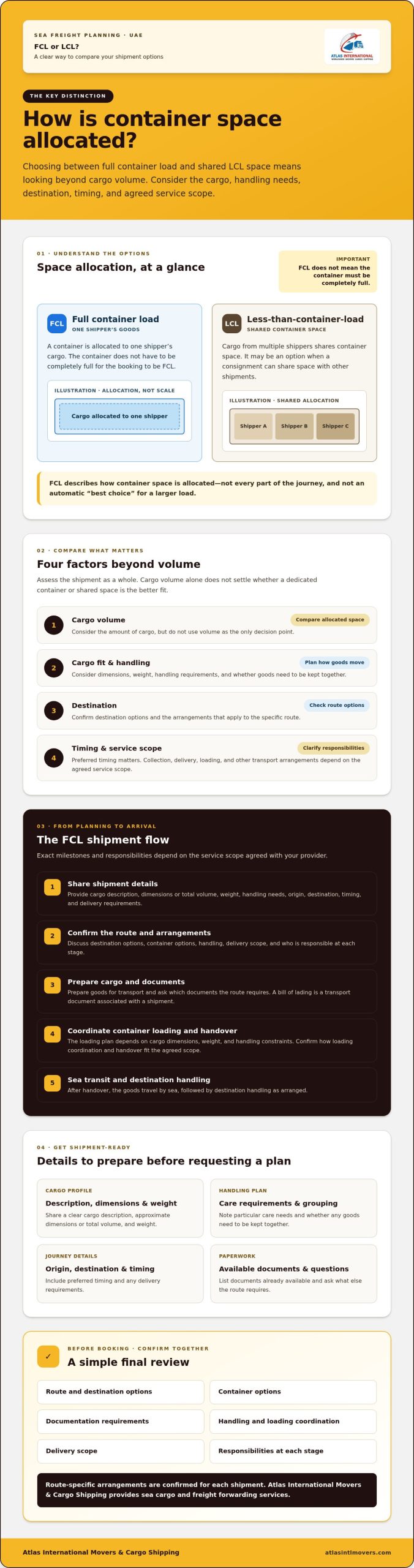
Before arranging sea freight, decide whether your cargo needs a container allocated to it or whether shared space could work. FCL shipping from the UAE is a sea freight arrangement in which a container is allocated to one shipper’s cargo. The container does not have to be completely full for the booking to be FCL.
FCL describes how container space is allocated, not every part of the journey. Collection, delivery, loading, and other transport arrangements depend on the service scope agreed with your provider.
For a related look at shipping responsibilities and trade terms, watch this video:
What does full container load mean in practice?
With FCL, the container is allocated to one shipper’s goods. With less-than-container-load (LCL), cargo from multiple shippers shares container space. This distinction affects how a shipment is planned, but it does not make FCL the better choice for every larger load.
Consider the cargo’s characteristics, handling needs, destination, timing, and agreed service scope alongside volume. Containers are standardized for freight movement. The standardized shipping containers reference explains the basic concept. FCL does not specify a particular container size or guarantee a particular service arrangement.
Who may consider FCL shipping from the UAE?
Businesses with substantial consignments may want to compare an allocated container with shared LCL space. FCL may also be worth discussing if the goods need to be planned and loaded together. Individuals moving a large quantity of belongings can consider container freight too. Suitability depends on the cargo and route, not just the type of shipper.
For example, a business shipping goods that need to move together may have different planning needs from a smaller consignment that can share space. Neither cargo volume nor the FCL label settles the decision on its own. Before booking, confirm destination options, handling, documentation, and who is responsible at each stage.
Atlas provides sea cargo and freight forwarding services. Our team can discuss your shipment details, with route-specific arrangements confirmed for each booking. Learn more about our sea cargo services.
How FCL Shipping from the UAE Works from Booking to Arrival
An FCL shipment involves several coordinated stages. The exact milestones and responsibilities depend on the agreed service scope. In general, you share shipment details, confirm the route and arrangements, prepare the cargo and documents, coordinate container loading, hand over the shipment for sea transit, and manage destination handling.
What information should you prepare before requesting FCL shipping?
Clear information helps a provider assess the shipment and identify what needs to be confirmed for its route. Before requesting a plan, gather:
- A clear cargo description, approximate dimensions or total volume, and weight.
- Handling needs, including whether any goods require particular care or must be kept together.
- Origin and destination details, preferred timing, and delivery requirements.
- Documents already available, along with questions about what else the route requires.
Ask the provider to confirm the documentation and responsibilities that apply to your shipment. A bill of lading is a transport document associated with a shipment, but document requirements can vary by route and arrangement. Clarify which party is responsible at each stage. For context on how trade terms can define responsibilities between buyer and seller, consult the International Trade Administration’s guide to understanding Incoterms.
What happens during container preparation and sea transit?
Once the shipment plan is agreed, prepare the goods for transport and confirm they are ready for the planned loading arrangements. Packing should suit the cargo and expected handling. The loading plan depends on the cargo’s dimensions, weight, and handling constraints, so accurate details are important. Ask how loading coordination and handover fit within the agreed service scope.
After handover, the goods travel by sea, followed by destination handling as arranged. Updates during transit depend on the provider and the service agreed. Confirm what updates are available, who will share them, and how destination-side responsibilities will be managed. Do not assume a particular tracking feature or schedule.
For a shipment-specific discussion, share your cargo profile, route, preferred timing, and delivery needs with a provider. Atlas provides sea cargo and freight forwarding services, with route-specific arrangements confirmed for each shipment. Explore our sea cargo services as a starting point for discussing your requirements.
FCL vs LCL Shipping from the UAE: How to Compare Your Options
Neither FCL nor LCL is automatically best for every shipment. FCL allocates a container to one shipper’s cargo, while LCL combines cargo from multiple shippers in shared container space. The right fit depends on shipment size, cargo characteristics, destination requirements, handling needs, and the agreed service scope.
Use this comparison to guide a conversation with your freight provider. The International Trade Administration’s overview of the international shipping process also provides context on how freight options fit into shipment planning.
| Consideration | FCL | LCL |
|---|---|---|
| Space allocation | A container is allocated to one shipper’s cargo. It does not have to be completely full. | Container space is shared with cargo from other shippers. |
| Coordination | Planning focuses on one shipper’s goods and the agreed loading arrangements. | Planning involves coordinating shared space with other cargo and shipment schedules. |
| Cargo handling | Consider whether a coordinated loading plan suits the cargo and its handling needs. | Ask how shared-container handling will work for your goods and route. |
| Planning | Assess container use, cargo details, destination, and service scope. | Assess the consignment’s needs alongside shared-space arrangements and schedules. |
When might FCL be a better fit than LCL?
For a larger consignment, allocating container space may be practical to discuss. FCL may also suit goods that benefit from a coordinated loading plan or need to remain allocated separately from other shippers’ cargo. These are planning considerations, not guaranteed advantages. Assess the route, cargo characteristics, destination requirements, and service details before deciding whether FCL shipping from the UAE fits your shipment.
When should shippers compare shared container space?
For a smaller consignment, ask whether LCL is available and appropriate. Shared space means your shipment is coordinated alongside other cargo, so ask how schedules, handling, and destination arrangements apply. Compare the complete service scope for both options, including responsibilities and required shipment details or documents. The FCL or LCL label alone will not tell you which arrangement best meets your needs.
How to Prepare an FCL Shipment from the UAE
A useful FCL enquiry starts with a clear picture of the goods and the journey you are planning. Accurate cargo details help a provider assess container use, handling, and route arrangements without relying on assumptions. Before requesting a plan for fcl shipping from uae, gather the information below and ask which details or documents apply to your destination.
- Cargo: Prepare an inventory or clear description of the goods, including approximate dimensions, total volume, and weight.
- Handling and packing: Identify fragile, heavy, or sensitive items, and describe any needs that could affect packing or loading.
- Route: Confirm the shipment’s origin and destination, including the final delivery point if delivery is part of the requested service.
- Timing: Share your preferred shipment timing and ask what schedule can be considered for the route.
- Service scope: Clarify which transport stages are included, who is responsible at each stage, and what destination handling is arranged.
- Documents: Ask the freight provider to identify the paperwork and shipment information required for this route.
How should cargo details and packing be planned?
Provide dimensions and weight as accurately as possible. These details help the provider assess how the goods may fit and plan loading coordination. A vague description such as “equipment” may not explain what handling is needed. Identify the items more clearly and flag delicate components or unusually heavy pieces. Packing should reflect the cargo’s characteristics and expected handling. Confirm any FCL-specific packing or loading arrangements rather than assuming they are included.
Which route and destination details need confirmation?
Confirm the destination, delivery scope, timing expectations, and the parties responsible for each agreed stage. Ask which route-specific documents and destination handling requirements apply. Requirements can vary, so do not treat any document list, customs process, duty, or clearance timeline as universal. A freight forwarder can coordinate shipment arrangements within the agreed scope. This is distinct from assuming the provider offers standalone customs brokerage. Confirm who handles each responsibility.
Atlas provides sea cargo and freight forwarding services, with route-specific arrangements confirmed for each shipment. Explore our sea cargo services to discuss your shipment details and the service scope.
Arrange FCL Sea Cargo from the UAE with Clear Shipment Planning
Before choosing FCL, bring the main parts of your shipment plan together: the cargo profile, likely container use, destination, handling needs, and required service scope. The FCL label alone does not confirm container availability or which services are included.
What should you ask a freight provider about an FCL shipment?
Clarify how the shipment will be coordinated before confirming arrangements. Ask which stages are included, who coordinates each handover, and what remains your responsibility. Then confirm details that can vary by shipment and route:
- Whether a suitable container is available for the intended route and timing.
- What destination handling and delivery arrangements are included, if any.
- Which cargo information and documents the provider needs for this route.
- What exclusions, timing assumptions, or responsibilities apply to the proposed service.
Clear answers help you understand the complete arrangement, not just the container booking. If a responsibility or handover is unclear, ask for an explanation before proceeding.
How can Atlas support sea cargo planning?
Atlas provides sea cargo and freight forwarding services from the UAE to international destinations. Our team can discuss your cargo details and help coordinate shipment planning within the agreed scope. Specific FCL options, container availability, documentation, and handling must be confirmed for each destination and shipment. Atlas does not offer standalone customs brokerage.
For a focused conversation, prepare your cargo description, dimensions, weight, destination, preferred timing, and delivery needs. These details give the provider a clearer basis for discussing the route and available options, while leaving time to confirm responsibilities and route-specific requirements. Atlas has operated since 2003 and provides freight coordination for business and relocation shipments.
Review our sea cargo services and discuss your sea cargo requirements with our team.
Plan Your Next Sea Shipment with Confidence
Choosing fcl shipping from uae starts with the cargo, not the container label. Consider how much space your goods need, how they should be handled, the destination, and which shipment stages need coordination. Compare FCL with shared LCL space, then confirm responsibilities, documentation, and route-specific arrangements before booking.
Accurate cargo descriptions, dimensions, and weight give your provider a useful basis for planning. Clear expectations about timing and delivery scope can also help prevent uncertainty as the shipment moves from preparation to destination handling.
Atlas provides sea cargo transportation and international freight forwarding. Route-specific options and requirements are confirmed for each shipment.
Ready to discuss your shipment? Discuss your sea cargo requirements with our team, and have your cargo details and destination ready.
Frequently Asked Questions
What is FCL shipping from the UAE?
FCL means full container load: a container is allocated to one shipper’s cargo rather than shared among multiple shippers’ goods. The container does not have to be completely full. Whether FCL suits your shipment depends on cargo volume, handling needs, destination, and the service being arranged. Share these details with a freight provider and confirm the route-specific arrangements before booking.
Is FCL shipping better than LCL?
Not in every situation. FCL allocates a container to one shipper’s cargo, while LCL combines goods from multiple shippers in shared space. Shipment size, cargo characteristics, route, timing, and handling needs can all affect the choice. Compare the full service scope and destination arrangements instead of assuming either option is always faster, safer, or more economical. Ask which responsibilities and stages each option includes.
How do I choose between FCL and LCL shipping from the UAE?
Start with your cargo’s dimensions, weight, handling requirements, and destination. Then ask a freight provider to compare container allocation, shipment coordination, and the services included for each option. Do not rely on a single volume rule without checking the route and cargo details. Choose the option that fits the complete shipment plan, including timing expectations and destination handling responsibilities.
What information is needed to arrange FCL shipping?
Prepare a cargo description, approximate dimensions or volume, weight, origin and destination, preferred timing, and any special handling or delivery needs. Identify fragile or sensitive goods rather than describing everything as general cargo. A provider may request additional details or documents depending on the route and cargo. Confirm what applies to your shipment instead of assuming the same paperwork is needed for every route.
Does FCL mean the container must be completely full?
No. FCL describes how container space is allocated, not whether every part of the container is occupied. A shipper may book a container for their cargo even if space remains unused. Whether that arrangement suits your shipment depends on the cargo, destination, shipment plan, and available alternatives, such as shared container space. Ask a provider to assess the details before deciding.
How long does FCL shipping from the UAE take?
There is no single transit time that applies to every FCL shipment. Timing can depend on the destination, route, sailing schedule, cargo readiness, and handling at each end. Ask the freight provider for an estimate based on your origin, destination, and agreed service scope. Confirm which stages the estimate includes, and ask how shipment updates will be communicated rather than assuming a particular schedule or tracking service.
Does Atlas provide customs brokerage for FCL shipments?
No. Atlas provides sea cargo and international freight forwarding, but does not offer standalone customs brokerage. Customs procedures and responsibilities can vary by destination and shipment. Ask Atlas and relevant destination-side providers to clarify who coordinates documentation or clearance-related steps within the specific arrangement. Confirm included services and responsibilities before proceeding, and do not assume brokerage or clearance support is part of freight forwarding unless it is explicitly agreed.