

What if the biggest risk in a corporate relocation isn’t the move itself, but losing track of what must keep running? For UAE businesses, office furniture, IT equipment, transport, and storage all need to be coordinated around operational priorities. A clear plan helps protect business assets and reduce avoidable downtime.
It’s understandable to worry that moving equipment or changing workspaces could interrupt services. The process becomes more manageable when responsibilities are assigned, critical systems are prioritized, and the scope of each provider’s work is clear. Our team at Atlas International Movers & Cargo Shipping has supported relocation and logistics needs since 2003, including corporate relocation and storage solutions.
This guide explains how to build an organized move plan, compare providers by the services they actually include, and prepare furniture and sensitive IT equipment for careful handling. You’ll also learn how transport and secure storage may help when move dates and workspace readiness don’t align. The goal is a practical relocation plan that fits your business and helps keep operations moving.
Key Takeaways
- Start your corporate relocation plan by identifying operational priorities and assigning a clear internal decision-maker.
- Map furniture, IT infrastructure, packing, transport, and delivery needs before asking providers to propose a service scope.
- Compare written proposals against the same inventory and destination details to make differences in responsibilities easier to spot.
- Plan the move in manageable stages, with clear contacts for each workstream and checks for the new workspace.
- Consider whether domestic or international moving, cargo, or storage solutions fit your project, and confirm each provider’s exact scope.
Corporate relocation: what a business move involves and why planning matters
Corporate relocation is the planned movement of a business’s assets, equipment, or operations from one workplace to another. It may involve office furniture, business equipment, and IT infrastructure, with the exact scope shaped by the company’s requirements and destination.
Unlike employee immigration, which concerns an individual’s right to live or work in a country, a business move focuses on operational needs and company assets. It also differs from a household move, which centers on personal belongings. The relocation services overview provides broader context on the term and its varied scope. For a business move, agreeing who handles each task is essential.
For a concise overview of the process, watch this related video:
Which business assets and activities may be part of a relocation?
A move may include desks, chairs, storage units, office equipment, and IT infrastructure. Some assets may need careful handling, while others may need to be accessible quickly at the new premises. The business and its provider should agree on a shared inventory and confirm what is included in the proposed service. This helps prevent assumptions about packing, transport, delivery, or setup from becoming gaps on moving day.
Timing can also affect the plan. If the old workspace must be vacated before the new one is ready, storage may help bridge the gap. Atlas provides corporate relocation and storage and warehouse solutions; confirm the precise scope for your project. Learn more about our office move planning services.
Why operational continuity belongs in the relocation brief
Before logistics are scheduled, identify the work that must continue, the equipment it depends on, and who needs access to it. For example, a team may need certain systems or files available while other furniture is packed. Listing these priorities helps the business sequence tasks and assign responsibility across its internal team and provider.
Continuity planning should begin before packing, so critical work, equipment, and responsibilities are accounted for in the move sequence. Clear ownership and agreed timing can support minimal disruption and downtime, while giving employees a reliable point of contact when plans need attention.
Corporate relocation services: match the move to your business requirements
The right service mix depends on what is moving, where it is going, and when the new workspace will be ready. A useful brief helps providers understand the requirements before they propose a scope. List the assets involved, delivery destination, timing constraints, and any work the business expects the provider to handle. Be specific about whether the request covers transport only or also includes packing, storage, or other coordination.
For a broader reference on planning an office move, Cushman & Wakefield outlines a move management strategy with planning stages and post-move considerations. Use resources like this to shape internal questions, then confirm each service and responsibility directly with your chosen provider.
Office furniture, packing, and IT equipment
Start with an inventory that distinguishes everyday furniture from fragile items and heavy or sensitive IT equipment. Note which items need careful handling, where each should be delivered, and whether any equipment must be available first at the new premises. This detail helps a provider assess the practical requirements rather than relying on broad estimates of the move.
Professional packing can support safer handling in transit, but confirm what packing is included and who is responsible for preparing each item. Don’t assume that unpacking, reconnection, or technical setup is part of the service. Agree on those responsibilities separately and document the scope before confirming arrangements.
Domestic, international, cargo, and storage requirements
A domestic move and an international shipment may involve different coordination, transport options, and service boundaries. Destination, shipment contents, and timing all affect what to discuss. For international moves, ask what coordination is needed to help shipments seamlessly cross borders and arrive safely and securely. Depending on the project, domestic or international moving, air cargo, or sea cargo may be relevant. For cross-border household and shipment context, review the international moving guide, then confirm which details apply to a business shipment.
If access to the current office ends before the new one is ready, ask whether temporary holding is suitable for the items involved. Atlas offers storage and warehouse solutions, which may help bridge a timing gap; discuss the required access and exact scope. Storage should be secure, flexible, and easy access for the business’s needs.
A clear brief makes provider discussions more focused and proposals easier to assess. If you’re preparing a move, review our corporate relocation services and confirm which options fit your inventory, destination, and timeline.
How to compare corporate relocation providers without overlooking risk
Outsourcing a move can seem like one more layer to coordinate. It’s easier to manage when the provider’s responsibilities, your team’s tasks, and the communication route are agreed in one written plan. Compare providers on the same criteria, not just on the overall impression of a proposal.
Questions to ask before appointing a relocation partner
Ask each provider to explain who handles each stage and where your business needs to stay involved. For fragile items, heavy furniture, and sensitive IT equipment, ask how packing and handling will be approached, and how items will be identified or tracked during the move. Confirm what happens if inventory or timing changes, who will communicate updates, and which contact should receive questions. Understanding the full role of business relocation specialists can help you ask more targeted questions and evaluate each provider’s scope more accurately.
Check any claims that matter to your decision, including licensing, insurance, guarantees, or availability. Request the relevant details directly and review what is documented; don’t assume a feature is included because it was discussed informally.
How to compare proposals on a like-for-like basis
Send each provider the same inventory, destination information, timing requirements, and requested services. Then use a simple comparison table to record what each written proposal confirms:
| Comparison area | What to confirm |
|---|---|
| Scope | Which items and move stages are included? |
| Packing | Which furniture, fragile items, or IT equipment will be packed, and by whom? |
| Transport | What transport arrangements are specified for the stated destination? |
| Storage | Is temporary storage included, optional, or outside the proposed scope? |
| Communication | Who is the main contact, and how will changes be shared? |
| Responsibilities | Which tasks remain with your business, and which are assigned to the provider? |
Comparable scopes make proposals easier to assess because differences in service, responsibilities, and assumptions are visible rather than hidden by inconsistent inventories or destination details. Mark each item as confirmed, excluded, or requiring follow-up. Resolve open questions in writing before selecting a provider, especially where a task could affect access to business-critical equipment or the move sequence.
A clear division of roles doesn’t add complexity; it gives both teams one agreed plan to follow. If you’re weighing up the scope for your move, our corporate relocation service is an option to discuss, with project requirements confirmed for each enquiry.
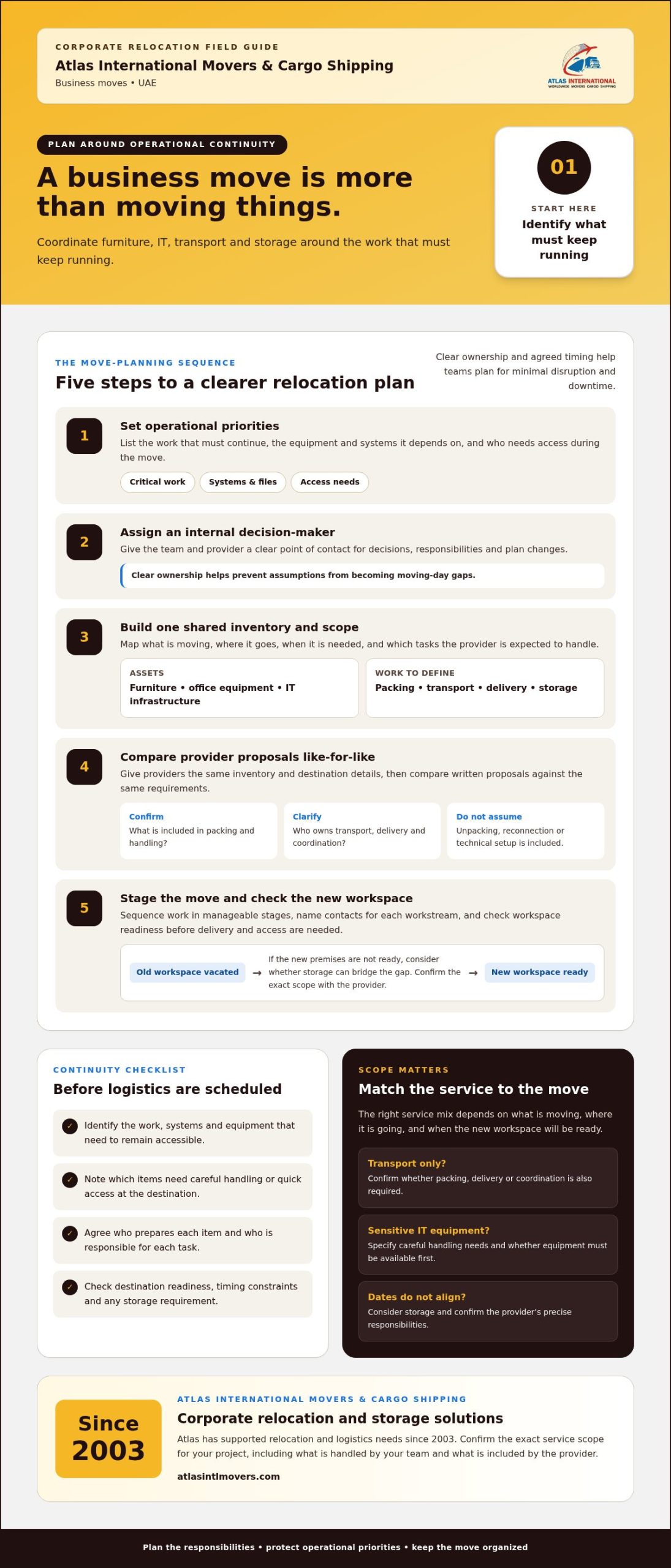
Plan a corporate relocation in clear, manageable stages
A practical plan turns a complex move into coordinated tasks without assuming every business follows the same timeline. Start by appointing one internal decision-maker to oversee approvals and keep the provider and internal teams aligned. Give each workstream, such as IT, staff communication, and facilities, a named contact who can confirm requirements and raise issues promptly.
Create an inventory, responsibilities, and move brief
Build a shared brief that records the items to be moved, handling needs, access constraints, destination details, and operational dependencies. Identify equipment or work that must remain available until a specific handover point. For a move within the UAE, Atlas’s domestic moving service is one option to discuss as you establish the required scope.
- 1. Define needs: Confirm why the business is moving, what must be relocated, and which operations need special consideration.
- 2. Assign ownership: Name internal owners for approvals, staff updates, IT requirements, and provider coordination. Make decision-making routes clear.
- 3. Confirm the brief: Review the inventory, destination, access arrangements, and agreed responsibilities with the provider before move activities are scheduled.
A Stress-free and organized move is a planning aim, not an assured outcome. Clear ownership and a current brief give teams a shared reference when details change.
Coordinate packing, transport, storage, and handover
Plan the move sequence around operational dependencies. For example, identify which equipment must remain accessible until teams are ready to transfer work, and agree when it can be packed and delivered. Confirm packing and transport arrangements against the agreed inventory and service scope. Setup or technical work should be treated as a separate responsibility unless it has been explicitly agreed.
- 4. Align dates and access: Check when the current office must be vacated, when the destination can receive items, and what access arrangements need coordination.
- 5. Resolve timing gaps: If access, delivery, or workspace readiness dates don’t align, ask whether storage is appropriate and confirm the arrangements and responsibilities in writing.
- 6. Complete handover checks: Use the inventory to confirm which items have arrived, note outstanding issues, and check that priority equipment is where the team expects it.
For an international move, ask the provider to clarify any customs-clearance coordination that may apply to the specific shipment. Confirm exactly what is included before proceeding; don’t assume standalone brokerage is part of the relocation service.
Our team can discuss your business’s requirements and help clarify which moving, cargo, or storage options may fit. Discuss your relocation requirements with us.
Choose a corporate relocation partner and prepare the next steps
The right partner should fit your operational priorities, the assets being moved, and the level of support your business needs. Compare those needs with each provider’s confirmed service scope, then agree who is responsible for each task. A proposal is easier to evaluate when it distinguishes included services from optional items and work your team will need to manage.
Atlas provides corporate moving, domestic and international moving, air and sea cargo, and storage and warehouse solutions. These may be options to discuss for your project, not automatic inclusions in every move. Review our corporate relocation services and confirm which requirements can be addressed for your specific inventory, destination, and timing.
What to prepare before requesting a relocation proposal
A clear brief helps providers understand the move and respond with a relevant proposed scope. Before making an enquiry, gather:
- An itemized inventory of furniture, equipment, and other business assets, noting fragile, heavy, or sensitive items that may need particular handling.
- The origin and destination, access conditions at each location, preferred move window, and any storage needs if access or readiness dates do not align.
- Operational dependencies, such as equipment that must remain available until a certain point, plus the internal contacts authorized to approve decisions.
Share any known constraints rather than relying on assumptions. For instance, clarify whether the business needs transport only or wants to discuss packing, cargo, or storage as well. Ask the provider to confirm what it can include and what remains outside the proposed arrangement.
Set expectations for a coordinated business move
Before proceeding, review the proposed plan in writing. Confirm inclusions and exclusions, responsibilities for both teams, the primary communication contacts, how changes will be handled, and the next actions. If packing, delivery, storage, or setup is discussed, check that the written scope reflects the agreed arrangement. Ask how the proposed sequence is intended to support minimal disruption and downtime without treating that outcome as guaranteed.
These checks help turn a broad request into a workable plan and give your team a clear basis for coordinating the move. The right partner aligns logistics with business continuity needs.
Ready to discuss your project? Prepare your inventory, origin and destination, timing needs, and handling requirements, then discuss your corporate relocation requirements with our team to confirm the service scope.
Set your business move up for a confident next step
A well-planned corporate relocation starts with business continuity: define which assets and work activities matter most, then match the move’s scope to those needs. A shared inventory, clear responsibilities, and written provider proposals help your team compare options and prepare for packing, transport, storage, and handover with fewer unanswered questions.
Atlas has operated since 2003 and offers corporate relocation, moving, cargo, and storage services. The right combination depends on your project, so confirm the precise service scope, responsibilities, and next steps before making arrangements. Our team can discuss your requirements and help you explore which options may fit your move.
Discuss your corporate relocation requirements with us. With clear priorities and a suitable plan in place, your business can approach its next move with greater confidence.
Frequently Asked Questions
What does corporate relocation include?
Corporate relocation is the planned movement of business assets, equipment, or operations to another workplace or destination. It may involve office furniture, IT infrastructure, packing, transport, delivery, and storage, depending on the business’s requirements. The exact service scope should be agreed with the provider in advance. Employee immigration and household moves are separate matters, so clarify that your request concerns company assets and operational needs.
How do I choose a corporate relocation company?
Choose a provider whose written proposal matches your inventory, destination, timing needs, and requested services. Compare what’s included for packing, transport, storage, communication, and responsibility for each task. Ask how fragile or sensitive equipment will be handled and how changes will be communicated. Check any claims that matter to your decision directly with the provider, and make sure inclusions, exclusions, and next steps are clearly documented.
How can a business minimize disruption during an office relocation?
Identify essential work, equipment, and access needs before scheduling move activities. Assign an internal decision-maker and clear contacts for IT, staff communication, facilities, and provider coordination. Then agree the sequence for packing, transport, and delivery around operational dependencies. For example, note which equipment must remain available until teams are ready to transfer work. A written plan can help everyone understand responsibilities and reduce avoidable confusion.
Can corporate relocation services include IT equipment and office furniture?
Yes, a business move can include office furniture, equipment, and IT infrastructure. Atlas’s corporate relocation service includes moving office equipment and infrastructure. Confirm the specific inventory and handling requirements with the provider, especially for fragile, heavy, or sensitive items. Don’t assume technical disconnection, reconnection, or setup is included; ask whether those tasks fall within the proposed scope or remain the responsibility of your business or IT team.
Can a corporate relocation company provide storage during a business move?
Some relocation providers offer storage as part of their available services, but its inclusion and scope should be confirmed for each project. Atlas offers storage and warehouse solutions that may be discussed if office access and delivery or workspace readiness dates don’t align. Before arranging temporary holding, clarify which items are involved, when they may need to be accessed, and what storage arrangements the provider’s proposal covers.
What information should I provide to get a corporate relocation proposal?
Share an itemized inventory, the origin and destination, access conditions, and your preferred move window. Identify fragile or sensitive equipment and describe any handling requirements. Include operational dependencies, possible storage needs, and the internal contacts authorized to make decisions. This information helps a provider understand the project and propose a relevant scope. Ask for any assumptions, exclusions, or unresolved details to be stated clearly in writing.
Does Atlas provide corporate relocation services across the UAE?
Yes. Atlas International Movers & Cargo Shipping serves customers nationally across the United Arab Emirates and provides corporate relocation services for businesses. Its listed capabilities also include domestic and international moving, air and sea cargo, and storage and warehouse solutions. These options aren’t automatically included in every project. Share your destination, inventory, and requirements with our team so we can confirm the precise service scope for your enquiry.