

Air freight is the speed-first option for moving cargo across borders. For urgent shipments, international air freight services in the UAE transport goods by aircraft and coordinate the journey from origin to destination, including the documentation and customs steps involved. The final cost depends on factors such as chargeable weight, destination, shipment type, urgency, and special handling needs.
It’s understandable to weigh speed against cost before choosing how to ship. This guide explains how air cargo works in the UAE, what cargo and customs processes can involve, and how air freight compares with sea and land shipping. You’ll also learn how rates are calculated and which shipment details affect the cost, helping you assess the method that best fits your cargo and timeline.
Key Takeaways
- Air freight suits time-sensitive cargo, while service type and handling needs affect the shipment plan.
- Consolidation can combine smaller shipments, and door-to-door service coordinates delivery across the journey.
- Prepare core shipping documents, including an Air Waybill, Commercial Invoice, and Packing List, for customs processing.
- Compare air, sea, and land freight by balancing transit time against the shipment’s priorities and requirements.
- Estimate chargeable weight using both package weight and dimensions, since the larger weight measure can affect the rate calculation.
Air cargo services, including consolidation and door-to-door delivery
Air cargo moves shipments by aircraft between the UAE and international destinations. Depending on the service, the journey can include collection, transport to the airport, export documentation, customs clearance, and delivery at the destination.
Consolidation and Door-to-Door Delivery
Cargo consolidation combines smaller shipments into one larger shipment. It can suit businesses sending separate cartons of retail stock or spare parts when each consignment doesn’t need its own full booking. The cargo travels together, while shipment records retain the details needed to identify each consignment.
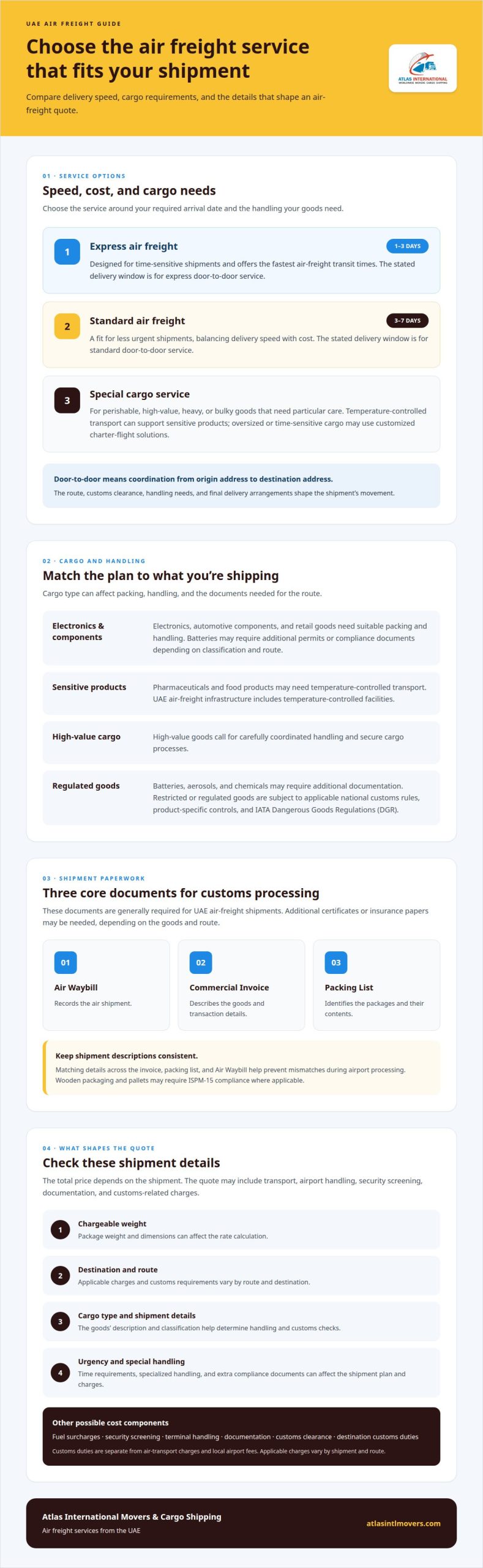
Door-to-door delivery coordinates the shipment from its origin address to its destination address. Standard door-to-door air delivery is stated to take 3-7 days, while express delivery is stated to take 1-3 days. The route, customs clearance, handling needs, and final delivery arrangements shape the movement.
Cargo Types and Special Handling
Electronics, automotive components, and retail goods each need suitable packing and handling for air transport. For example, a shipment of electronic equipment may include batteries, which can require additional permits or compliance documents depending on their classification and route. Aerosols and chemicals may also require additional documentation.
Pharmaceuticals and food products may need temperature-controlled transport to protect sensitive cargo. High-value goods call for carefully coordinated handling and secure cargo processes. The UAE’s air freight infrastructure includes temperature-controlled facilities and secure handling practices. Restricted or regulated goods are subject to applicable national customs rules, product-specific controls, and the IATA Dangerous Goods Regulations (DGR).
Express, Standard, and Special Service Options
Express air freight is designed for time-sensitive shipments and offers the fastest air freight transit times. Standard service suits less urgent shipments, balancing delivery speed with cost. Choose between them by comparing your required arrival date with the shipment’s handling and delivery needs.
Special cargo services address shipments that need particular care, including perishable, high-value, heavy, or bulky goods. Temperature-controlled transport can support sensitive products such as pharmaceuticals. Oversized or time-sensitive cargo may use customized charter-flight solutions. These options match the transport plan to the goods rather than treating every shipment alike.
Export Documents and Customs Clearance
Air freight shipments to or from the UAE generally require an Air Waybill, Commercial Invoice, and Packing List. Depending on the goods and route, documents may also include certificates and insurance papers. These records identify the shipment, describe its contents, and support customs processing.
For exports, the customs rules and documents depend on the goods’ classification and destination requirements. Regulated categories, including pharmaceuticals, batteries, aerosols, and chemicals, may need additional permits or compliance documents. Wooden packaging and pallets may require ISPM-15 compliance where applicable. Accurate shipment details help align documentation with the cargo being transported.
Tracking, Insurance, and Liability
Air cargo tracking can provide online updates on departure, transit, and arrival, with email or SMS notifications about delays or other changes. Insurance papers may form part of shipment documentation. Liability is addressed through the applicable transport terms, so tracking updates alone don’t define coverage or responsibility for cargo.
Customs clearance
Air freight costs can include transport, airport handling, security screening, documentation, and customs-related charges. The total price depends on the shipment and is provided after a quote request. Key factors include chargeable weight, destination, cargo type, and special handling.
Booking and Clearance Documents
At booking, shipment details establish the route, cargo description, handling needs, and transport arrangements. An Air Waybill records the air shipment, while the Commercial Invoice describes the goods and transaction details. The Packing List identifies the packages and their contents.
These three documents are generally required for customs processing on UAE air freight shipments. Depending on the goods and route, certificates or insurance papers may also be needed. Consistent descriptions across the invoice, packing list, and Air Waybill help prevent mismatches during airport processing.
For exports, customs requirements depend on the goods and destination. The shipment’s classification and documentation help determine which checks apply. Regulated cargo, such as batteries, pharmaceuticals, aerosols, or chemicals, may need additional permits or compliance documents according to its classification and route.
Customs Duties and Local Fees
Customs duties depend on the goods and the rules applied at the destination. They are separate from air transport charges and local airport fees. The shipment description, classification, and Commercial Invoice provide important information for assessing customs treatment.
Other cost components can include fuel surcharges, security screening, terminal handling, documentation, and customs clearance. Applicable charges vary by shipment and route. A detailed quotation should distinguish these components from transport costs so you can understand the total before booking.
Fuel surcharges relate to air transport, while security and terminal handling charges cover airport processing. Documentation fees cover shipment paperwork, and customs-related charges arise during clearance. These line items can vary by route and cargo type, particularly when specialized handling or extra compliance documents are involved.
UAE air freight costs combine applicable service charges with shipment-specific factors. Weight, package dimensions, destination, urgency, cargo type, and handling requirements all influence the total. Customs duties also depend on the goods and destination, so distinguish them from freight and airport charges.
For shipments moving from the UAE to Saudi Arabia or Kuwait, accurate cargo details support booking and documentation. Our air cargo shipments can be planned around the route, cargo type, and required handling.
Air freight compared with other shipping methods
For UAE exports, the choice between air, sea, and land freight depends on delivery timing, cargo, and destination. Air freight transit times from the UAE typically range from 2 to 7 business days, while sea freight is listed at 20 to 40+ days and land freight at 3 to 10 days. These ranges help frame the trade-off, but route and shipment conditions affect the actual movement.
Air, Sea, and Land Freight Compared
Air freight is the fastest of these options on many international routes. It can suit urgent stock replenishment, replacement parts, or other shipments with a firm arrival deadline. Sea freight generally takes longer, but can suit cargo where speed is less important. Land freight may be relevant for regional routes connected by road.
For example, a company exporting components could prioritize air transport when a production delay depends on prompt delivery. The same business might use sea freight for planned inventory replenishment when the goods can travel over a longer period. For a nearby regional destination, land transport may be a practical comparison.
Air cargo accounts for a specific portion of international trade cargo volume, reflecting its role in moving goods where speed matters. Leveraging professional international air freight services uae, businesses can transport cargo to nearly every country worldwide, supporting a global export network. Transit time alone doesn’t settle the choice: cargo dimensions, handling needs, destination access, and the cost of holding inventory also influence the decision.
What to Consider When Comparing Options
Compare each mode against the shipment’s purpose. A temperature-sensitive product may need controlled handling, while bulky cargo may call for a different transport plan. Consider the complete journey, including origin collection, airport or port handling, customs clearance, and final delivery. A fast flight doesn’t eliminate the time needed for those steps.
- Air: Consider it when delivery speed is a priority or goods need to reach a distant market quickly.
- Sea: Consider it when a longer transit time fits the inventory plan and cargo schedule.
- Land: Compare it for regional routes where road connections support the delivery plan.
Choosing an Air Freight Company in the UAE
When selecting Atlas International Movers & Cargo Shipping for an export from the UAE, assess how the shipment will be coordinated from collection through delivery. The plan should account for the route, booking, cargo type, documentation, customs clearance, and any specialized handling. Clarify whether the quoted timeline covers airport-to-airport movement or the full door-to-door journey.
Air cargo routing may involve different airport options across the Emirates. A suitable route depends on destination connections and the shipment’s needs. For electronics, automotive parts, or retail goods, clear cargo descriptions and handling instructions help align booking and transport arrangements. Compare the proposed service scope with the shipment’s actual deadline and delivery location before selecting a freight method.
Air freight rates from Dubai by destination
Transit time from the UAE varies by destination and shipment conditions. Air freight from Dubai to London typically takes 2-3 business days; Dubai to New York takes 3-4 business days, while Dubai to Shanghai takes 4-6 business days.
Destination affects the rate, but it doesn’t determine the full charge by itself. The payable rate depends on shipment-specific details and is provided after a quote request. Destination, chargeable weight, cargo type, urgency, and special handling all shape the rate. A Europe-bound shipment and an Asia-bound shipment can have different transport requirements, even when both leave the UAE.
Destination examples help clarify how routes influence planning:
- Europe: Dubai to London typically takes 2-3 business days.
- North America: Dubai to New York typically takes 3-4 business days.
- Asia: Dubai to Shanghai typically takes 4-6 business days.
- South Asia: Sharjah to Mumbai can take less than 24 hours hub-to-hub.
- Central Europe: Abu Dhabi to Frankfurt typically takes 2-3 business days.
These are route examples, not door-to-door schedules. Airport processing, customs clearance, and final delivery add steps around the flight, while service type and shipment conditions can affect total transit time.
Dubai International Airport (DXB) is a central UAE air freight gateway. Abu Dhabi International Airport (AUH) and Sharjah International Airport (SHJ) provide additional cargo capacity; specialized facilities at Abu Dhabi and Sharjah support cargo types such as perishables. The suitable departure airport depends on the route, schedules, and cargo handling needs. Temperature-controlled facilities matter for sensitive imports and exports.
For air imports to the UAE, the shipment’s journey doesn’t end when the aircraft lands. Cargo must move through airport handling and customs clearance before onward delivery. Documentation, cargo classification, and any specialized handling requirements shape those steps. Planning the destination address and delivery arrangements alongside the flight helps coordinate the full movement.
Schedules also matter when a shipment has a fixed arrival requirement. A direct connection and a route involving transit hubs can produce different journey plans. For example, Dubai-to-London and Dubai-to-Shanghai transit times differ, so the destination should be part of the booking plan from the outset. Importers can use the expected arrival window to coordinate receiving staff, storage, and distribution without treating flight time as the complete delivery timeline.
Air freight cost calculation by chargeable weight
Air freight quotes consider both the shipment’s physical weight and the space it occupies. Understanding chargeable weight helps explain why two shipments with similar scale readings can have different logistics costs.
Chargeable and Volumetric Weight
Volumetric weight estimates how much aircraft space a package uses. For air cargo, calculate it by multiplying the package’s length, width, and height in centimetres, then dividing by 6000. The result represents volumetric weight in kilograms. Measure the outer dimensions after packing, because protective materials and carton shape affect the space taken.
Chargeable weight is the basis used to price transport. Carriers compare the shipment’s actual weight with its volumetric weight, then use the higher figure for rating. A dense, compact parcel may be rated closer to its scale weight. A light but bulky carton can have a higher volumetric figure and therefore a higher chargeable weight.
For multiple packages, record each carton’s dimensions and weight separately. Their combined size and physical weight determine the shipment totals. This is especially useful for irregularly shaped goods, where measuring only one side or the inner product can understate the space occupied. Accurate measurements at booking help logistics teams prepare a more suitable estimate.
Weight-Based Air Freight Costs
Chargeable weight is only one part of the total cost. Air freight charges also depend on destination, cargo type, urgency, customs duties, and special handling requirements. Sensitive goods or time-critical cargo may need different arrangements from standard shipments, affecting the overall quote beyond its weight basis.
Carriers and freight forwarders use shipment details to calculate applicable transport charges. The route matters because the destination affects available services and schedules. Package dimensions establish volumetric weight, while cargo classification helps identify specialized handling needs. Customs duties and airport-related charges are separate considerations from the freight charge itself.
To prepare a clear quotation, calculate the shipment in a practical sequence:
- Record the packed weight and outer dimensions for every package.
- Calculate volumetric weight using centimetres and the 6000 divisor.
- Compare actual and volumetric weight to establish chargeable weight.
- Apply route, urgency, cargo type, and handling requirements to the quote.
When a shipment changes after packing, revised dimensions or weight can change its chargeable basis. Keeping the package measurements consistent with the final cargo helps align the booking, carrier rating, and transport plan. For a shipment estimate based on your cargo details, request an air cargo quote.
Atlas International Movers & Cargo Shipping
Atlas International Movers & Cargo Shipping helps individuals and businesses plan international or domestic moves and cargo shipments. Our services include air cargo and sea cargo, giving you options when balancing delivery urgency, cargo needs, and destination. Share your shipment details with our team to discuss the transport method that fits your plans.
If your cargo is part of a wider relocation, coordinated planning can help keep the move organized. International Moving helps your belongings seamlessly cross borders and arrive safely and securely, while our comprehensive Domestic Moving service makes moving within the UAE easier. The right approach depends on what you’re moving, where it needs to go, and how the cargo fits into your wider plans.
Contact Atlas International Movers & Cargo Shipping to discuss your shipment or move through our contact team.
Plan the Next Move with Confidence
The next step is to turn your shipment priorities into a clear transport plan. Consider what is moving, its destination, required arrival timing, and any handling needs. These details help frame a practical discussion about how to move your cargo or belongings.
Atlas International Movers & Cargo Shipping provides Air Cargo alongside International Moving and Domestic Moving. Whether your shipment is part of a wider relocation or a separate cargo movement, our team can help you consider the right service for your plans. Choosing international air freight services in the UAE is one part of coordinating a smooth transition, with cargo details and delivery requirements guiding the next decisions.
Discuss your shipment plans with Atlas International Movers & Cargo Shipping, and take the next step with a clear plan in place.
Frequently Asked Questions
What is Air Freight?
Air freight transports goods by aircraft between an origin and a destination. It can suit commercial shipments, household goods, urgent replacement parts, or products that need controlled handling. The service may cover more than the flight itself, including collection, airport processing, customs coordination, and delivery. For example, a business can use air cargo to move a small, time-sensitive stock replenishment to an overseas market.
What international air freight services are available in the UAE?
UAE shippers can arrange express, standard, and special cargo services, with options such as consolidation and door-to-door delivery. The right fit depends on the shipment’s deadline, size, goods, and handling needs. For instance, a retailer sending several small consignments may consider consolidation, while sensitive goods may require temperature-controlled transport. Atlas International Movers & Cargo Shipping offers Air Cargo and Sea Cargo, along with international and domestic moving.
Which UAE airports handle international air cargo?
Dubai International Airport (DXB), Abu Dhabi International Airport (AUH), and Sharjah International Airport (SHJ) handle air cargo movements. The best departure or arrival airport depends on the route, available schedules, and cargo requirements. Abu Dhabi and Sharjah also provide specialized facilities for cargo types such as perishables. For an import, consider the airport’s role in the full journey, including customs processing and onward delivery to the receiving address.
What are typical air freight rates from the UAE by destination and weight?
There isn’t one rate that applies to every UAE air freight shipment. The quote depends on destination, chargeable weight, urgency, cargo type, and any special handling requirements. A lightweight but bulky package can be rated differently from a compact, dense parcel because the space it occupies matters. Provide the packed dimensions, actual weight, destination, and cargo description to establish a shipment-specific estimate in AED.
What are the UAE customs clearance requirements for air freight imports?
Air freight shipments to or from the UAE generally require an Air Waybill, Commercial Invoice, and Packing List. For an import, these documents identify the shipment, goods, and packages for processing. Some products, including batteries, pharmaceuticals, aerosols, and chemicals, may require additional permits or compliance documents depending on classification and route. Clear, consistent goods descriptions help customs processing match the paperwork to the arriving cargo.
How do DHL, FedEx, UPS, Emirates SkyCargo, and local UAE freight forwarders compare?
DHL, FedEx, UPS, Emirates SkyCargo, and local UAE freight forwarders are different shipping options, but no single name is best for every shipment. Compare the service scope, route, delivery arrangement, cargo acceptance, handling requirements, and documentation support for your specific consignment. A parcel shipment and a larger commercial cargo booking may need different arrangements. Focus on how each option handles the complete journey, not only the aircraft leg.
How do I book international air freight in the UAE, from pickup to delivery?
Start by providing the origin and destination, cargo description, packed dimensions, actual weight, and required delivery timing. The shipment can then be assessed for service type, route, handling, and documentation. Once booking details are set, the cargo is collected or delivered for airport processing, transported by air, cleared, and moved to its destination address. Keep shipment information consistent across the booking and accompanying documents.
What should businesses check when choosing an international air freight provider in the UAE?
Businesses should assess whether the proposed service matches the cargo, route, timeline, and delivery location. Check what the transport plan includes, how documentation and customs coordination are handled, and whether special requirements such as temperature control are addressed. For example, a shipment containing sensitive goods needs a plan that accounts for handling throughout its journey. Also review which charges are included in the quotation and which are separate.