

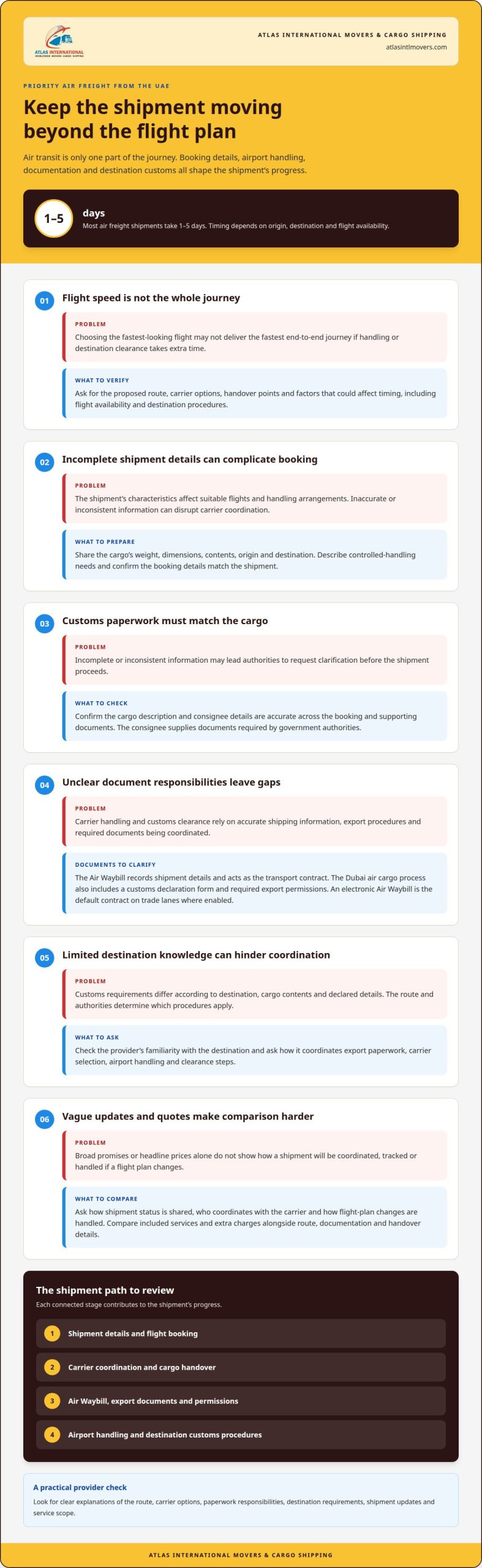
Speed matters, but the fastest-looking flight plan is only useful if the shipment can move through each stage without avoidable delays. For priority air freight forwarding in the UAE, most air freight shipments take 1-5 days, depending on the origin, destination and flight availability.
Air cargo is often chosen when goods need to arrive sooner than sea freight allows. But transit time depends on more than the time in the air: documentation, cargo preparation, airport handling and customs procedures all shape the journey.
This guide explains how Dubai air cargo shipping works and what to consider when choosing a forwarding provider for an urgent shipment. You’ll learn how flight selection and the Air Waybill fit into the process, which shipment details can affect timing, and how to assess whether air freight suits your cargo and delivery needs.
Key Takeaways
- Most air freight shipments take 1-5 days, with timing shaped by origin, destination and flight availability.
- Understand how booking, carrier coordination and Air Waybill details fit together to keep a shipment moving.
- Assess a provider’s destination experience, communication and handling of documentation before choosing a forwarding partner.
- Learn which shipment characteristics can affect air transport suitability, handling and insurance options.
- See how air cargo and sea cargo can support different shipping priorities from the UAE.
How to Choose the Right Air Cargo Shipping Company?
For priority air freight forwarding in the UAE, booking, carrier coordination and customs paperwork all shape a shipment’s progress. Each stage connects the cargo to its flight and destination procedures.
Booking and Carrier Coordination
Booking starts with the shipment details: weight, dimensions, contents, origin and destination. The forwarder uses this information to identify suitable airlines and flights, then coordinates the cargo handover with the selected carrier. Flight availability and the shipment’s characteristics affect which option fits the supply chain. A clear booking process explains the proposed flight plan and the information needed to arrange transport.
Companies in Dubai also coordinate cargo collection and airport delivery. The forwarder prepares the Air Waybill, which records shipment information and acts as the transport contract. Confirming that the shipment details match the booking helps keep carrier coordination consistent. This matters for controlled goods, where cargo type can affect handling arrangements.
Customs Clearance and Export Permissions
International air freight involves customs procedures at the UAE departure point and the destination. The forwarder can assist the consignor or consignee with export documentation and clearance procedures. Before cargo moves, required customs steps and confirmations must be completed, including obtaining permission for export. The process links the shipment’s paperwork with the authorities responsible for its passage through the airport.
Clearance depends on the cargo’s destination, contents and declared details. The forwarder coordinates the relevant procedures, while the consignee supplies documents required by government authorities. If information is incomplete or inconsistent, officials may request clarification before the shipment proceeds. Accurate details help all parties manage this stage as part of the booking.
Customs Documentation and Shipping Documents
The Air Waybill is a central shipping document. It contains the shipment’s weight, size and type, alongside shipper and consignee information. The forwarder prepares it using the booking details, so accuracy across those records is important. An electronic Air Waybill is the default contract on trade lanes where it is enabled. A customs declaration form is also part of the Dubai air cargo process.
Documents support both carrier handling and customs clearance. The shipment description should match the goods being transported, and the consignee’s information should identify the receiving party. Customs authorities use submitted documents to facilitate the movement of goods through the airport. The forwarder coordinates shipping paperwork, while the consignee provides documents required for the relevant procedures.
Customs Requirements Experience
Familiarity with the destination country’s customs requirements helps a forwarder identify documentation needs and coordinate clearance. A well-defined process accounts for the route, cargo type and information authorities require. For example, the declared contents should match the supporting documents and Air Waybill. Destination knowledge can make customs coordination a more integrated part of the booking.
When assessing a provider’s experience, focus on its familiarity with the destination and its role in documentation and export procedures. The forwarder should explain how it coordinates carrier selection, paperwork and airport handling for the route. These connected steps help businesses understand where the shipment stands in the supply chain and what must happen before it moves onward.
Choosing an air freight provider
Choosing an air freight partner means matching its logistics process to your shipment and destination. For exports from the UAE, assess the proposed route, carrier coordination, communication and destination experience together.
Start with your delivery requirement, then ask how the provider plans to meet it. The fastest flight may not mean the fastest end-to-end journey if cargo handling or destination clearance takes extra time. A useful proposal explains the route, carrier options and handover points. It should also identify factors that can affect timing, such as flight availability and destination procedures.
Destination experience matters for international shipments. A provider familiar with the receiving country’s customs requirements can help coordinate relevant documents and clearance steps. Consider whether the team can explain what information the consignee must supply and how export procedures fit into the booking. Clear answers show how the forwarder connects transport planning with the shipment’s arrival process.
Assess reliability by the quality of communication, not by broad promises. Ask how the provider shares shipment status, who coordinates with the carrier, and how it handles flight-plan changes. Air freight offers tracking, while airline and forwarder networks can help address disruptions. These details show whether the process gives your logistics team useful visibility.
Review the scope of the air freight services in the proposal. Check that the shipment description, route, carrier coordination and documentation responsibilities are clear. When comparing quotes, compare the services included and any extra charges, not just the headline amount. A consistent scope makes it easier to see which arrangement suits your supply chain and delivery priority.
Cargo suitability is another practical consideration. Give the provider an accurate description of the goods, their dimensions and their destination. These details help determine handling needs and available flight options. For example, cargo requiring controlled handling may need different arrangements from ordinary boxed goods. A suitable partner explains these considerations before finalizing the booking.
Choose a provider that can connect each step, from export preparation to carrier handover and destination coordination. For a UAE business, the right partner is not automatically the one naming the fastest flight. It is the one whose route, communication and responsibilities align with the shipment’s actual needs. Explore air cargo planning as you assess the next step.
Air freight transit speed
Most air freight shipments are delivered within 1-5 days. Timing depends on origin, destination and flight availability. That range describes shipment delivery, not simply time in the air. Airport handling, unloading and customs procedures also form part of the journey, so the flight duration alone cannot show when cargo will reach its final destination.
Air transport is generally faster than sea freight because aircraft travel faster than ocean liners. For an urgent shipment from the UAE, this can help businesses meet a short delivery window. Sea freight may still suit cargo with a more flexible timeline. The right mode depends on when the goods are needed and their role in the supply chain.
A commercial flight schedule is only part of the timing picture. The shipment must also be prepared, accepted at the airport and transferred to the aircraft. After arrival, unloading and customs procedures come before onward delivery. Each stage connects to the next, so an efficient flight cannot eliminate the time needed for airport handling or destination clearance.
Route structure also matters. A direct flight and a route with a connection can have different schedules and handover points. Flight availability affects which option can carry the shipment, while the destination determines onward arrangements. Airline networks connect cargo from the UAE with destinations worldwide, but the route plan still needs to suit the cargo and required delivery timing.
For a time-sensitive shipment, map the journey in stages: origin handling, airport acceptance, flight, arrival processing and onward delivery. This helps distinguish air transit from the full transportation timeline. For example, a shipment may be airborne for only part of its total journey because airport and customs procedures take place before and after the flight.
Air freight’s shorter transit time can also reduce the need for warehousing or extended stock storage. A business shipping replenishment cargo can plan around the arrival window rather than holding the same inventory for a longer sea journey. The useful comparison is not speed alone, but how each transport mode fits stock requirements and the destination schedule.
Tracking can help you follow a shipment through the transport network. The Air Waybill provides shipment information and supports tracking, while carrier and forwarder networks can help address disruptions. Check the latest status at key handover points, such as airport acceptance, departure and arrival. These milestones show the shipment’s place in its route, not just its estimated flight time.
When setting a delivery plan, allow for the full route rather than treating the fastest flight as a guaranteed arrival date. Origin, destination, available flights, airport processing and customs all influence timing. Air freight suits goods where speed matters; sea freight may be more appropriate when the delivery window allows a slower transport mode.
Which UAE freight forwarders offer priority air freight services?
In the UAE, forwarders arrange priority air freight by coordinating cargo bookings with airlines. The practical difference lies in how they handle an urgent shipment: flight selection, booking confirmation, airport handover and destination coordination. The service description should make clear which of these steps the forwarder manages.
Look for a defined priority process, rather than relying on the word “priority” alone. A useful plan identifies the proposed route, available flight, cargo acceptance arrangements and next handling point. For example, an urgent shipment from Dubai needs a suitable departure and a clear plan for getting the cargo to the airport. The schedule still depends on flight availability and destination requirements.
Forwarders differ in the routes and carrier connections they can coordinate. A provider arranging international air cargo should explain how it selects a carrier for the destination and what happens if the planned flight changes. A priority booking is part of a wider transport chain, not a way to bypass airport handling or customs procedures.
Before booking, give the forwarder accurate details about the cargo, its dimensions, contents, origin and destination. This information helps determine suitable flight and handling arrangements. The Air Waybill then records the shipment details and supports its movement through the carrier process. If the cargo description changes, the booking and related documents may need updating.
For UAE exports, the provider’s role in documentation and airport coordination is another useful distinction. Some forwarders coordinate carrier booking and paperwork as connected stages; others may focus on a narrower part of the journey. A clear service plan identifies who manages each handover and how the consignee’s information supports destination procedures.
For an urgent shipment, compare the proposed arrangements rather than provider labels. Check the route, carrier, flight availability, airport delivery plan and destination handling in the quotation or shipment plan. Note any extra charges included in the final amount. Comparing proposals based on the same shipment details gives a more meaningful view than comparing headline prices alone.
Priority air freight may suit time-sensitive documents, replacement parts or stock needed for an imminent order. Each shipment still needs to be assessed individually, since contents and handling needs affect transport arrangements. The forwarder should explain how the cargo moves from booking to carrier acceptance and onward destination processing, so each stage of the priority plan is clear.
In short, choose a UAE forwarder that can coordinate an appropriate flight and connect booking, cargo handover and destination arrangements. No provider can remove steps required by the route or flight availability. A well-defined priority service explains its process, helping businesses align shipment timing with operational needs.
What cargo restrictions, risks, and insurance options apply to priority air freight from the UAE?
Priority handling does not remove cargo suitability checks. Before booking, assess the shipment by its contents, destination and transport method. Air freight providers sort cargo to identify hazardous, flammable and fragile items that may need special handling. An accurate description helps the forwarder plan packaging and carrier arrangements for the goods being shipped.
Dangerous goods need particular attention. Handling them involves specialist documentation, packaging and a carrier capable of transporting them, and must comply with IATA regulations. These requirements affect whether and how a shipment can move by air. Clearly describe the contents at the booking stage so the forwarder can consider the relevant handling needs before the shipment reaches the airport.
Packaging is another practical way to manage risk. Select materials according to the quality and nature of the shipment’s contents. Fragile goods, for example, need protection suited to their contents, while other cargo may require different packaging. Appropriate preparation helps reduce the chance of damage during handling and transport. The cargo description and packaging plan should match.
Airport inspection and handling can reveal weak packaging or unclear cargo descriptions. A shipment may be checked for its type, destination and transport method before loading. Clear labels and consistent shipment information help identify what is being handled. Describe fragile, hazardous or flammable items accurately rather than as general cargo, so their handling requirements are clear.
Transit risks can also arise during handovers between the forwarder, airport and carrier. Secure handling and clear shipment records help maintain continuity at each stage. Air freight relies on airport cargo processes and carrier networks, so shipment details need to remain consistent from booking through arrival. Priority service shapes the plan but does not remove inspection or cargo handling procedures.
Insurance is separate from carrier handling. Air freight companies in the UAE can arrange shipment insurance at the customer’s request. Consider it when the shipment’s contents or replacement needs make financial exposure important. Before transport, clarify what the arrangement covers and how a damage claim is handled. If a shipment is damaged, check the applicable insurance and claims arrangements.
For an urgent shipment, share its contents, packaging condition, destination and any known handling sensitivities before dispatch. This helps the forwarder assess carrier suitability and coordinate preparation. A fragile item, for instance, needs a different packaging assessment from a robust item, while dangerous goods have specialist requirements. Accurate details help prevent avoidable handling issues.
Careful cargo preparation supports safer handling, but it cannot eliminate every transport risk. Arrange air cargo support for your shipment when you need help coordinating its transport and handling needs.
Atlas International Movers & Cargo Shipping
Atlas International Movers & Cargo Shipping helps individuals and businesses plan cargo and moving requirements from the UAE. If your priority shipment needs air transport, our Air Cargo service supports the booking, route and handling considerations explained above. For less urgent shipments, Sea Cargo offers another transport option. International Moving and Domestic Moving support broader relocation needs.
Talk to our team when you need to decide how your shipment or move fits the available transport options. Sharing the cargo’s destination and timing needs helps us focus on your requirements. We can help you consider the service that best fits your plans.
For assistance with your shipment or moving plans, contact Atlas International Movers & Cargo Shipping.
Make Your Next Shipment Decision with Confidence
Before arranging priority air freight forwarding in the UAE, define what the shipment needs to achieve at its destination. Consider the operational impact of a late arrival, when the goods are needed and who will receive them. These points turn urgency into a practical transport plan rather than relying on the word “priority” alone.
Whether you have a one-off shipment or a broader relocation, clear planning starts with the cargo details and the purpose of the move. Atlas International Movers & Cargo Shipping can help you discuss suitable options. Share your shipment or moving requirements with our team to plan the next steps.
Contact Atlas International Movers & Cargo Shipping to discuss your plans. A clear starting point can make the journey ahead feel more manageable.
Frequently Asked Questions
How does Dubai air cargo shipping work?
Air cargo shipping moves goods from sender to airport, then by aircraft to the destination. The forwarder arranges the booking and cargo handover, while the airline transports the shipment. On arrival, the cargo is unloaded and proceeds through destination customs before onward delivery. Shipment updates can help the consignee prepare for arrival and coordinate receipt after notification from the airline.
What is priority air freight forwarding in the UAE?
Priority air freight forwarding in the UAE focuses on arranging a suitable flight and coordinating cargo handling for time-sensitive goods. It involves booking with a carrier and organizing transport around the shipment’s destination and cargo details. Priority status does not remove airport processing or customs procedures. Instead, it structures the shipment plan around urgency and available flight options.
How much does priority air freight cost from the UAE per kg?
There isn’t one fixed per-kilogram price for every shipment. The price depends on the case and is provided after a quote request. Relevant factors include origin, destination, cargo dimensions, weight, contents, flight availability and handling needs. Dimensional weight may also matter: multiply length, width and height in centimetres, then divide by 6000 to calculate volume weight in kilograms. Provide accurate measurements for a useful quote.
What are the transit times for priority air freight from Dubai, Abu Dhabi, and Sharjah?
Most air freight shipments are delivered within 1-5 days, depending on origin, destination and flight availability. That range applies to shipments generally; it doesn’t assign a separate transit time to Dubai, Abu Dhabi or Sharjah. The departure airport, route, available flight and destination processing all influence the schedule. For planning, consider the full journey, including airport handling and customs, rather than flight time alone.
Which destinations and cargo types are covered by UAE priority air freight services?
Air freight can move cargo from the UAE to destinations around the world, subject to route and carrier arrangements. Suitability depends on the cargo’s contents, dimensions, destination and handling needs. Ordinary boxed goods may have different requirements from fragile items or dangerous goods. Dangerous goods require specialist documentation, packaging and a capable carrier under IATA regulations, so identify their contents during shipment planning.
What are the UAE customs rules and documents required for priority air freight?
International shipments need documents that support carrier handling and customs procedures. Common shipment records include an Air Waybill with shipper, consignee, cargo type, size and weight details, as well as a customs declaration form. The consignee also supplies documents required by government authorities for the shipment’s passage. Requirements depend on the cargo and destination, so accurate descriptions and consistent information help the forwarder coordinate export and clearance steps.
How do priority air freight services compare with express courier and standard air freight?
Priority air freight arranges air cargo around an urgent shipment’s flight and handling needs. Standard air freight also moves cargo by aircraft, but bookings may follow a less urgent schedule. Express courier is generally arranged as a parcel-focused delivery service, while freight forwarding coordinates cargo transport with carrier and airport processes. Compare services by shipment size, delivery needs, handling and the transport steps included.
How do I book priority air freight with a UAE freight forwarder?
Start by giving the forwarder the shipment’s origin, destination, contents, dimensions, weight and required delivery timing. This information helps assess flight options and coordinate a carrier booking. Then provide the shipper and consignee details needed for the Air Waybill and relevant customs paperwork. Confirm the proposed route, cargo handover arrangements and document responsibilities before sending the shipment to the airport.