

UAE summer temperatures can reach 45 degrees, putting heat-sensitive belongings at risk in ordinary storage. Climate-controlled storage units in the UAE help protect items such as wooden furniture, electronics, photographs and important documents by managing temperature and humidity.
Climate controlled storage units UAE customers consider can be useful when belongings will be stored for an extended period or may be affected by heat and moisture. The right choice depends on what you’re storing, how much protection those items need and how long they’ll remain in storage.
This guide explains how climate control helps protect sensitive items, what can affect the cost compared with standard storage, and what to consider when looking for storage in Dubai and Abu Dhabi. You’ll also learn how secure, flexible storage can support a move or a change in space without adding unnecessary complexity.
Key Takeaways
- Climate control manages temperature and humidity, which can help reduce environmental risks to belongings during storage.
- Wood, clothing and electronics can respond differently to heat, so the right storage conditions depend on what you’re keeping.
- Artwork, photographs, wine and important documents may need particular care; their storage requirements are not all the same.
- Climate-controlled storage can cost more than standard storage. Unit size, storage duration and the level of environmental control affect the overall cost.
- When considering storage in Dubai or Abu Dhabi, match the facility’s conditions and access arrangements to your belongings and moving plans.
What is Climate-Controlled Storage?
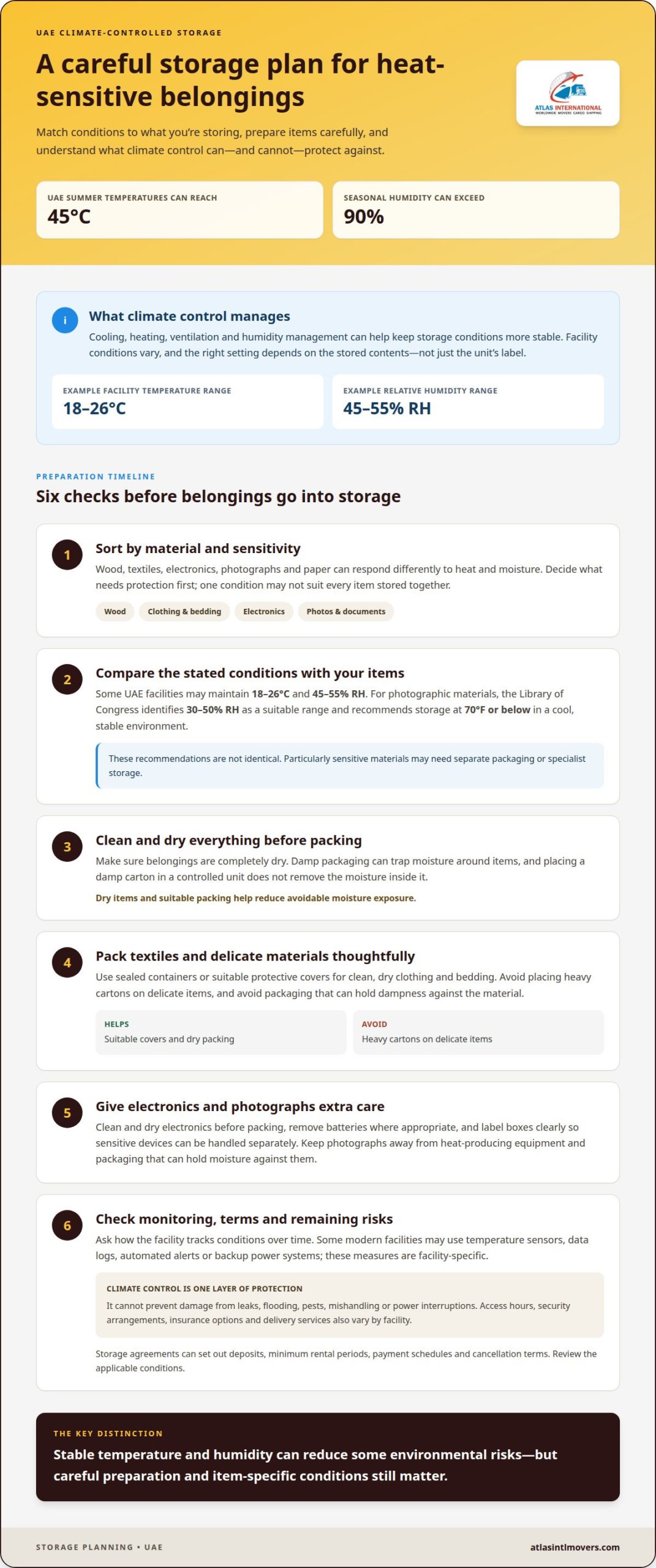
Climate-controlled storage manages temperature and humidity around stored belongings. In the UAE, summer heat can reach 45°C, while seasonal humidity can exceed 90%.
Temperature and Humidity Control
Climate control uses cooling, heating, ventilation and humidity management to keep storage conditions more stable. UAE facilities may maintain temperatures from 18°C to 26°C and relative humidity from 45% to 55%. These ranges matter for items that respond to changing conditions, such as wood, paper and photographs. The right setting depends on the stored contents, not simply the unit’s label.
For photographs, the Library of Congress identifies 30-50% RH as a suitable relative humidity range. That guidance highlights why mixed belongings may need different conditions. A moderate setting can help limit exposure to temperature swings, but it may not match every item’s conservation needs. Separate packaging or specialist storage may be appropriate for particularly sensitive materials.
Dehumidification and Moisture Risks
Dehumidification removes water vapour from indoor air, helping limit moisture that can encourage mold or condensation. The U.S. Environmental Protection Agency recommends keeping indoor relative humidity below 60% RH, with an ideal range of 30%-50% RH. A climate-controlled facility’s managed range may differ, so understand the stated conditions in relation to your belongings.
Condensation can form when warm, humid air meets a cooler surface, including metal or a container wall. Damp packaging can also trap moisture around stored items. The Library of Congress’s 30-50% RH range for photographic materials illustrates why humidity control matters for paper-based belongings. Dry items and suitable packing reduce avoidable moisture exposure before storage.
Risks Prevented and Remaining Limitations
Managed temperature and humidity can reduce exposure to conditions associated with mold, mildew, rust, warped wood and weakened adhesives. In the UAE’s heat, a wooden table, paper archive and electronic equipment may each respond differently. Climate control can reduce some environmental risks, but it does not prevent every type of damage or replace careful packing, clean belongings and suitable placement.
Temperature control cannot prevent damage from leaks, flooding, pests, mishandling or power interruptions. It also cannot restore items already affected by moisture. For example, placing a damp carton in a controlled unit still leaves moisture inside the package. The storage environment is one layer of protection, not a substitute for preparing belongings properly.
Storage agreements set out terms such as deposits, minimum rental periods, payment schedules and cancellations. These vary by agreement, so read the applicable conditions before committing.
Access hours, security arrangements, insurance options and delivery services are facility-specific terms. Temperature control alone does not determine access, security coverage or how belongings reach the unit.
For sensitive belongings, match the storage conditions to the materials. Photographs, leather furniture and electronic devices may have different needs, even when stored together. Stable conditions can help reduce exposure to heat and moisture, while clean, dry packing addresses risks the room itself cannot remove.
Temperature protection for wood, clothing and electronics
Stable storage temperatures can help limit material changes caused by extreme UAE conditions. Wood, textiles and electronics each respond differently, so plan storage around the belongings and how long they will be stored.
Temperature Stability and Material Protection
Temperature stability means reducing sharp changes in the surrounding air over time. This matters because wood can expand, contract, warp or crack as conditions shift. For example, a wooden cabinet may be more vulnerable to repeated hot and cool periods than to a stable environment. Leather furniture can lose texture or develop mold in unsuitable conditions.
Clothing and bedding can also lose fabric quality after prolonged exposure to heat and moisture. Pack textiles only when clean and completely dry, using sealed containers or suitable protective covers. Avoid placing heavy cartons on delicate items, since pressure can leave creases even when temperature is managed. Packaging should protect fabric without trapping residual dampness.
Electronics need particular care because extreme heat and humidity can accelerate wear on plastics, rubber seals and other components. Batteries may swell or fail, and weakened adhesives can affect assembled parts. Remove batteries where appropriate, and make sure equipment is clean and dry before packing. Label boxes clearly so sensitive devices can be handled separately.
For photographs, the Library of Congress recommends storing photographic materials at 70°F or below in a cool, stable environment. That benchmark is useful when planning for prints or negatives, which may need different care from everyday household belongings. Avoid storing photographs beside heat-producing equipment or in packaging that can hold moisture against the material.
Facility Air Conditioning and Monitoring
Air conditioning removes heat from a storage facility and helps maintain a more consistent indoor environment. In Dubai, climate-controlled facilities may use temperature sensors, data logs and automated alerts to identify changes. Those tools help staff see a developing temperature issue rather than relying only on a single reading. Ask how the facility monitors conditions over time.
Modern cold-storage facilities in Dubai can use IoT sensors, automated deviation alerts, backup power systems and data logs. These measures are useful because cooling can be affected by equipment interruptions or power loss. A backup system can support continued operation, while recorded readings help reveal whether temperatures changed during storage. Monitoring does not remove every risk, but it makes conditions easier to track.
Temperature-sensitive cargo also needs a plan beyond the storage room. During air or sea transport, handling and time spent outside controlled conditions can affect goods before they reach a facility. Customs clearance is one point in that journey where cargo may move between locations or handling stages. Coordinating the storage period with the transport plan helps keep temperature-sensitive belongings together as one logistics requirement.
For belongings that need storage during a move, our secure warehouse storage can form part of a coordinated plan.
Storage for art, electronics, wine and documents
Art, electronics, wine and documents respond differently to heat, moisture and handling. Suitable storage starts with the materials involved, then pairs stable conditions with careful packing and placement. A framed painting, a laptop and signed papers should not automatically be treated as one storage category. Climate controlled storage units UAE residents consider can help manage some environmental exposure, but preparation still matters.
Artwork, photographs and documents
Paintings, drawings and photographs can be affected by excessive heat, changing humidity and direct contact with damp surfaces. Keep artwork in protective packaging, separate frames to prevent pressure marks, and avoid leaning heavy cartons against canvases. For a mixed photo collection, Library of Congress guidance recommends a 30%-50% RH set point, with fluctuations no greater than ±5% RH.
Paper records also need protection from moisture and bending. Place documents in clean, dry folders or archival boxes, then store them above floor level and away from exterior walls. Label each box by contents and date range so you can find items without repeatedly opening every package. A sealed container can help exclude dust, but only dry documents should go inside.
Electronics and household appliances
Electronics include circuit boards, screens, cables and rubber components that can be affected by extreme heat or humidity. Before storage, power down devices, disconnect accessories and pack smaller parts with their equipment. Keep original packaging where available, or use cushioning to prevent movement. For larger appliances, clean and dry internal spaces before wrapping them.
ASHRAE TC 9.9 guidance lists a maximum relative humidity of 80% and a maximum dew point of 22°C for electronics safeguards. These are safeguards, not a universal storage target for every device. Place computers and audio equipment away from heavy furniture, and keep cartons upright where their labels indicate. This reduces avoidable pressure and handling damage.
Furniture, valuables and wine
Wooden furniture, leather seating and musical instruments may need different environmental care from metal valuables. Wrap furniture with breathable protective materials, and avoid tight plastic around pieces that may retain moisture. Keep small valuables together in clearly marked containers, separate from items that could scratch or crush them.
Wine needs particular attention to stable storage conditions, but a general climate-controlled unit is not automatically a wine cellar. Keep bottles in secure packaging, protect them from movement and avoid placing them beside equipment that produces heat. For valuable artwork, wine or electronics, match storage conditions to each item’s preservation needs. When comparing climate controlled storage units in the UAE, consider how the conditions suit your belongings. Careful inventory records also make stored items easier to locate.
Climate-controlled versus standard storage costs
Climate-controlled storage typically costs more than standard storage because it involves temperature management and humidity control. The added value depends on what you’re storing: photographs, wooden furniture and electronics may be more vulnerable to heat or moisture than durable household items. Compare the conditions with the risks of storing each item in a less controlled environment.
The price depends on the case and is given after a quote request; key factors include unit size, location, rental duration and required environmental control. A smaller unit can suit cartons and selected valuables, while larger furniture inventories need more floor space. Location affects local demand and access arrangements, and a short stay differs from a longer rental commitment.
UAE facilities list unit sizes from 30 to 200 square feet. A compact space may hold a limited set of boxes, while a larger unit can accommodate bulky furniture and additional cartons. The useful comparison is not simply the monthly amount: consider whether belongings fit safely without blocking access or stacking delicate items under heavier ones. Oversizing adds unused space; undersizing can make storage disorganized.
What changes the comparison?
Standard storage may suit durable belongings that tolerate ordinary indoor conditions. A controlled unit is more relevant for items whose materials respond to heat or humidity. For example, someone storing plastic chairs and robust tools may weigh the added environmental control differently from someone storing leather furniture, electronics or family photographs.
Rental duration affects the overall calculation. A brief transition between homes may call for a different unit size and rental term than an extended renovation or move overseas. Read the agreement for billing periods, deposits, minimum rental terms and cancellation conditions. These details affect the total commitment even when two units have similar dimensions.
Food and pharmaceutical storage
Food and pharmaceutical products may have handling needs that differ from household belongings. A standard climate-controlled room should not automatically be treated as a food-safe or pharmaceutical-grade environment. Requirements depend on the product, packaging and storage instructions. A packaged pantry item and a temperature-sensitive medicine, for example, do not necessarily need the same conditions.
Food and beverage logistics in the UAE must account for halal compliance and food safety regulations. This is relevant to commercial goods, not a blanket feature of every household storage unit. For regional food retailers such as Regal Plus AE that handle packaged groceries, sweets, and bakery goods, proper climate management protects shelf life and quality against high temperatures. Pharmaceuticals likewise require conditions suited to their product instructions; general air conditioning does not establish that suitability. Keep goods in their original packaging and separate them from household belongings where handling needs differ.
To assess value, match the unit’s size, rental terms and environmental controls to the items being stored. A secure, controlled unit may justify a higher cost for sensitive belongings, while durable items may not need the same level of control. The decision depends on what you’re storing, for how long and the conditions the facility maintains.
Climate-controlled storage in Dubai and Abu Dhabi
UAE conditions include high summer temperatures and, in some areas, coastal humidity, so the environment matters when choosing storage. The useful comparison is not simply the location or unit size. Consider how the facility’s temperature and humidity management, security and handling arrangements suit your belongings.
In coastal UAE cities, humidity can exceed 60%, and some seasons bring levels above 90%. A climate-controlled unit can help manage indoor temperature and moisture, while sealed, dry packing adds another layer of protection. Leather furniture, paper records and metal valuables each respond differently. Group belongings by material and sensitivity before deciding how much space they need.
Dubai and Abu Dhabi facilities may offer unit sizes from 30 to 200 square feet. A smaller space can suit cartons and selected valuables; larger furniture inventories need room for placement and access. Leave practical space around items rather than stacking every box tightly. This helps reduce pressure on leather seating, framed pieces and cartons that need to remain upright.
What are the best climate-controlled storage providers in the UAE, and what features do they offer? There is no single best option for every inventory. In Dubai or Abu Dhabi, look for stated temperature and humidity conditions, clear access terms, security arrangements and handling options that match your belongings.
Security is separate from climate control. Dubai SIRA guidance for storage services specifies a minimum CCTV recording retention period of 90 days. CCTV is one feature to consider, alongside controlled entry and the way valuables are handled. Review what the facility actually provides; a temperature-managed room alone does not describe its security arrangements.
Ask how storage access works and how deliveries are handled. Access hours and delivery arrangements affect how practical a facility is during a move. Keep an inventory with carton labels, photographs and records of valuable items. This makes it easier to identify what is stored and plan retrieval without opening every package.
Dust and sand can enter poorly sealed spaces, so packaging and facility condition matter in both cities. Keep belongings clean and dry before storage, and use closed cartons or protective covers suited to each material. For example, protect leather from dust while avoiding wrapping that traps moisture against its surface.
The clearest takeaway is to match three things: local conditions, the materials in your inventory and the facility’s actual features. A well-sized unit with suitable environmental management and practical handling arrangements can support a smoother storage period in Dubai or Abu Dhabi. Choose based on the belongings and access needs, not the label alone.
Choose a provider whose stated temperature and humidity conditions suit your belongings, with access and delivery arrangements that fit your needs. Compare its security and handling options too, including CCTV, controlled entry and care for valuables.
Atlas International Movers & Cargo Shipping: Storage & Warehouse
Atlas International Movers & Cargo Shipping provides Storage & Warehouse solutions for belongings that need a place between moves, during a home transition or while business arrangements change. Storage can be coordinated with domestic or international moving to help keep planning and handling organized.
Our storage solutions are secure, flexible, and easy access. If your move involves air cargo, we can also help coordinate that service as part of the wider logistics plan. For temperature-sensitive belongings, use the guidance in this article to identify the conditions they need and plan storage accordingly.
If you’re arranging storage in the UAE, contact Atlas International Movers & Cargo Shipping to discuss your requirements.
Plan your next move with confidence
Choosing climate controlled storage units in the UAE is one part of planning a smooth transition. Consider what you’ll need to retrieve first, where those belongings are going next and how storage fits your household or business schedule. For individuals or professionals relocating and needing flexible executive transportation while vehicles and personal belongings are stored, services such as Delta Rentals Dubai offer convenient vehicle options. A clear inventory and simple priorities can make handovers and unpacking more orderly.
Atlas International Movers & Cargo Shipping can help coordinate storage with your wider relocation plans. Whether your next step is a move within the UAE or an international transition, our team can help organize logistics around your belongings and priorities. This gives you a practical starting point for planning how storage fits into the journey ahead.
Contact Atlas International Movers & Cargo Shipping to discuss your plans and take the next step with confidence.
Frequently Asked Questions
What Is a Temperature Controlled Warehouse?
A temperature-controlled warehouse manages indoor temperature for stored goods. Unlike an ordinary warehouse, it can help reduce exposure to extreme heat or cold. The term does not automatically mean humidity is controlled too. Electronics may need a stable temperature, while paper records and photographs can also be sensitive to moisture. Check which conditions the storage arrangement manages.
Does Abu Dhabi’s humidity justify dehumidification in storage units?
Abu Dhabi’s humidity can make dehumidification relevant for belongings sensitive to moisture. Reported monthly relative humidity typically ranges from about 52% to 69%, while reported average maximum and minimum relative humidity are 78.1% and 33.1%. These figures describe varying conditions, not a constant indoor reading. Paper, leather and metal items can have different moisture concerns, so consider the stored materials and the indoor conditions together.
Are undefined temperature and RH ranges a warning for Storage Units Abu Dhabi?
Unstated temperature and relative humidity ranges make it harder to judge whether a unit suits sensitive belongings. That gap alone doesn’t prove the facility is unsuitable, but a climate-control label without operating ranges offers limited detail. Compare the stated conditions with the needs of your items, such as framed photographs, wooden furniture or electronics. A clear description of how temperature and humidity are managed gives you a more useful basis for assessing suitability.
Do odors and dust in Storage Units Abu Dhabi indicate measurable risk?
Odors and visible dust can signal conditions worth investigating, but neither precisely measures the risk of damage. Dust may enter poorly sealed spaces and settle on furniture, fabrics or electronics. A musty smell may prompt attention to possible dampness, though smell alone cannot identify its cause or extent. Consider the item, its packaging and any visible residue or moisture when evaluating its condition.
Can I change the unit size later?
Changing unit size depends on the available space and the rental agreement. If your inventory grows, a larger unit may help; if you remove bulky furniture, a smaller one may be a better fit. A change can involve moving belongings and revising the agreement or billing. Plan your inventory before booking, and account for the facility’s process when considering a later change.
Can I share access to my unit with others?
Shared access depends on the facility’s security procedures and rental agreement. Some arrangements may require other users to be named or authorized, while others may restrict entry to the renter. Agree on who can visit before storing valuables, and keep a record of shared access. For example, a family member collecting a labelled carton should know what they may remove and how access is managed.
Can I visit the storage unit before renting?
Whether you can view a unit before renting depends on the facility’s viewing and access arrangements. A visit can help you judge the space, entry route and practical fit for items such as a sofa or stacked cartons. Some facilities may show a comparable unit rather than the exact space. Understand the viewing process and any access conditions before making a rental decision.
What is climate-controlled storage in the UAE, and what temperature and humidity ranges are maintained?
Climate-controlled storage in the UAE manages indoor temperature and humidity to limit exposure to changing conditions. A commonly described range is 18°C to 26°C, with relative humidity managed around 45% to 55%. These figures are not universal specifications for every facility or every stored item. For example, photographs, wine and electronics can have distinct preservation needs, so match the facility’s stated conditions to your contents.